Ryan Glick was on his way to get his computer fixed when he found something else to do with it. Newly arrived in New York, he had been learning the city by walking to coffee shops. He kept photographing his coffee against his clothes. On the walk to an Apple Store, the combination acquired a name: #coffeenclothes. The errand had produced a small idea with unusually portable instructions. Anyone with a cup and an outfit could join in.
The year he now gives for the beginning is 2014. He worked in social media, so reserving an Instagram account was a familiar move. What followed was less familiar. A picture became a recurring activity for other people, and the activity became something brands wanted to borrow. Glick spent several years trying to make a media company out of it. Then the invitations started asking him to bring the coffee.
The appealing part of this origin is how little it demands of its audience. Nobody has to understand a new device or learn a private vocabulary. Coffee supplies the everyday habit; clothes supply the choices. The photograph gives both a frame. It is an invitation that can fit between ordering a drink and returning to work. Even the business name sounds as though it could have been written on a napkin.
Before the cup, an eye for clothes
Glick had already been practising the work of choosing what deserved attention. In 2013, he ran SWGNT, a fashion website and online boutique for emerging brands. He described it as part blog, part shop, with most of the operation resting on him. A web collaborator and two friends helped. His day involved posting, answering messages, looking at collections and meeting people who made, photographed or promoted clothes.
His buying rule was refreshingly short. An unfamiliar label could have made only one shirt and still get into the shop if he liked it. For editorial decisions, he asked whether he would wear something and whether it suited the site. He disliked the labels streetwear and menswear as ways of boxing in his taste. The clothes interested him more than the filing system.
That early project matters because it puts the hashtag in context. Before there was an agency, there was a person making repeated judgments: this shirt belongs here, that collection deserves a look, this picture will work. A shop also asks a question a blog can postpone: will somebody buy it? His later career keeps moving between those two kinds of response, attention and purchase, without quite settling for either alone.
A very particular kind of casual
By 2015, Glick was running Coffee ‘n Clothes alongside a men’s jewelry business, Lust Limited, and helping friends promote the food-photo app Wine ‘N Dine. His preferences were exact enough to be funny. Untied shoelaces bothered him. So did people walking straight into puddles. A sloppy sandwich photographed close up was unlikely to earn his enthusiasm. Asked what he would never post, he answered: “A picture of me drinking tea.”
He wanted strong clothes, a good cup and a pleasing location. He also wanted Coffee ‘n Clothes to have physical locations and offline activations. That ambition was already there while the account was still being discussed as an Instagram phenomenon. The café was not a later explanation pasted onto the early photographs; a place people could visit was part of the wish.
The little rules reveal the tension in a supposedly effortless image. Casual is a look somebody has selected. A puddle can interrupt it. A shoelace can spoil it. Glick’s humor makes the standards feel personal rather than bureaucratic, but standards they remain. The account’s simplicity left room for different people and different places while keeping its basic composition recognizable.
“A picture of me drinking tea.”
Ryan Glick, on what he would never post, 2015

Nike wanted two coffees at once
In July 2017, Coffee ‘n Clothes had nearly 300,000 Instagram followers. That is a dated figure, a snapshot of the early audience rather than a claim about its size today. Glick was describing a business that combined editorial work, social media, influencers and event production. He had also launched Plus 1, a social media agency. His ambition stretched across media, agency services and retail, with each supporting the others.
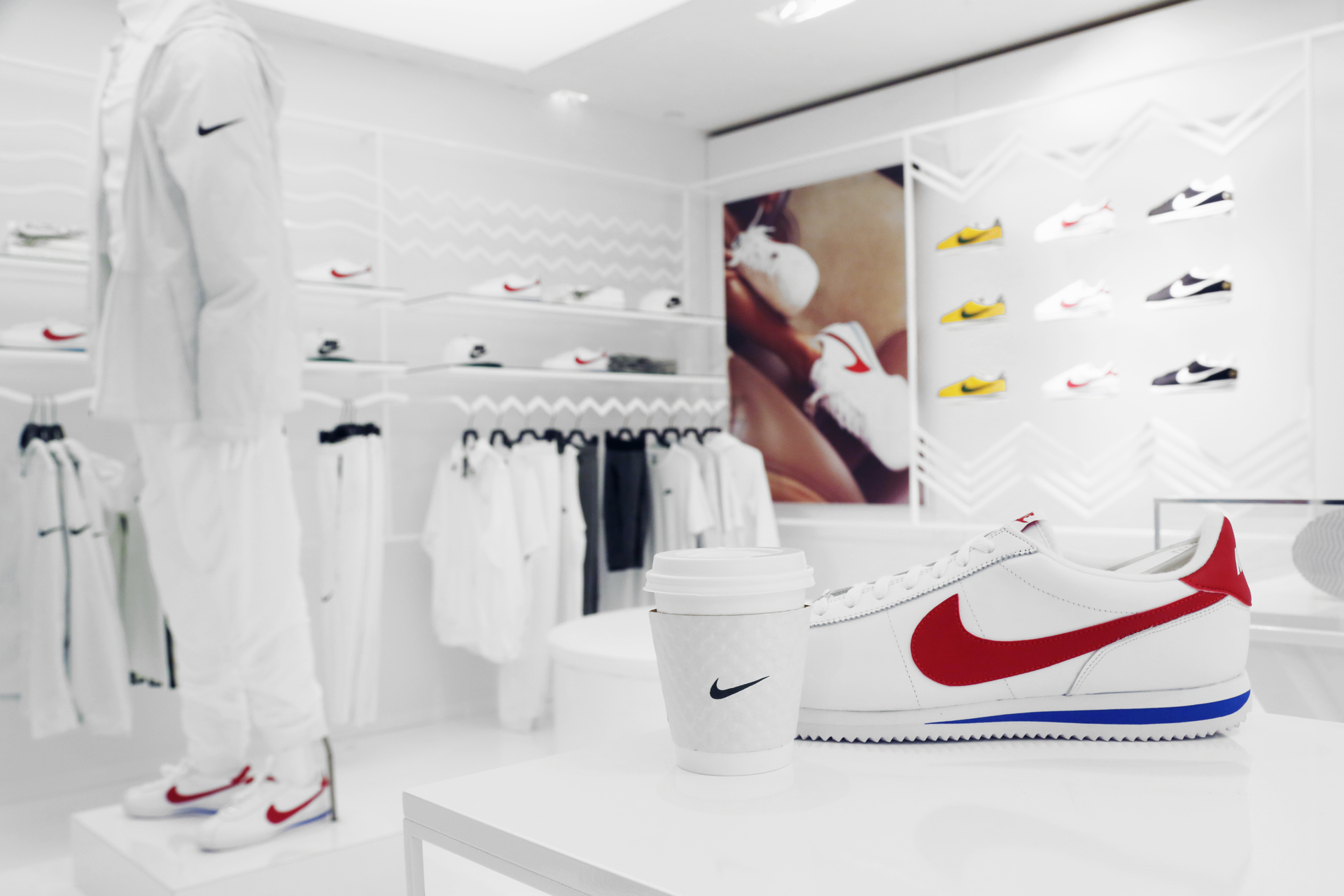
A retail invitation tested how far an appealing picture could travel. Nike asked for events at two New York stores, in Midtown and SoHo. Coffee ‘n Clothes had never produced an event before. Its introduction to the job came in duplicate. The logistical question was no longer which image to post. It was how to serve people in two places at the same time.
Glick drew on relationships with café owners. They could supply equipment and staff; he could supply marketing and branded materials. That division of labor gave the early events a practical shape. Coffee was the thing being served, but the retailer was buying a coordinated encounter with its customers. A sleeve, a cup and a shop floor had become parts of the same assignment.
There is a useful humility in that arrangement. Knowing how a thing should look does not mean knowing how to operate every part of it. Glick’s route into events depended on people who already knew how to make and serve coffee. The photo’s apparent ease had acquired a backstage: equipment, staffing, timing and the ordinary business of getting the drink into a customer’s hand.
The café had more than one customer
In 2019, Coffee ‘n Clothes opened its first pop-up café in New York. Glick managed it while running the brand. The space also hosted takeovers for Bumble, Abercrombie & Fitch and Samsung. A customer could come for a drink; a brand could come for an audience and a room in which to meet it. The café was doing several jobs, and so was its founder.
The café closed in 2020. In January 2021, Glick committed to building an event agency beyond the coffee assignments. Jason Witkes and Aly Lespier Tatnall became part of the next chapter. By 2023, he was separating the business into CNC Agency and Coffee ‘n Clothes, the consumer brand. The distinction gave the original idea space to remain a coffee-and-fashion proposition while the agency accepted a wider range of work.
The portfolio had already moved well beyond a counter. It included a DSW Airstream travelling through Los Angeles and Nashville, a coffee truck for Hermès, and a brunch for Forever 21’s collaboration with Hervé Léger. These were different settings for the same underlying problem: giving a brand a place, an activity and a reason for someone to linger.
The October 2023 announcement formalized separate ambitions for agency experiences and consumer products, retail and content. There is something revealing about preserving both. A founder can outgrow the service that brought in the first customer without losing interest in the original idea. Here, the coffee kept its own name. The initials took on the expanding assignments.
- 2014The hashtag
Coffee + outfits - 2019The café
A place to gather - 2021The agency
Beyond coffee - 2023Two identities
CNC + the brand
The founder has to leave room
The numerical record gives the expansion a firmer outline. CNC placed No. 1,102 on the 2025 Inc. 5000 and No. 1,392 in 2026. Its 2026 listing records 254 percent growth over three years. These are company measures, not a measure of Glick’s personal fortune. They show how far the business has travelled from a recurring photograph.
He now describes a change in his own work. The early years meant pushing projects forward personally; the present requires building leaders and thinking over longer periods. His phrase for the task is “step back without stepping away.” It captures an awkward promotion. The person who has learned to intervene everywhere must become selective about where an intervention helps.
Some of that change is visible in the machinery. CNC began working with Oceans Talent in 2023 to free Glick for sales, vision and expansion. A July 2026 account of that work describes operators taking responsibility for calendars, the pipeline, budgets and marketing. Processes were built around Google Sheets, a tool he used, with automation added where it proved useful.
This is a less photogenic development than a coffee truck, but it belongs in the story. A calendar has no flattering angle. An invoice rarely goes viral. Yet a company that relies on its founder to remember, approve and connect everything has a limit built into its working day. Giving that work a home outside his head is part of making the next event possible without making every decision his.
2026 Inc. 5000 listing
Glick’s 2026 account
What remains when the guests go home
Glick’s current argument is that an experience should keep doing work after it ends. On In Real Life, his Substack, he describes clients asking for an activation that supplies months of content, a launch whose revenue can be traced, or a pop-up idea that can continue across other channels. He calls CNC bootstrapped and describes a team of more than 75 people. The original pairing has become a much broader question about how attention turns into something durable.
His approach to community starts with participation and a reason to return, including when there is nothing to sell. The physical encounter remains central. A guest has to decide that leaving home was worthwhile. Pictures can extend that encounter, but they cannot retrospectively improve the welcome at the door.
He has a story that makes the stakes plain. An activation had been designed and built around a leased venue. When the team went to collect the keys, it learned that the person who had leased the space had no right to it. With less than a day before opening, they found another location, changed the build and opened on time. The guests never knew.
That is a long way from deciding whether a sandwich is ready for its close-up. It also explains why the two halves of his career belong together. A good event has to be worth looking at and possible to deliver. Glick began with the first requirement and has spent the intervening years building a company around the second. The next coffee break can still produce an idea. He is working on making sure the whole business does not have to wait for him to finish it.
Keep following the thread
Glick’s writing and public profiles, plus conversations from different chapters of the business.