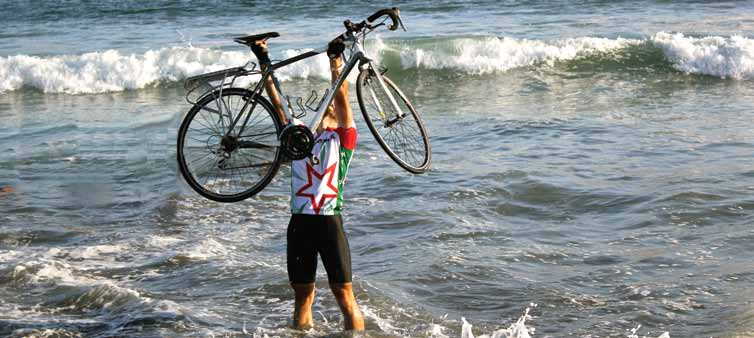
At the end of a very long bicycle ride, Russell York picked up the bicycle. The photograph shows him standing in the Pacific, holding it above his head while waves roll toward the beach. He had arrived in San Diego from Washington, D.C. There are easier ways to get home from college. Most of them leave you with rather less to talk about.
It was 2011. York, then a Patrick Henry College senior, had ridden more than 3,200 miles in 40 days to raise money and awareness for Young Life’s work with Ukrainian orphans. After reaching California, he traveled to Ukraine to meet the children whose circumstances had prompted the ride. The journey had a destination beyond the finish line.
Fifteen years later, he runs Cosmo Technologies, which makes connected watches for children. The distances involved are usually more modest: the park, a friend’s house, the trip home. Yet his working question has a familiar shape. What would make it possible for someone to go a little farther on their own?
A long way home
The bike ride has followed York into his business life. Retelling it years later, he described a college summer without a job or internship lined up and the thought of riding home to his family. He had little cycling experience. That is an excellent qualification for underestimating a continent.
His account of the lesson is pleasingly unadorned: “You just have to keep going.” There is no proprietary method hidden in it. The task gets smaller when it becomes the next stretch of road. A founder can recognize the appeal of that arithmetic without pretending every business problem can be solved by pedaling harder.
Washington, D.C. San Diego · 2011
The finish-line picture also preserves something that can disappear from a founder biography: the pleasure of doing the thing itself. A goal can be useful and still be an adventure. In York’s later work, those two ambitions keep turning up together. The connection is particularly visible when he talks about the neighborhood where he grew up.
The neighborhood had gone quiet
York remembers San Diego childhood days full of water fights and improvised entertainment. One scheme involved a bicycle towing a child on a skateboard toward recycling bins. The neighborhood children were apparently capable of inventing their own transport infrastructure, although a municipal engineer might have declined to sign it off.
Returning to his parents’ neighborhood, he noticed fewer children playing outside. Families were still there. The street felt quieter. That observation became part of the question behind Cosmo: how could a device help parents feel comfortable giving children more room to explore?
He started the company before becoming a father. By an August 2025 conversation about his work, he had a seven-month-old son. Parenthood had given the mission a new audience at home, although neighborhood expeditions were still some way off. His interest in childhood freedom had preceded his own need to arrange it.
There is a practical challenge underneath the nostalgia. Adults can remember being sent outside and still want a way to reach a child today. A remembered childhood supplies a direction; designing for a family’s actual afternoon requires more detail. Where is the child going? Who can call? What happens when the plan changes?
Secure communications, smaller wrists
Before Cosmo, York worked as a civilian on the commanding general’s advisor team in Kabul, Afghanistan. He later worked in cybersecurity communications, helping explain threat intelligence to a wider audience. He describes those experiences as formative to his thinking about secure communication and responsible handling of data.
The route from those jobs to children’s watches looks unusual on a résumé. In practice, both involve deciding who should be able to communicate, what information is necessary, and how much trust a system asks of the people using it. York brought those questions into a domestic setting where the user might still need help tying shoelaces.
He also offers a plain answer when asked what work has taught him: “Ego gets you nowhere.” He favors admitting what he does not know and leaving room to learn. It is a useful stated principle for hardware, where confidence alone has never improved a battery.
“Ego gets you nowhere.”
Russell York
The people from before the pitch
Cosmo began at York’s kitchen table in 2020. Its early team drew on relationships formed much earlier. York and co-founder Michelle Ross had first met through high-school speech and debate competitions, then became friends during their undergraduate years at Patrick Henry College. Fellow alumnus Ryan Gilles joined the business a few months after the founders started it.
That history gives the company’s origin a social texture a funding announcement cannot quite capture. These were people with a shared educational community and years of acquaintance behind them. In 2021, Cosmo partnered with Homeschoolers of Maine on a holiday sales donation initiative, returning to a community that had helped shape its founders.
By June 2021, Cosmo was announcing pre-seed funding and plans for JrTrack 2. The amount was undisclosed. Its early proposition already included a cellular watch for children and a parent application for managing connected devices. The purpose was specific enough to explain without a tour of the entire technology industry.
A child could communicate with family. A parent could manage the connection. Building that apparently ordinary arrangement into a device, software, and service would be the work of the company. The kitchen-table question had acquired all the obligations that follow when someone buys an answer.
A smaller job for a connected device
York’s public argument keeps returning to the space before the first smartphone. A family needs a way to get in touch, and a phone offers one. It also arrives with a much larger set of possibilities. Cosmo’s JrTrack approach gives calling, messaging, and location a more bounded setting, with contacts and settings managed by parents.
In his 2026 conversation with Jennifer Jolly, York pointed back to the older infrastructure of childhood communication: payphones and ways to ring home. His argument is that independent children have long needed connection. The modern design problem is deciding how much else must come along with it.
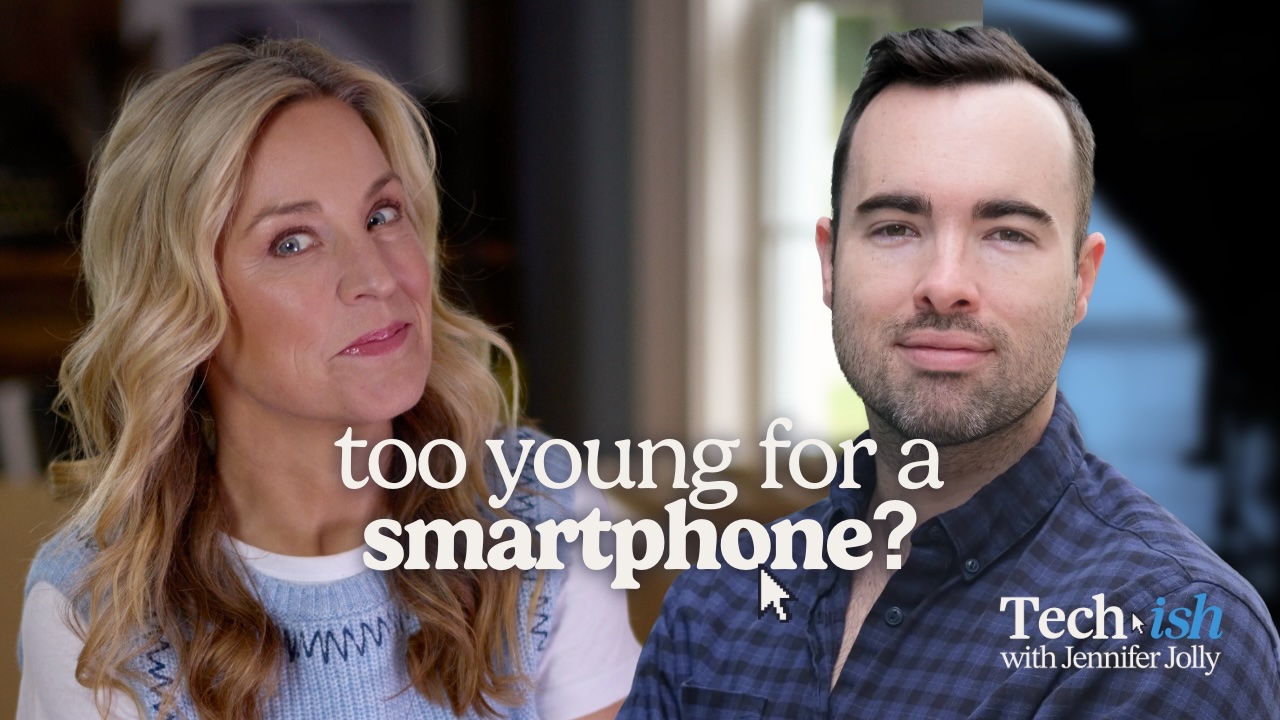
This is also where the product has to stand up to ordinary scrutiny. Jolly’s conversation addressed what the watch allows, its limits, and subscription commitments. Families have to consider the ongoing service alongside the hardware. A clear philosophy is useful; so is reading the bill.
For York, the interesting unit is the family arrangement around the device. Permission to visit a friend, an agreed check-in, a contact list someone has considered: these are small decisions. They are also the decisions through which a child’s world gets bigger. The product lives among them.
When the school bell rings
A watch that helps after school has a different job during class. York has written in favor of preserving ways for families to communicate while reducing classroom distractions. Cosmo’s earlier Focus Mode let parents schedule restrictions, including different levels of lockdown. The choices attempted to account for a day with several kinds of attention in it.
In July 2026, the company introduced School-Fi. Cosmo describes it as a location-based system that recognizes school entry and departure and adjusts device capabilities. Parents can configure routines in the app. The ambition is to reduce the daily housekeeping required to make a connected device behave appropriately in a classroom.
- ArriveSchool location recognized
- FocusFamily-configured school routines
- LeaveFunctions adapt after departure
The distinction between a product’s capability and a school’s permission still matters. A setting cannot decide classroom rules. It can, however, give families and educators a more concrete thing to discuss than the word “device.” York’s approach makes context part of the design problem: the same child occupies a classroom, a bus, and a neighborhood in one afternoon.
The calendar on the wrist
Some of the company’s recent work is less dramatic than an emergency call. In February 2026, Cosmo and Maple announced an integration bringing family schedules, tasks, and to-dos to JrTrack watches. Parents could send information from the household organization app to a child’s wrist.
There is something revealing about that choice. Independence includes remembering an activity and knowing what happens next. A calendar is a small piece of shared knowledge. Moving it between parent and child gives the product another ordinary job, one that can be judged by whether it helps the afternoon run.
York’s aspirations have also found company among advocates of outdoor play. He has returned to conversations with Ginny Yurich of 1000 Hours Outside, and their organizations announced an Adventure Bundle partnership in 2025. The pairing puts his technology business beside an audience already interested in what happens beyond the screen.
The next ride
On October 7, 2026, Cosmo announced JrTrack Pro and opened presales. The company described nearly two years of engineering work behind the model. Its stated specifications include a 12mm frame, a 730mAh battery, and a 5MP camera, with a $179.99 hardware price and a required membership. Holiday-season arrival was the plan at announcement.
Those details show how much practical engineering sits beneath the apparently simple wish to let a child call home. A device must fit a wrist, hold a charge, and be usable at the moment it is needed. Each specification carries a small part of that responsibility.
The bicycle photograph remains a useful counterweight to the product sheet. York had traveled across a country, reached the ocean, and lifted the machine that carried him. His company now works on equipment for much smaller departures. The aspiration is recognizable: give someone enough confidence to go, and a way to remain connected to the people waiting at home.
Follow the ride
Conversations, company news & further reading
- Cosmo website
- Russell York on LinkedIn
- The 2011 bicycle journey
- Founder conversation
- The My Outdoorsy Mom interview
- The early team and Maine partnership
- 2021 funding announcement
- York on school-day connection
- School-Fi announcement
- Maple partnership
- Techish interview and video
- 1000 Hours Outside conversation
- JrTrack Pro announcement