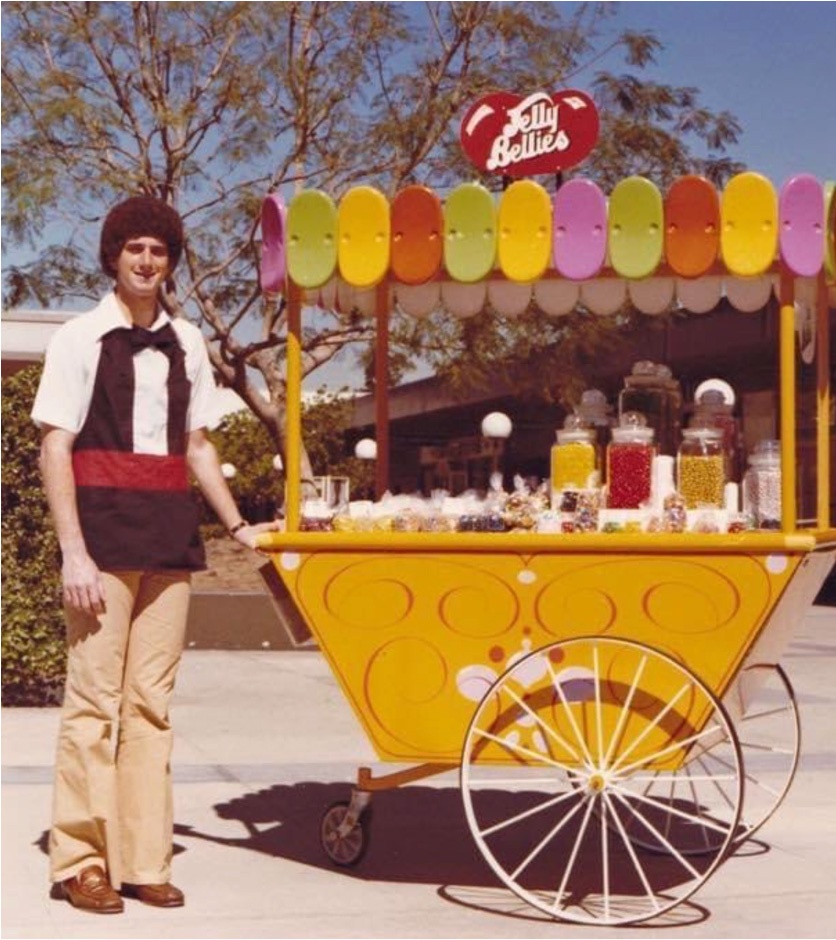
The young man beside the jelly bean cart has a striped shirt, a substantial amount of hair, and a business to run. In the photograph, the cart is yellow, the display is cheerful, and the merchandise offers a rather straightforward proposition: stop here, buy something sweet. Russell M. Kern would eventually spend decades helping companies find customers. Before any of that, he had to persuade people to pause on their way somewhere else.
He sold Jelly Bellies between his sophomore and junior years of college, operating a business with three pushcarts. It was an education with inventory. Packaging, distribution, selling, managing employees: the subjects arrived together, without the convenience of separate classrooms. Later, when an advertising internship became available, that experience helped distinguish him from the other applicants.
The cart makes a useful opening to Kern’s story because it gives the later executive a recognizable beginning. There is no holding company in the picture. No national staff. There is a person who has bought something and would very much like somebody else to buy it.
A cart with a curriculum
Kern studied economics at UCLA, completing his degree in 1979. His early advertising work included Needham Harper & Steers. He developed an interest in direct response, the part of advertising that asks a recipient to do something measurable. An appealing message is only the beginning. Someone has to answer, inquire, order, or otherwise make the next move.
That practical orientation stayed with him. In his marketing work, relevance mattered: a message needed to fit the person receiving it. Knowing somebody’s name was a limited accomplishment if the offer had nothing to do with their circumstances. There is a pleasing lack of ceremony about that distinction. A carefully addressed envelope can still contain something nobody wants.
The agency began with an unusual reunion. Kern encountered his former high school principal, who was also working in marketing. They found common ground and went into business together. Their early financing came from credit cards, with roughly $5,000 to $10,000 to get started. Neither initially drew a salary.
Their proposition combined brand advertising with direct marketing. They wanted to help clients develop a brand while generating a response. Early opportunities with Microsoft, Lotus, and First Interstate Bank helped the business establish itself. The ambition was commercial, and so was the test: would the work bring customers through the door?
The boss needed lessons, too
Getting a company started and helping it grow required different abilities. Kern has described reaching a plateau when the agency had roughly 50 to 75 people. At a trade show, a former competitor who had already sold his own agency offered to mentor him. The proposed course of study would take five years.
It is an arresting detail in a founder’s account. By then, Kern had a business substantial enough to encounter serious organizational problems. He also had gaps in the ordinary machinery of management: operating procedures, personnel processes, and his own conduct as a leader. The offer of help required him to become a student again.
The experience gives his later interest in leadership development some weight. He remembers having to learn it. Growth brought new responsibilities, including the obligation to build an organization that could function through the work and judgment of other people.
On February 12, 2008, Omnicom’s Diversified Agency Services division announced its acquisition of The Kern Organization. The business would retain its own brand and operate under Rapp Collins Worldwide. Kern would remain president. The arrangement gave his agency access to a larger network’s data, analytics, and infrastructure while preserving its identity.
The deal also left him with a continuing job. He stayed at the agency until 2023. In his account, the team expanded from 200 to 400 following the acquisition. A transaction that could have served as a tidy ending instead became another stage in the work of running the company.
A second business, with people at its center
Kern and Partners, his next venture, put leadership and collaboration at the center of the offering. The move followed a long habit of teaching. He had written S.U.R.E.-Fire Direct Response Marketing, published by McGraw-Hill, and developed guides intended to help marketers solve immediate business problems. Education was part of how he found clients.
He brought that approach into the new business. Useful material should speak to something a potential client is dealing with now, rather than simply announce the author’s expertise. The logic is easy to recognize from the candy cart: give people a reason to stop that belongs to them.
His professional study continued, including Appreciative Inquiry leadership at Case Western Reserve University, creative leadership courses through IDEO U, and learning and development work through the Josh Bersin Academy. The course names changed as the business changed. The habit of studying the work remained.
There were relationships behind the methods, too. Positive Inquiry’s account of its partnerships credits Kern with commissioning change projects at KERN and Canon USA. That work brought an approach built around inquiry and organizational strengths into a company setting. It also connected the language of leadership development with the practical business of getting colleagues to work together.

His consultancy’s learning approach gives practice a continuing role. Modules are paired with coaching, then applied at work before the next module arrives. It is an arrangement that assumes people need opportunities to try a behavior, receive feedback, and return to it. A workshop is easier to schedule than a changed habit.
That distinction suits a founder who has spent years watching creative work move through an organization. A useful idea has to survive daily routines, deadlines, and the way colleagues treat one another. Training has similar obligations if it is going to matter after everyone closes their notebook.
Four letters, continuing homework
His surname now supplies the initials for the K.E.R.N. Human+AI Collaboration Framework: Know, Empower, Reflect, Nurture. It is a convenient mnemonic, though the verbs ask for a considerable amount of ongoing attention. Knowing involves understanding people and the tools available to them. Empowering gives them room to contribute. Reflection makes experience available for learning. Nurturing keeps development going.
His book Transform or Die: How to Build Teams that Outthink, Outpace, and Outprofit the Competition in the AI Age sets those ideas in the context of changing technology. The title has the urgency of an advertising headline. The proposed work includes the quieter disciplines of communication, trust, and making time to learn.
AI, in Kern’s approach, becomes a knowledge partner in that work. Teams can use it to explore ideas and problems, while developing the skills to decide how its contribution should be used. His interest sits at the point where a new tool meets an existing group of people, with all the habits and expectations that group already carries.
“I love direct mail.”
Russell M. Kern
The affection for his old trade remains. In conversation about marketing, he can still sound delighted by the possibilities of a physical message. That enthusiasm makes the move into AI less surprising: he has spent a career considering how an idea reaches someone and what happens afterward. The medium changes; his interest in the response continues.
Where the departments meet
By 2026, his public work had developed a particular focus on manufacturing and the friction between departments. Kern calls its accumulated cost the Silo Tax, expanding the initials into Tolerated Hidden Expense. The term gives an accounting flavor to problems that can otherwise sound like complaints about meetings.
His current consultancy offers a sequence of assessment, diagnosis, and a pilot with measurements. It identifies decision delays, rework, cycle time, and meetings that end without a decision as things to examine. Those are proposed areas of intervention, rather than proof that every organization will achieve the same result. The emphasis is on connecting behavior with an observable consequence.
The manufacturing interest has a specific public setting. The 2026 IndustryWeek Operations Leadership Summit lists Kern alongside BMW Manufacturing’s Paul Sinanian for a session about Plant Spartanburg’s weLEAD program. Its subject is developing the next generation of leaders through cross-functional problem-solving, decisions grounded in values, and continuous improvement.
His recent writing follows that direction. A July 2026 article addresses manufacturing silos; an August piece considers AI in workforce management. The proposed changes include shared goals, better information flow, training, and gradual experimentation. These are recognizable concerns for someone whose own agency once needed stronger systems to keep growing.
Outside work, Kern’s interests include horses and gardening. The gardener is a particularly useful presence in this story: attentive to conditions, patient with development, obliged to return. A plant has limited interest in the gardener’s impressive intentions. It needs the conditions that let it grow.
The young entrepreneur at the candy cart was learning how to run a business. The later founder had to learn how to run a larger one. His current work asks leaders to keep that education going. The photograph preserves the hair and the yellow cart. The lesson, rather less photogenic, is the willingness to remain teachable.