A coin toss helped decide who would pay the bills. Russ Wilcox and his wife, Gina, had gone through Harvard Business School together. When it came time to find jobs, they agreed that one would take a corporate salary and the other could try a startup. Gina lost the toss and went into consulting. Russ got permission, in the most practical household sense, to chase an idea.
The arrangement produced a memorable telephone call. Gina was in Chicago preparing for a client presentation when her husband announced that he had met an MIT professor and intended to change the world. By the time she returned to Boston, he was at work on E Ink’s business plan. Domestic venture capital had made its first investment.
Years later, that company’s display technology would sit inside Amazon’s Kindle. Readers would carry whole libraries in devices whose pages looked remarkably unbothered by the technological effort behind them. Wilcox’s contribution was to help make an invention into something a factory could produce and a customer would buy. Those turned out to be separate, expensive accomplishments.
A blinking pixel, an empty job, a business plan
Wilcox had studied applied mathematics at Harvard, graduating in 1989, and earned his MBA in 1995. His path toward electronic paper went through speech recognition. At PureSpeech, a venture-backed software company, the group he worked in closed. The next opportunity came through business-school connections and a visit to the MIT Media Lab.
Joseph Jacobson had an idea for a page that could rewrite itself. The founding group included Jacobson, JD Albert, Barrett Comiskey, Jerome Rubin, and Wilcox. The attraction, at first, was wonderfully small: particles moving under a microscope. Wilcox later described the encounter with the cheerful admission, “Emotion, not logic, led me here.”
He joined the effort in March 1997. That spring, he worked on the business plan with Jacobson and Rubin, an experienced publishing entrepreneur. By August, E Ink had an office. Albert and Comiskey worked close together at a rented fume hood while Wilcox learned the technology, recruited people, built corporate relationships, and negotiated a $1.7 million seed investment.
The business person had to understand what the scientists were doing. Otherwise, every conversation with a prospective partner would begin with a translation problem. E Ink’s promise crossed chemistry, electronics, manufacturing, and publishing. No single professional vocabulary would get the company all the way to a bookstore.

The customer had not logged in
Electronic paper sounds like an obvious thing to want. That description is little help when deciding what to sell first. E Ink initially pursued retail signs, including an installation for JCPenney. Its displays worked inside its own building. Store lighting exposed weaknesses that forced changes to the chemistry.
The wireless system brought another education. Pagers were supposed to communicate with the signs, but steel beams, metal goods, and weak coverage interfered. The company eventually installed signs in 100 locations, doing work from software to wireless that stretched well beyond its central expertise.
Then came a smaller humiliation. E Ink had offered the ability to change advertising instantly. After two weeks, a customer had not even logged into the software. The company had supplied a capability without first understanding how someone would use it. The untouched login was a more eloquent review than any customer survey.
In 2003, the choice between watches and electronic readers sharpened the problem. Watch displays offered business, but their small size and fragmented fashion market limited the opportunity. Wilcox chose readers. Saying no to an available customer hurt. Keeping every opportunity would have cost something too: the attention needed to make one market work.
Make the image work
Make it survive use
Make it at scale
Six years is a long demonstration
Wilcox’s account of development has the rhythm of a patient correction. Roughly two years went into producing an image people liked. Another two went into making the chemistry endure repeated operation and different environmental conditions. Two more went into manufacturing at scale. A promising demonstration had acquired a six-year apprenticeship.
That sequence explains the peculiar difficulty of a materials company. A presentation can show that something happens once. A manufacturer must arrange for it to happen repeatedly, across batches, in places it does not control. The gap contains most of the work and very little of the glamour.
The display itself offers a useful illustration. Tiny capsules contain particles that respond to an electric field. Moving them changes what a reader sees. The image can remain after power is removed. The result is a screen whose everyday behavior conceals its engineering: it sits quietly on a page while its owner reads.
Wilcox spent 13 years at E Ink. The duration matters as much as the eventual transaction. Long before electronic paper became familiar, a team had to keep believing in the usefulness of a page while repeatedly changing the way it was made. Investors, employees, and customers were being asked to wait for different reasons, on different schedules.
Sell the ingredient
E Ink eventually settled into a role as a supplier. Other companies would sell the finished reading devices. Wilcox compared the arrangement to an ingredient business: participate in an established industry by providing something its manufacturers need. A company can help change reading without having to own the bookstore, the publishing house, and the customer’s shopping basket.
That distinction is easy to miss when the most recognizable object is a Kindle. Amazon made the device famous; E Ink supplied the electronic paper technology. Sony was another customer. The screen’s success could travel across brands, which gave the underlying invention more routes into people’s hands.
In June 2009, manufacturing partner Prime View International announced an agreement to acquire E Ink for approximately $215 million. Later that year, the terms were revised to add potential share-based consideration. Retrospective accounts often describe a roughly half-billion-dollar outcome. The original announcement and the later accounts refer to different points in the deal’s evolution.
The industrial logic was straightforward. E Ink supplied display materials and intellectual property; Prime View supplied complementary manufacturing capabilities. Joining them put more of the production chain under common ownership. After years of solving problems between the laboratory and the market, Wilcox had helped build a business valuable to the company on the other side of that chain.
A useful qualification: having been wrong
In 2017, Wilcox joined Pillar, the Boston venture firm founded by Jamie Goldstein. Their connection went back to PureSpeech. Goldstein had asked Harvard Business School professor Bill Sahlman to recommend talented graduating students in 1995. Sahlman introduced Wilcox. More than two decades later, a former colleague became a partner in a different kind of enterprise.
That relationship makes the move into investing feel less like a costume change. Goldstein had seen Wilcox before the familiar product and the successful exit. His welcome to Pillar emphasized curiosity and kindness alongside experience. Those are useful qualities when the person across the table is explaining a company that still exists mostly in the future.
Wilcox’s stated test for founders includes drive, intelligence, and charisma, but also humility and an awareness of personal limits. He looks for someone capable of changing as the company changes. The founder who can recruit the first team may have to become a different sort of manager when the business has hundreds of employees.
His own advice has become pointedly practical. Meet customers early. Find out whether enough of them want the product. Admit mistakes so that better ideas can get a hearing. He has described humility as the permission to learn. Coming from someone whose sign software sat unused, that preference has a fairly concrete backstory.
“Make meaning, then make money.”
Russ Wilcox’s motto, discussed in his 2015 Harvard Business School interview
Back through the laboratory door
Teaching and advising gave Wilcox other ways to remain close to early inventions. Harvard named him to its Experts-in-Residence program in 2019, supporting faculty and researchers working toward commercialization. His teaching has included an entrepreneurship capstone bringing business and engineering students together. The recurring question is how a scientific possibility becomes a company with a reason to exist.
By December 2024, he was describing another such attempt: Trellis Air, a startup developing a different approach to dehumidification. He was splitting his time between the new company and Pillar. Having spent years backing founders, he had again become the person who needed to get a physical product working beyond the laboratory.
The new company draws on Harvard research into membranes that separate water vapor from air. Christopher Petty, at Harvard’s technology development office, brought the opportunity to Wilcox. More than a dozen meetings followed before he agreed to become CEO. Several former E Ink colleagues were willing to join him. The prospect, he said, “just seemed like the most joyful thing I could do.”
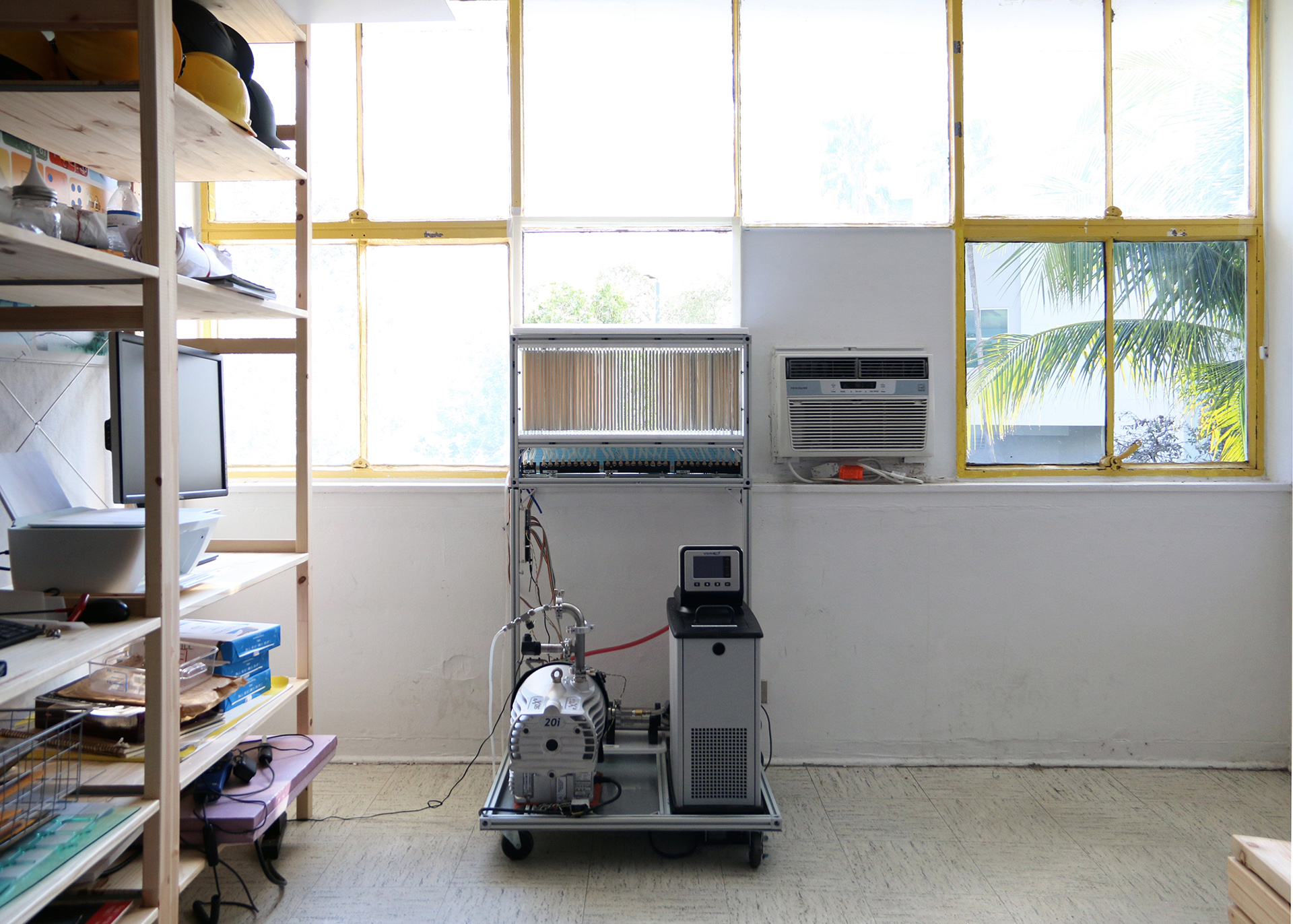
Trellis Air has explored industrial drying, household dehumidification, and integration with air conditioners. Prototypes were tested in Miami and at Harvard’s HouseZero. The ambition is to reduce the energy spent removing moisture before cooling air. That remains a commercialization project, with the familiar distance between a working system and widespread adoption.
Pillar now lists Wilcox as Trellis Air’s CEO and a venture partner. Electronic paper is the achievement for which he is known, but the return to operating gives the story its present tense. Once again there is a material, a team, and a machine that has to perform outside the room where it was invented. This time, the customer may never read a word on it. They may simply notice the air.