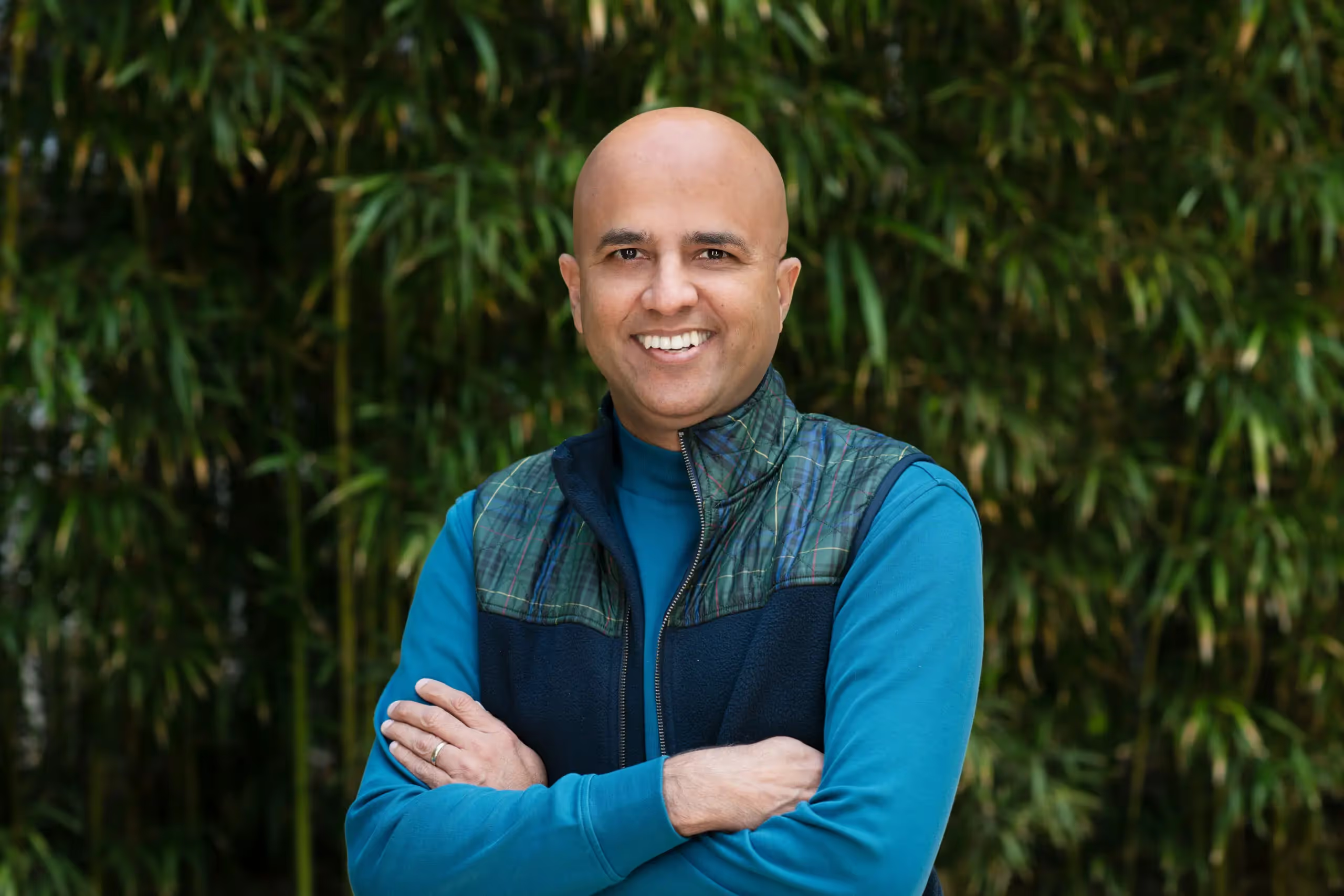
He graduated top of his class at IIT Madras with a medal that carries the President of India's name on it. Then went to Bell Labs. Then got an MBA at Harvard. Then joined a biofuels startup - which failed. That detour through failure is the part Rajesh Swaminathan tends to lead with. It explains everything about how he invests now.
Walk into a room with Rajesh and you get the rare sense of someone who has been watching the same clock for 20 years and knows precisely what time it is. He was in renewables at Deutsche Bank in 2007, when CleanTech 1.0 was either the future or a catastrophe depending on who you asked. He ran Applied Ventures - the venture arm of Applied Materials - for a decade, deploying over $300 million across 85 hardware startups on six continents. He saw the bubble. He waited. He is still here.
"Technology is the only way to make an impact nonlinearly - you can't just green-tape around the edges."
- Rajesh Swaminathan, Partner, Khosla VenturesNow, as a Partner at Khosla Ventures, Rajesh runs at the intersection where materials science meets the megaton problems nobody else will touch: decarbonizing cement and steel, scaling geothermal and fusion, building the compute infrastructure that makes everything else possible. His fund check ranges from $100K to $50 million. His patience ranges from a decade to longer.
What separates him from most investors in the space is the engineering depth. He does not just ask whether a technology works. He asks whether it can compete without subsidies in China and India - what he calls the "Chindia cost" test. He asks whether founders understand the techno-economics of their solution. "They don't need to be economists," he has said. "But do they care about the techno-economics of their solution?" It is a question most venture investors do not know to ask.
"We're hunting for the twelve entrepreneurs that will save the world - the 12 instigators."
- Rajesh SwaminathanThe KV framework he operates within is precise. Every investment must clear five circles: 10x impact (non-incremental), technical differentiation with defensible IP, leverage of existing infrastructure, competitiveness without subsidies, and team capacity to recruit the people needed to scale. If a company clears all five, it gets his attention. If it does not, the conversation ends. Politely, but quickly.
At Applied Ventures, he put his name on some of the era's most consequential bets. Enphase Energy, now one of the world's leading residential solar inverter companies, was in his portfolio. So were Solid Energy, Rockley, Infinite Power Solutions, Adaptive3D, Tango, Inpria, PlayNitride, and Norsk Ti. He also drove the establishment of an $850 million Materials Engineering Technology Accelerator (META) facility in New York - a semiconductor manufacturing access program that let hardware startups skip the line at a fab. That facility alone changed the trajectories of dozens of companies who otherwise could not have afforded to test their chips.
His reading of CleanTech 1.0 differs sharply from the consensus. Where most investors filed it under "cautionary tale," Rajesh files it under "foundation." Solar scaled from 20 gigawatts to 800. EVs went from novelty to mainstream. The biofuels companies became sustainable aviation fuel companies. "One size doesn't fit all," he told TechCrunch. "Climate tech companies are different from most other VC investments." He was not wrong then. He is not wrong now.
"Our job is not just to back you - it's to walk with you as you build."
- Rajesh Swaminathan, on the KV founder relationshipHe joined Khosla Ventures in 2020, adding a partner whose technical fluency in materials and hardware was almost singular in the venture landscape. KV runs 12 investment partners and 12 operating partners, and Rajesh sits at the center of a web connecting Nobel laureate advisors to seed-stage founders trying to replace Portland cement. His co-investors include Vinod Khosla, Keith Rabois, and a network he had been building alongside Khosla for more than 12 years before he officially joined the firm.
The sectors he now owns at KV span renewables generation, battery storage, hydrogen, industrial decarbonization, critical minerals, plastics, foodtech, healthcare, and the AI convergence threading through all of them. It sounds like a lot. It is a lot. But the through-line is consistent: he backs technologies that address fundamental material constraints on civilization, not convenience problems looking for distribution.
His advice to founders is characteristically direct: pick value-added investors over valuation. Climate is a marathon, not a sprint. Patient capital with genuine technical engagement - the kind that helps with recruiting, business model iteration, and IP strategy - is worth far more than a higher pre-money number from a generalist fund that will be unavailable when things get hard. "Industries aren't disrupted by insiders," he has said - a reminder that the best people in climate tech often come from aerospace, pharma, and materials science, not energy companies.
In 2019, Global Corporate Venturing placed him on its Powerlist - an annual ranking of the most influential corporate venture investors. He spoke at PDAC 2025, the world's largest mineral exploration convention, and was already confirmed for PDAC 2026. He appeared at the 2025 Hello Tomorrow Summit on the future of climate tech, and at San Francisco Climate Week on AI-driven mineral exploration alongside BHP Ventures. The conference circuit is where he looks for patterns nobody else has noticed yet.
The down-to-earth detail his colleagues tend to remember: he worked at a failed biofuels startup. Not as an investor - as an employee. He knows what it feels like to be on the inside of a company that does not make it. That knowledge sits underneath every term sheet he signs at Khosla. He has been at the whiteboard. He has seen the cap table get complicated. He has watched smart teams make avoidable mistakes. When he says "our job is to walk with you," he means it as someone who has done the walking.