BREAKING Samir Kaul cut the first $50M check into OpenAI before anyone believed in language models PORTFOLIO Guardant Health · Nutanix · Impossible Foods · QuantumScape · Varda Space · Oscar Health ORIGIN STORY Former genomics researcher at Craig Venter's institute who sequenced the Arabidopsis genome in 2000 PHILOSOPHY “I like technical risk and I don’t take market risk” PHILANTHROPY $3M gift to University of Michigan establishes MICDE Directorship BREAKING Samir Kaul cut the first $50M check into OpenAI before anyone believed in language models PORTFOLIO Guardant Health · Nutanix · Impossible Foods · QuantumScape · Varda Space · Oscar Health ORIGIN STORY Former genomics researcher at Craig Venter's institute who sequenced the Arabidopsis genome in 2000 PHILOSOPHY “I like technical risk and I don’t take market risk” PHILANTHROPY $3M gift to University of Michigan establishes MICDE Directorship
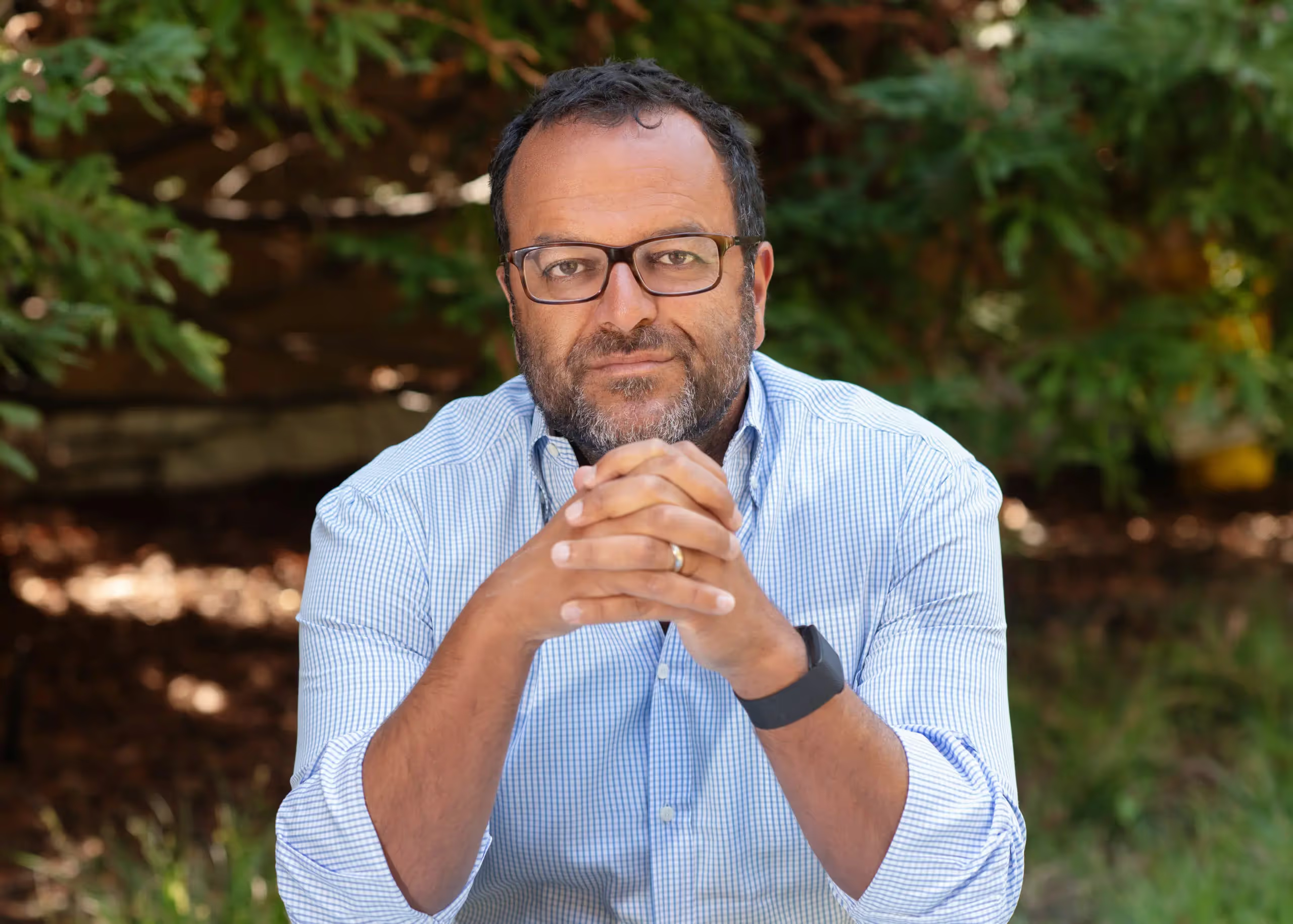
Samir Kaul, Founding General Partner at Khosla Ventures
Founding General Partner · Khosla Ventures

Samir
Kaul

The scientist who bet on the machine - and won.

In 2019, when Silicon Valley shrugged at language models, a former plant genomics researcher from Craig Venter's lab wrote a $50 million check to a small research nonprofit called OpenAI. His name is Samir Kaul. He has been right about transformative technology, repeatedly, for twenty years.

Venture Capital Deep Tech AI Pioneer Biotech Climate Space
$50M
First OpenAI Check
2006
Khosla Founding Year
7
Peer-Reviewed Papers
$3M
UMich MICDE Gift

The Weed That Changed Everything

Before Samir Kaul was making calls that would reshape artificial intelligence, he was studying a weed. Not metaphorically. Arabidopsis thaliana - a small flowering plant of no particular agricultural significance - was the organism that occupied his early career at The Institute for Genomic Research, Craig Venter's pioneering lab outside Washington D.C. In December 2000, Kaul co-authored a landmark paper in Nature announcing the first complete genome sequence of a flowering plant. Volume 408, pages 796-815. Seven peer-reviewed papers deep into a scientific career.

That's the detail most profiles skip. They start with the investments. They miss the point. Samir Kaul's edge in venture capital is not pattern matching. It's the instinct of someone who has actually done the work - designed experiments, evaluated evidence, sat in a lab and tried to understand what something fundamentally is before deciding what it could become.

"I like technical risk and I don't take market risk."
- Samir Kaul, Khosla Ventures

After earning his MBA from Harvard Business School, Kaul joined Flagship Ventures, where he co-founded Helicos BioSciences and served as the founding CEO of Codon Devices. These were not passive board seats. He built companies. He hired people. He made payroll decisions. Then, in 2006, Vinod Khosla was assembling the team for a new firm - one that would bet on technologies that felt impossible by the standards of the day. Kaul became a Founding General Partner.

The firm's thesis was simple and radical at once: back founders attacking problems too hard for most investors to evaluate. Clean energy. Advanced biology. Deep computing. The kind of work that requires you to actually read the technical papers, not just the pitch deck. Kaul was built for exactly this.

"You can only lose one time, your money, and that you can make infinite amounts."
- Samir Kaul on asymmetric returns in venture capital

By 2019, Kaul had already backed companies that would become meaningful public enterprises - Guardant Health, pioneering liquid biopsies for cancer detection (NYSE: GH); Nutanix, reimagining enterprise cloud infrastructure (NASDAQ: NTNX); QuantumScape, the solid-state battery company (NYSE: QS). The thesis was working. But then came a call about a small San Francisco research lab that had been quietly building large language models. The lab was called OpenAI. Most investors were skeptical - language models were curiosities, not products.

Kaul wrote the first check. The largest check. $50 million when $50 million felt like a lot to spend on something you couldn't yet demonstrate to a skeptical LP base. The decision reflected everything about his method: this was technical risk - genuine uncertainty about whether the technology would work - in a market that was, if it worked at all, essentially unbounded. His kind of bet.

The rest is the history everyone is now scrambling to rewrite in their own favor. But Kaul was there first, and he was there because of how he thinks, not because of luck or timing.

"We look for great people trying to disrupt large markets with technology."
- Samir Kaul on the Khosla investment framework

Today Kaul's portfolio reads like a catalog of problems that shouldn't be solvable yet. Varda Space Industries is building manufacturing facilities in orbit - the logic being that microgravity enables the production of materials impossible to make on Earth. Ultima Genomics is attacking the cost of DNA sequencing. Mainspring Energy is developing a linear generator that converts fuel directly to electricity. Impossible Foods is making meat from plants at scale. Mirvie is predicting pregnancy complications before they occur.

Each of these represents a genuine scientific or engineering frontier. That's not an accident. That's the methodology. When Kaul evaluates a company, he is evaluating whether the underlying science makes sense, whether the founders understand the actual mechanism of what they're building, and whether the market, if the technology works, is genuinely large. The market question is the easy one. The technical question is where most investors stop reading.

He doesn't.


The Method Behind the Madness

Kaul's framework is structured around a distinction most investors blur: technical risk versus market risk. He will take the former. He avoids the latter. If a technology works, does a market exist? That's a question with a fairly clear answer, even for speculative technologies. Is the technology possible at all? That's the interesting question - and it's the one that requires a scientific mind to evaluate properly.

This is why his career path - from Craig Venter's lab to Harvard Business School to Flagship to Khosla - makes a certain kind of sense. He built the scientific fluency first, then learned the capital structure. Most VCs do it the other way around, or skip the science entirely.

The result is a portfolio that looks, in hindsight, almost obvious - but only because the technologies eventually worked. At the moment of investment, each one was genuinely uncertain. Liquid biopsies for cancer. Solid-state batteries. Plant-based meat at scale. Language models. Orbital manufacturing. The through-line isn't a sector. It's a method.

Kaul's non-consensus bets share a structure: high technical risk, large addressable market if solved, and a founder who understands the actual mechanism. He is particularly drawn to founders with deep scientific or engineering backgrounds - people who are not just disrupting a category but genuinely trying to solve a hard problem. The asymmetry he describes is real: you can lose your initial investment once, but if the technology works, the upside is functionally uncapped.

Technical Risk
Will the science actually work? This is the question Kaul's background equips him to answer where others can't. He reads the papers. He evaluates the mechanism. He has been wrong, but he's been right in ways that compound.
Market Certainty
If the technology works, is the market large? For the problems Kaul backs - cancer, climate, AI, space - the answer is yes almost by definition. He refuses to back small solutions to large problems.
Founder Conviction
High-agency founders who understand the actual mechanism of what they're building. Not marketers who found a problem. Scientists and engineers who chose their problem first.

Bets That Changed Industries

OpenAI
Artificial Intelligence
First Investor
Guardant Health
Cancer Diagnostics
NYSE: GH
Nutanix
Cloud Infrastructure
NASDAQ: NTNX
QuantumScape
Battery Technology
NYSE: QS
Impossible Foods
Food Technology
Private
Varda Space
Space Manufacturing
Private
Mainspring Energy
Clean Energy
Private
Oscar Health
Health Insurance
NYSE: OSCR
Mirvie
Maternal Health
Private
Ultima Genomics
Genomics
Private
Granular
AgTech
Acquired: DuPont
Raxium
Display Technology
Acquired: Google

From the Lab to the Ledger

1991-1995
B.S. Biology, University of Michigan. Goes deep on the science before thinking about business at all.
1995-2000
Researcher at The Institute for Genomic Research (TIGR), Craig Venter's lab. Leads the Arabidopsis Genome Initiative. Publishes 7 peer-reviewed papers.
2000
Co-authors landmark Nature paper (Vol. 408, pp. 796-815) - the first complete genome sequence of a flowering plant. The scientific community takes note.
2000-2002
MBA at Harvard Business School. Adds capital structure fluency to a scientific foundation few peers can match.
2002-2006
Partner at Flagship Ventures. Co-founds Helicos BioSciences. Serves as founding CEO of Codon Devices. Invests in Epitome, LS9, Morphotek. Promoted to Partner in November 2005.
2006
Joins Vinod Khosla as a Founding General Partner at the newly formed Khosla Ventures. Begins building a portfolio around transformative technology.
2015-2019
Guardant Health IPO (NYSE: GH). Nutanix IPO (NASDAQ: NTNX). The thesis starts publishing results publicly.
2019
Personally leads Khosla Ventures' investment in OpenAI. First institutional investor. Largest check: $50 million. Silicon Valley was skeptical. He was not.
2020-2022
QuantumScape IPO (NYSE: QS). Granular acquired by DuPont. NanoH2O acquired by LG Chem. Raxium acquired by Google. Portfolio momentum accelerates.
2023
Fortune magazine names Khosla as OpenAI's first VC backer. The $50M check becomes one of the most discussed investments in venture history.
2024-2025
Active board work at UCSF Benioff Children's Hospital and Michael J. Fox Foundation. Khosla Ventures exploring AI-infused roll-ups of mature companies. Still moving forward.

The Record

Where to Hear Him Think

Fortune Magazine
"OpenAI's first VC backer weighs in on generative AI" - February 2023. The piece that put Kaul's early OpenAI bet in public context for the first time.
The Full Ratchet - Ep. 392
"Cutting the 1st and Largest Check into OpenAI" - Deep conversation on generative AI moats, market opportunities, and why climate tech is having a moment.
Venture Unlocked Podcast
February 2024. 42 minutes on building iconic VC firms, non-consensus decision making, and what separates the investors who matter from the ones who just show up.
GEN Edge Interview
One-hour conversation with GEN (Genetic Engineering & Biotechnology News) on evaluating and managing risk in 2023. He speaks the language of the science he's funding.
The Twenty Minute VC
Pro-rata strategies, the technical vs. market risk framework, and how his scientific background shapes every investment decision. Essential listening for deep tech founders.
MPods Episode 4
October 2023, recorded at the Menlo Park office. A more candid look at how he thinks about founder psychology and the companies building at the frontier of what's possible.

The Giving Side of the Ledger

Samir and Puja Kaul both attended the University of Michigan - Samir graduating in 1995, Puja in 1998. In 2023, they donated $3 million to establish the Samir and Puja Kaul Directorship at the Michigan Institute for Computational Discovery and Engineering. MICDE sits at the intersection of computation and scientific discovery - exactly the space where Kaul built his career before moving to Sand Hill Road.

The gift wasn't random. Kaul has long believed that the bottleneck on scientific progress is not ideas but computation - the ability to model, simulate, and analyze at scale. Supporting MICDE is an investment in the infrastructure that produces the kind of founders he backs.

He chairs the Development Committee at UCSF Benioff Children's Hospital, one of the country's premier pediatric research institutions, and serves on the board of the Michael J. Fox Foundation for Parkinson's Research. These aren't trophy board seats. They are extensions of a genuine interest in how science translates into better outcomes for actual patients.

Philanthropic Roles
  • Chair, Development Committee - UCSF Benioff Children's Hospital
  • Board Member - Michael J. Fox Foundation
  • Named Directorship Donor - University of Michigan MICDE ($3M)

The Parts That Don't Fit the Resume

His first major scientific paper was about a weed. The Arabidopsis plant has no agricultural value. It has extraordinary value as a model organism for genetics research. Kaul understood the difference, and the logic shaped everything that followed.

He wrote a $50M check to OpenAI in 2019 - before ChatGPT, before GPT-4, before most of Silicon Valley stopped dismissing language models. The check was the largest in that round. He was also the first.

He roots for the Michigan Wolverines, Boston Red Sox, and Washington Commanders. Three franchises with very different relationships to winning. He has experience managing long-term conviction through volatile stretches.

One of his portfolio companies (Varda Space Industries) is building factories in orbit. The logic: microgravity enables production of materials physically impossible to make on Earth. Another bet where the market is obvious if the technology works.