The golf balls went into egg cartons. Before there were televisions with his surname on them, Ruslan Kogan collected stray balls near a Melbourne golf course, washed them and offered them back to golfers for 50 cents each. He had noticed that a ball could escape the course, lose its owner and somehow retain its usefulness. The golfers had a problem. A child with some empty packaging had a proposition.
His weekend takings, he later recalled, were $20 to $30. Much of the money found its way to the milk bar, where Warheads, snakes and Paddle Pops provided an agreeable return on labour. “I was king of the milkbar!” he said. It is a pleasingly modest first kingdom for someone who would eventually put his name on a listed retailer.
The interesting part is the attention. Kogan noticed a gap between what something cost and what somebody would accept for it. Years later, the objects would be larger and the negotiations more complicated. The question would remain familiar: how much of this price belongs to the product, and how much belongs to the way we have decided to sell it?
A computer before a company
Kogan was born in Babruysk, in what is now Belarus. His family moved to Australia in 1989 and settled in Melbourne, living in public housing in Elsternwick. His parents arrived with $90. That figure recurs in his accounts of childhood, alongside their willingness to work several jobs. He has described their move as an example of the risk and effort he later associated with starting a business.
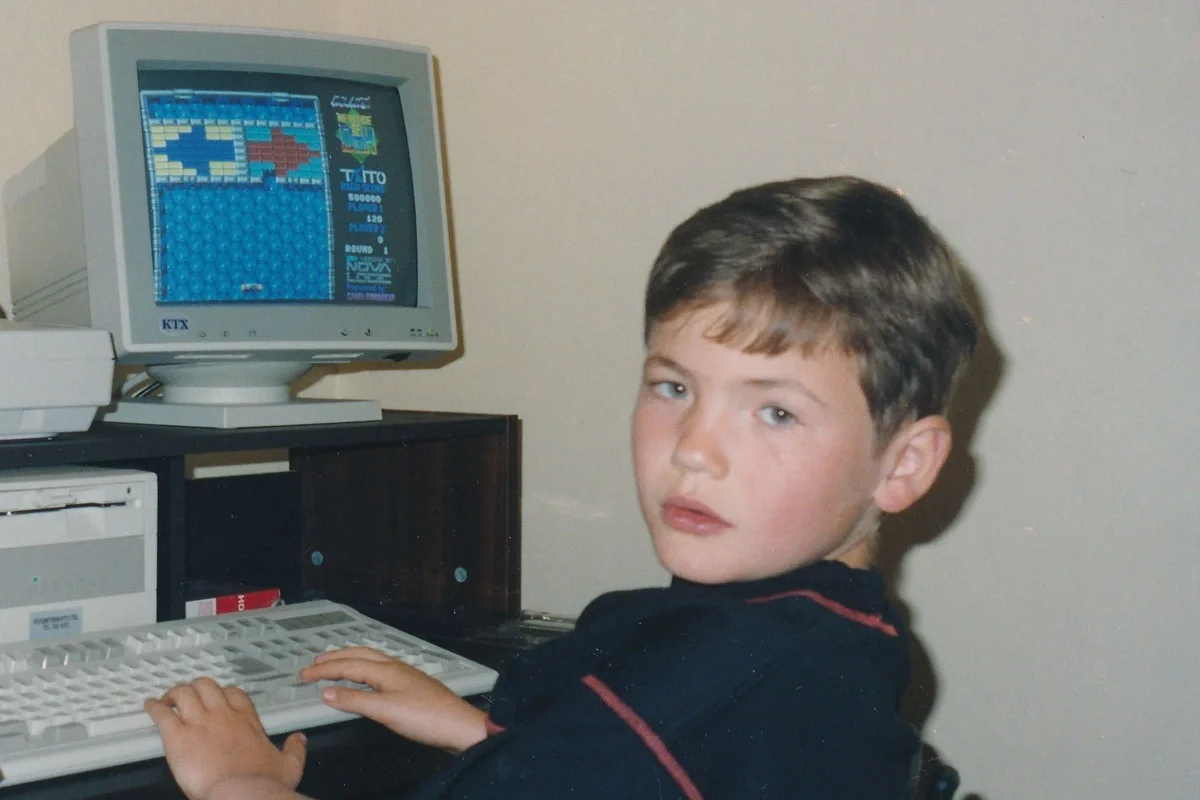
At nine, he assembled a computer from parts bought at the Caulfield Town Hall computer swap meet. Later came car washing, phone repairs and website design. These were practical ways of getting closer to things he wanted. They also gave technology a commercial dimension: a machine could be built, a phone repaired, a website sold. Computers were both an interest and a means of earning.
His degree was a Bachelor of Business Systems at Monash University. Before founding Kogan.com he worked in IT at Bosch and GE, then as a consultant at Accenture. The combination matters. He had seen how large organisations worked from inside them, and had acquired the technical vocabulary to question how their work was organised.
The fridge that arrived with a lesson
During a university exchange in Miami, Kogan went to Walmart for a small fridge. It seemed the obvious choice: a large retailer, enormous buying power, the familiar promise that scale meant value. Then came the less attractive part of the transaction, getting the appliance back to his room.
The local students had ordered online. Their fridges arrived by FedEx, and they had paid less. Kogan has retold the episode as an early influence on Kogan.com. A smaller seller had beaten a retail giant on both price and convenience. For a student learning about economies of scale, the delivery driver had supplied a useful footnote.
The observation stayed with him when he returned to Australia. By 2006, he was selling televisions online from his parents’ Melbourne garage. The proposition depended on sourcing directly from manufacturers and removing layers of distribution and shopfront expense. The screen was the product. The route it took to the customer was the opportunity.
Early coverage described a business financed with credit cards and built through eBay. In his later Foundr interview, Kogan recalled auctions starting at one cent with no reserve. Those were opening bids, rather than a promise that every television would leave for a cent. The distinction is substantial if you happen to be paying the factory.
A bargain still needs an audience
Price alone did not explain how an unfamiliar surname could persuade someone to buy a television without walking into a shop. Kogan understood that shopping also involves watching other people shop. In an essay about social proof, he described a stall selling remote-control helicopters that initially attracted very little business.
Then his teenage cousin arrived with friends and started playing with the toys. A crowd formed; sales followed. In Kogan’s telling, he offered the cousin $50 a day to keep coming back with his friends, and sold his stock before the Christmas selling period was over. A demonstration had made the product interesting. Other people’s interest had made it reassuring.
He carried that thinking online, describing a feed that showed recent purchases to visitors. His account of the helicopter stall is revealing because it gives the supposedly bloodless business of digital retail a very human mechanism. A low price invites inspection. Evidence that other people have trusted the seller helps a customer take the next step.
The public arguments served a related purpose. Kogan challenged established retailers, including Gerry Harvey, and made his case for online competition in a 2010 essay about regulation and innovation. The language was combative. It also gave a small company a place in a discussion usually occupied by businesses with many more shops.
Even the browser got a bill
In 2012, Kogan.com announced a 6.8% surcharge for purchases made using Internet Explorer 7. The explanation was that supporting the ageing browser consumed development time and money. Customers could avoid the charge by switching browsers. A technical irritation had become a news story, complete with a percentage.
The browser surcharge was characteristic: a complaint about wasted effort, expressed through a provocation people would repeat. It is possible to appreciate the joke while noticing the marketing calculation. An online retailer had turned the software used to reach its checkout into another reason to discuss the checkout.
His interest in efficiency extended beyond the publicity. In a 2012 interview, he explained how search data helped the company identify demand before choosing products. The premise was straightforward: listen to what customers are already looking for, then work backwards through sourcing and distribution. A retailer could use the internet to learn as well as to sell.
Buying the name above the old shop
In 2016, Kogan.com acquired the Dick Smith brand and online business. The announced plan was to operate it online; the physical stores would close. For Kogan, there was a personal connection. As a child, he had visited Dick Smith looking for computer parts. Now the customer had become the buyer of the name.
The A$2.6 million purchase included brand assets, web addresses and a database with 1.5 million names. It was a different sort of retail acquisition from taking over a street full of shop leases. Reputation and a relationship with customers could have value after the old physical network had ceased to work.
Kogan.com listed on the Australian Securities Exchange on 7 July 2016. David Shafer, who had worked with the company since 2006 and joined full time in 2010, became a familiar counterpart as finance and operations chief. The business had reached the stage at which a founder’s hunch had to coexist with the routines of public ownership.
The reach widened again with the acquisition of New Zealand’s Mighty Ape in December 2020, announced at a headline A$122.4 million. Gaming, toys and entertainment brought different expertise and another customer base. Expansion now meant making separate operations work together, with all the unglamorous detail that implies.
“I’m not the fluffy CEO who can give a big motivational speech.”
Ruslan Kogan / 2023
The costs that refused to disappear
The hard chapters complicate the garage story. Following the 2020 sales boom, Kogan.com was left with too much inventory and had to discount stock. An efficient route to market could still deliver more products than customers wanted. Warehousing and clearance costs are less entertaining than a browser tax, and rather harder to turn off.
Kogan’s own description of his leadership is brisk: “I’m not the fluffy CEO who can give a big motivational speech.” It fits the operator who prefers to identify what needs fixing. It also sets a test for him. A culture organised around numbers has to confront the numbers when they become uncomfortable.
Mighty Ape supplied another such test. Problems following its October 2024 website upgrade contributed to a difficult period, and Kogan.com announced a A$46.3 million goodwill write-down in August 2025. For a business whose argument centres on digital efficiency, trouble with the digital machinery cuts close to the original claim.
The recovery is measurable, though uneven. For the year ended June 2026, group revenue was A$510.7 million and statutory profit after tax was A$11.2 million, following a A$39.5 million loss a year earlier. Mighty Ape’s revenue fell 29.9% during its reset; it generated positive adjusted EBITDA in the final quarter. Those measures describe progress and remaining work at the same time.
Twenty years, and another look at the receipt
Kogan marked the company’s twentieth birthday in March 2026. The business now includes marketplace sellers, memberships and partner services as well as products. Some revenue can be earned without first filling a warehouse. The company’s stated priorities include expanding those activities and completing Mighty Ape’s recovery.
In a May 2026 interview, he described the same customer-value philosophy that underpinned the first televisions. The ambition remains to turn operating efficiencies into a more attractive offer. The scale changes the job: an early founder can personally inspect a complaint; a larger organisation needs systems and colleagues who can act without waiting for him.
His public life also includes speaking to students and entrepreneurs, and investing through his family office. These activities extend a career that began with small experiments rather than a single polished founding idea. There were phones, websites and washed golf balls before there was a listed company.
The egg carton remains a useful place to finish. It held a product someone else had overlooked, presented at a price somebody might pay. The adult business is full of complications the child never had to consider. Kogan keeps returning to the original transaction, looking for the part of the receipt that could have been smaller.
Keep following the receipt
More from Ruslan Kogan, and the conversations behind the story.