At four years old, Rushang Shah stood before a family Christmas party and attempted his first joke. “What was the name of the first bus in America?” he asked. The answer was Columbus. The room answered with silence. Decades later, Shah could still make something useful from the flop: a punchline about never forgiving the adults and an early warning about his future in comedy. It is a tiny story, efficiently edited, with the embarrassment left in. Naturally, it belongs to a marketer who once made editing his business and now teaches rooms full of insurance professionals why stories survive when bullet points do not.
Shah is chief marketing officer and a board member at HawkSoft, the family-owned agency-management software company based in Canby, Oregon. The title suggests campaigns. His public vocabulary keeps returning to less decorative matters: trust, gratitude, ownership, behavior and the consequences of a company’s choices. He describes his job as communicating HawkSoft’s values and story while acting as a custodian of the trust placed in the company by two groups, its customers and its employees.
That is an unusually fiduciary verb for marketing: custodian. It implies the brand was entrusted to him rather than invented by him. HawkSoft had existed for roughly two decades before it built a formal marketing department. Its reputation moved mostly through customers telling other agency owners about the software and its support. Shah joined a company with a story already walking around in the world. His work was to give that story sharper language without making it wear a costume.
The programmer learns to edit
The route to insurance software began in computer science. Shah earned a bachelor’s degree in the subject at the University of California, San Diego, then an MBA in marketing management at California State University, Hayward. The pairing matters. He can see a product as a constructed system and as a promise made to a market. Before insurance, he spent about a decade in mobile software, including work as director of marketing at CompanionLink, a Portland-area maker of synchronization tools for phones, contact managers and business software.
Mobile technology in that period was a parade of devices, operating systems and changing expectations. CompanionLink’s job was to keep information moving between them. Shah brought what the company described as a quantitative focus to marketing, business development and strategy. During his tenure, CompanionLink reached the Inc. 5000 and ranked No. 18 among Oregon’s 100 fastest-growing private companies. It also appeared on the state list in consecutive years.
Even then, he was suspicious of participation for participation’s sake. When CompanionLink started using social media in 2011, Shah said the company had waited until it could join “in a meaningful manner.” It is a sentence from an earlier internet, but its test has aged rather well. A channel is not a strategy merely because everybody has an account.
A career in four translations
- Code into commercial language
- Messy drafts into clearer prose
- Mobile systems into useful benefits
- Company behavior into a trusted brand
While marketing software, Shah also founded Gramlee. Launched in 2007, the web service connected customers with human editors who revised grammar, spelling, punctuation, structure and flow. The premise sounds modest until one sees how Shah explained it: an editor has to understand the reader, the tone and the purpose. Software could catch pieces of syntax. A person could understand what a sentence was trying to do.
He advised writers to make more than one draft and to leave time between revisions so the mind could reset. Gramlee’s customers sent everything from business documents to personal letters. One submission, a young woman’s account of love written while ending a relationship, moved the team enough that it asked permission to share the piece with its editors. For a founder selling clean copy, Shah noticed the human freight inside the sentences.
“Our customers and employees put their trust in our company, and it’s our responsibility to curate this trust and position them for success.”Rushang Shah, on his role at HawkSoft
An old company discovers its voice
HawkSoft attracted Shah through what he calls its bedrock values and family-oriented environment. The company was founded by insurance agents and built its system around the daily work of agencies. Shah likes to say the origin story runs backwards from many competitors: instead of beginning with accounting software and adding policyholder work later, HawkSoft began with agency workflows.
The distinction is practical. A management system sits inside renewals, client conversations, documents, downloads and accounting. Friction repeats all day. So does ease. In a 2019 account of HawkSoft’s growth, Shah said agencies remained customers for an average of 18 years. Some departures came when an agency was sold rather than when it switched systems. The number belongs to that moment, but it illuminates the kind of marketing problem he inherited. The relationship lasts longer than most campaigns and occasionally longer than the person who chose the software.
The quiet marketing stack
An editorial visualization of recurring themes in Shah’s public talks and writing, not a measured survey.
At HawkSoft, Shah’s marketing philosophy became education before promotion. He points to HubSpot as an influence on that model. Teach people how to think about the problem. Help them ask better questions. Earn the right to describe the product. In insurance technology, the lesson expands beyond content marketing. Shah has spoken about agency data ownership, the risks hidden in vendor agreements and the need to understand how information can be accessed or used. Trust needs clauses, permissions and export buttons as well as kind words.
He also treats refusal as a form of clarity. The fantasy that one platform can do everything may sound convenient, but specialized businesses accumulate specialized needs. A company has to decide whom it serves and which capabilities deserve its attention. Shah’s recent comments on positioning sharpen the point: the market learns what a company is from the deals it declines, the segments it ignores and the features it deliberately leaves for others.
The purple cow and the quiet room
There is, inevitably, a purple cow. HawkSoft’s mascot, Bessie, turns up at conferences and in the company’s visual world. The lineage runs through Seth Godin’s Purple Cow, Shah’s favorite nonfiction book and a familiar argument for being remarkable enough to earn attention. The joke is visual. The strategic question is sterner: what has the company chosen that another company would not?
Shah has used the cow to discuss private ownership, service, culture and long horizons. He has worked for companies with different endgames and avoids making one structure morally pure. His point is that the desired destination changes today’s decisions. A business aiming for an exit and a business choosing patient independence may fund products, partnerships and customer service differently. Buyers deserve to understand the incentives behind the interface.
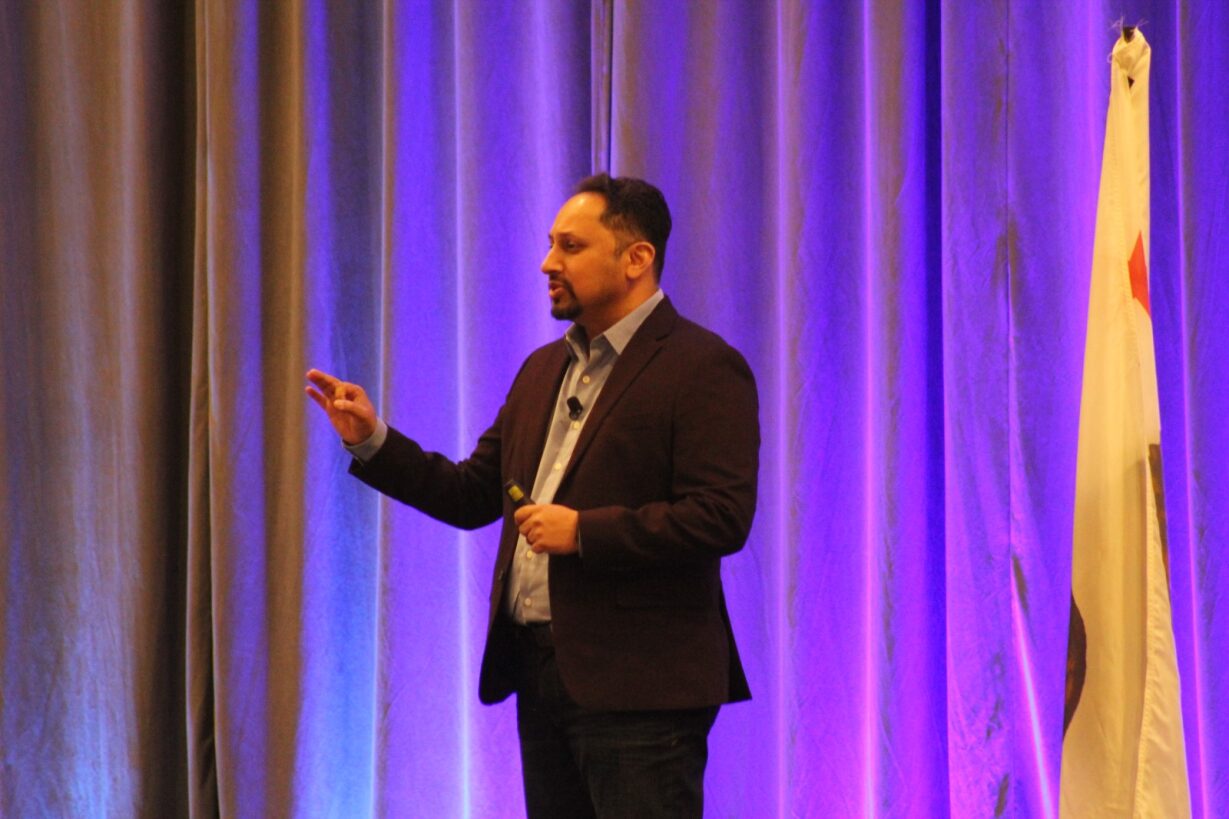
In 2024, Shah stood before the HawkSoft User Group conference and taught a seven-point storytelling framework. He argued that narrative joins facts to emotion and used episodes from his own life to show how stories help people make sense of themselves and one another. Later, HawkSoft leaders invited the audience to vote on roadmap priorities. Automated communications, email logging and integrated intake forms rose to the top. The sequence was revealing: tell people where you came from, then ask them where the product should go.
His leadership reputation carries the same quiet signature. A colleague who has worked with him through the user group describes a calm, intelligent and “refreshingly zen” guide who creates autonomy instead of micromanaging. Shah once lived as a monk in an ashram in India, a biographical fact that makes the description irresistible. It would be too tidy to use the ashram as a universal explanation. Still, composure has become part of how others experience him.
The sequence was revealing: tell people where you came from, then ask them where the product should go.
Gratitude with jalapeños
Shah believes gratitude is an underrated competitive advantage. He helped write one of HawkSoft’s core values around it and speaks of appreciation for the people who made the journey possible. In a 2025 conversation with CEO Paul Hawkins, the pair described culture as repeated behavior, purpose as something larger than selling a product and core values as living documents. The point is less sentimental than it first appears. Gratitude changes whose work gets noticed, whose feedback is heard and how a company behaves when a customer has a problem.
The solemnity is usefully punctured by his particulars. His imaginary autobiography is titled My Experiments in Life. He has watched The Godfather and The Godfather Part II repeatedly, carefully separating the life lessons from the Mafia ones. He grew up in the San Francisco Bay Area supporting the Oakland A’s, Golden State Warriors and San Francisco 49ers, then adopted the Portland Trail Blazers on a local-first principle. He cannot say no to bread. Pizza gets jalapeños. Ice cream gets coffee. His latte wants an unusually generous ratio of milk.
These details do more than brighten a corporate biography. They show a person alert to the comic edit, the memorable object and the value of specificity. “Executive believes in trust” disappears on contact with the eye. The silent Christmas party, the purple cow, the milky latte and the warning to remove the Mafia lessons stick around.
Shah’s career keeps circling the same act of translation. Code becomes a benefit somebody can use. A rough draft becomes a sentence that lands. An old company’s behavior becomes a story a new customer can understand. A roadmap becomes a conversation with the people who will live inside it. The output may be marketing, but the raw material is attention: close enough to see what the technology does, patient enough to hear what people need, and disciplined enough to leave a few things out.
Perhaps that first joke was not such a failure after all. The adults gave Shah his earliest audience research. He kept the silence, revised the ending and told it again.