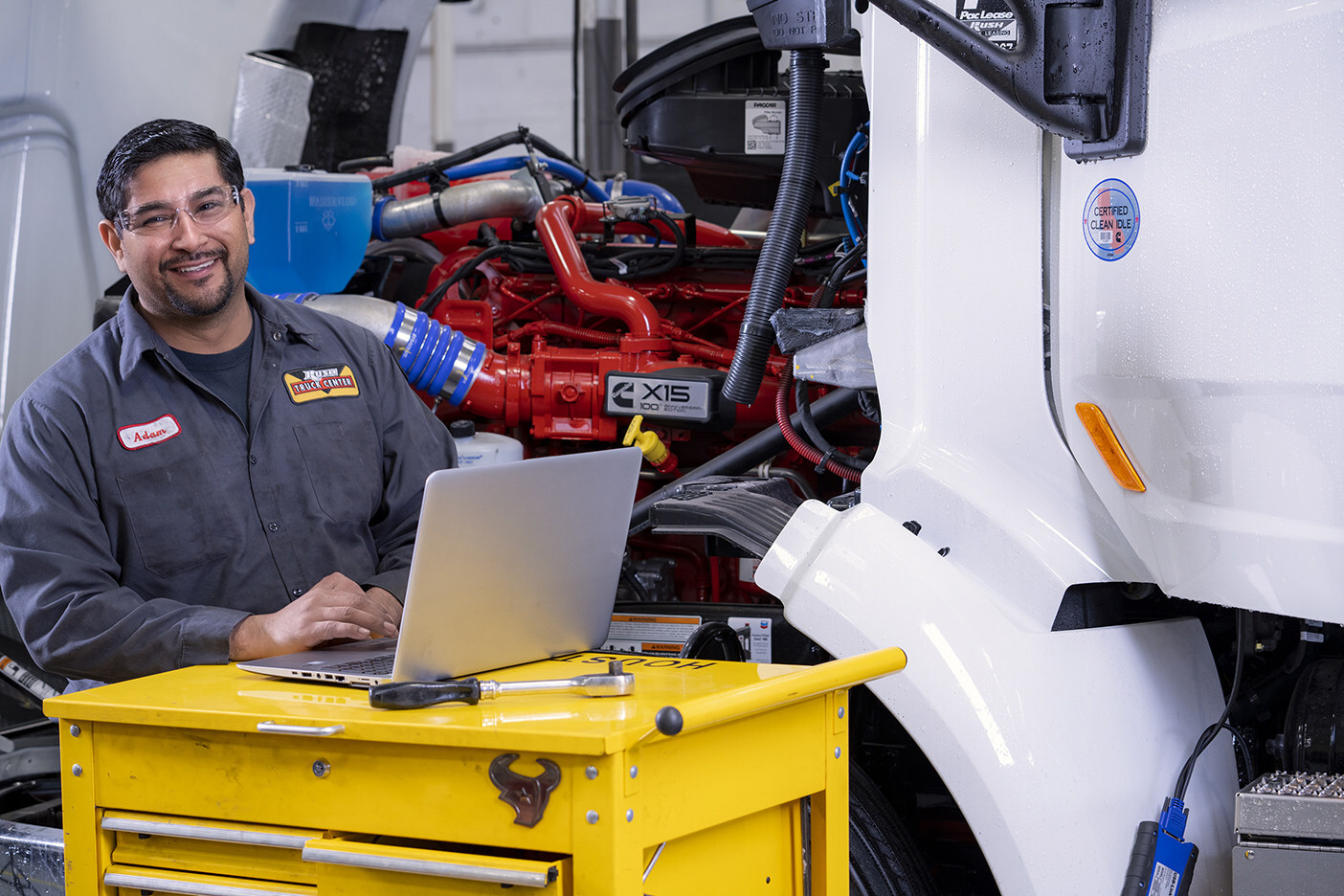
At the Rush Enterprises Tech Skills Rodeo, the trucks arrive with problems planted in them. Technicians have to find the faults, make repairs and explain their work. In 2025, more than 2,700 technicians tested to qualify; more than 200 reached the competition. There were trophies and nearly $300,000 in cash and prizes. For a company known for selling trucks, that is a revealing place to put the spotlight.
A dealership lot makes an easy photograph. Rows of cabs. Chrome. The promise of movement. But a truck earns its owner money by working, and an impressive machine becomes an expensive inconvenience when it cannot leave the yard. Rush has spent decades building a business around that inconvenience.
- The sale starts the relationship. Rush supplies commercial trucks, buses, financing and leasing.
- The workshop does the heavy lifting. Aftermarket operations produced 63.7% of 2025 gross profit.
- The network is the bet. Parts, people and coordinated service make a scattered fleet easier to support.
Follow the wrench
In 2025, Rush recorded $7.434 billion in revenue. Vehicle sales accounted for about $4.504 billion. Parts, service and collision repair brought in $2.523 billion. Yet that smaller aftermarket business generated nearly two-thirds of gross profit. The shiny object out front and the economic engine out back are different parts of the same enterprise.
The distinction matters when freight markets turn sour. Rush’s revenue fell 4.7% in 2025, and new heavy-duty deliveries declined. Aftermarket revenue edged up 0.3%. Maintenance gave the company some protection while customers hesitated over new purchases. Net income attributable to Rush still fell to $263.8 million from $304.2 million. The workshop softened the downturn; it did not cancel it.
A dealership becomes a system
W. Marvin Rush opened a GMC truck dealership in Houston in 1965. His father had owned a bus company. Two years later came the first Peterbilt franchise. Leasing, finance and insurance followed. The ambition, as the company tells it, was a connected dealership network across the southern United States.
The early insight was practical: buying a commercial vehicle creates several other jobs. Someone must finance it, insure it, configure it, maintain it and eventually replace it. Rush kept adding ways to do those jobs. The company went public in 1996 and passed $1 billion in annual revenue in 2004. W.M. “Rusty” Rush became CEO in 2006.
Expansion also created a coordination problem. The company’s history describes a subsequent emphasis on integration and standardized processes. Acquiring a location adds a dot to a map. Getting its inventory, service practices and customer communication to work with the other dots requires a different kind of effort.
The clock is the customer’s problem
Rush serves owner-operators, freight fleets, delivery businesses and vocational operators, along with public-sector and bus customers. A refuse truck and a long-haul tractor do different work. Both need parts and competent repairs. Through Rush Truck Centers, customers can buy new or used vehicles, order all-makes parts and arrange service or collision repair.
RushCare adds a support team available around the clock to coordinate help, schedule service and dispatch roadside assistance. Service Connect lets customers follow repairs and communicate with the shop online. These are useful answers to an unglamorous fleet-management problem: finding out what is happening without spending the afternoon chasing updates.
For vocational buyers, Ready to Roll offers trucks with bodies and equipment already fitted. Full-service leasing and contract maintenance offer another route for customers who want outside support. Rush earns from vehicle margins, parts, repair labor, leases, rentals and financial services. Each offering gives the customer another reason to return.
“The customer is the boss.”
RUSH ENTERPRISES’ COMPANY MOTTO
The number behind the service bay
Rush pays close attention to its absorption ratio. It divides gross profit from parts, service and collision repair by dealership overhead, excluding vehicle-selling expenses and vehicle-inventory carrying costs. At 100%, those service operations cover that defined overhead base. Rush achieved 130.7% in 2025.
Service gross profit relative to a defined dealership overhead base. This is a coverage measure, not a profit margin.
That is a useful discipline to copy: ask whether the continuing relationship can support the infrastructure needed to win the original sale. But spare parts are physical objects, technicians need training, and inventory needs financing. Service revenue may repeat; earning it requires people, equipment and working capital.
A bigger map has a price
The Summit deal makes those costs concrete. Rush’s 2021 annual report recorded approximately $205.3 million for acquired assets and another $57 million for real estate. Roughly $102 million of the asset purchase was financed through inventory and lease-fleet arrangements. The remaining asset price and real estate were paid in cash.
Competitors also sell service. Transwest, for example, offers parts, repairs and mobile support. Rush’s case rests on the breadth and coordination of its network. That advantage is useful only where the customer’s routes, vehicle brands and repair needs match the available facilities. A nearby independent shop can still be the practical choice.
Beyond the truck itself
Rush has kept moving into connected businesses. Its joint venture with Cummins supplies compressed natural gas fuel systems. In September 2026, it announced completion of a 50% investment in MCT Companies, adding exposure to transport refrigeration through 17 full-service dealerships and three mobile service locations. Keeping cargo cold extends the maintenance relationship beyond the cab.
The latest reported quarter offered cautious encouragement: second-quarter 2026 revenue was $1.900 billion and aftermarket revenue rose 1.5%. Management described improving freight conditions. Still, fewer miles, deferred maintenance, financing pressure or a shortage of technicians can all weaken the model. The enduring lesson is straightforward: sell something customers use for years, then become useful throughout those years. At Rush, that usefulness is tested with the hood open.