An excavator sitting in a yard is an expensive promise. It can move earth, open a trench, prepare a foundation. Until it reaches a job that needs it, however, it mostly occupies space. Equipment rental turns on this awkward interval between what a machine can do and when somebody will pay for it. Herc Rentals has spent six decades working on that interval.
- Rent the machine, plus help getting it to work.
- H&E added roughly 160 branches in 2025.
- More capacity pays off only when customers use it.
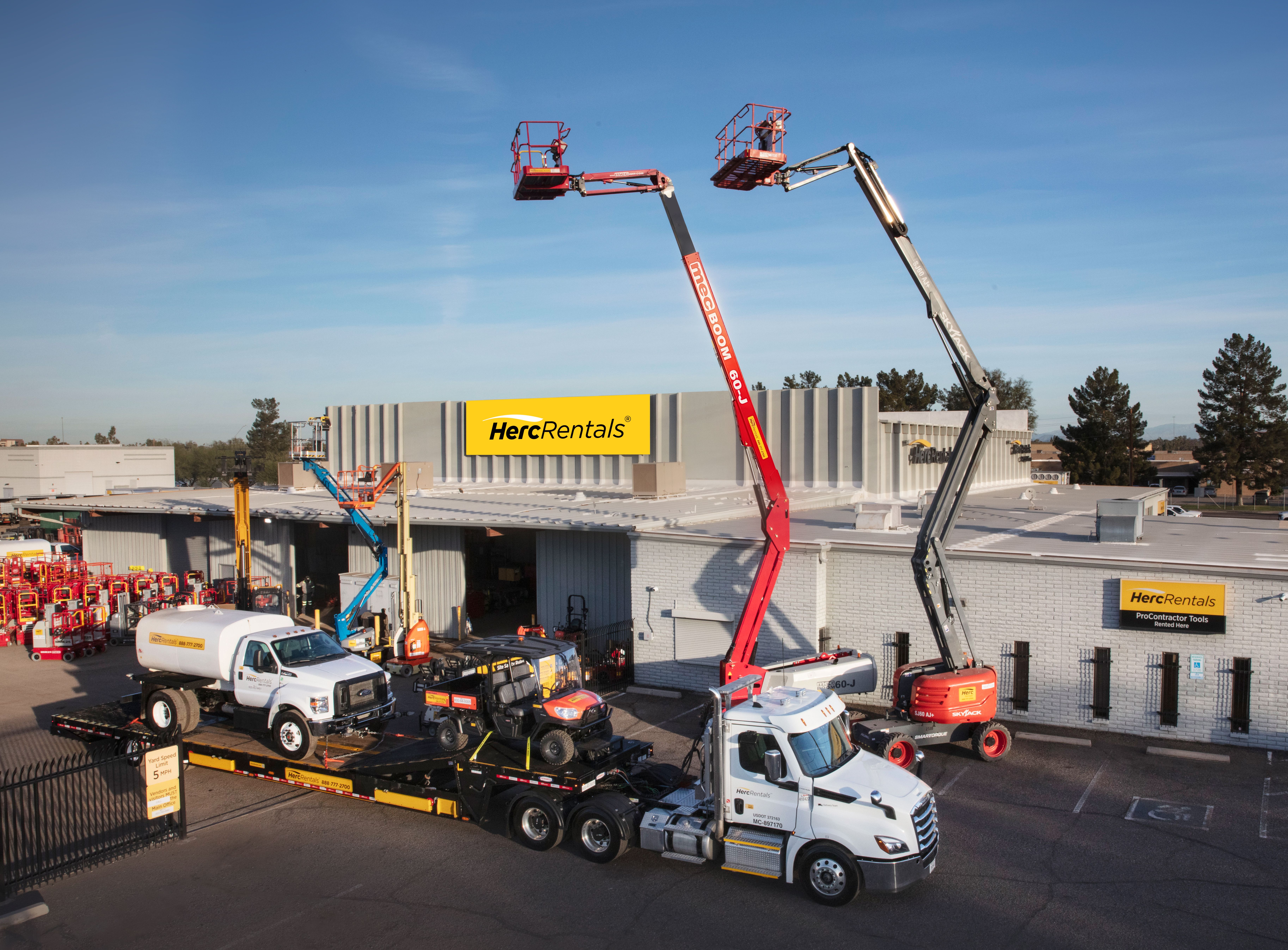
The company rents the physical vocabulary of a working job site: aerial lifts, earthmoving machines, forklifts, compressors, trucks and tools. Its specialty offering, ProSolutions, adds temporary power, climate control, pumps, restoration equipment and trench shoring. Contractors are obvious customers. Hospitals, factories, utilities, municipalities and warehouse operators also need equipment for work that cannot justify a permanent purchase.
The useful question is rarely simply whether a customer can afford a generator. It is whether that customer wants to own, maintain, transport and eventually sell a generator needed for a particular project. Herc takes on the fleet investment and charges for access. Delivery, pickup and other services add revenue; selling used machines helps turn the fleet over.
A map with a balance sheet
Herc began in 1965 as Hertz Equipment Rental Corporation. In 2016, the equipment business separated from Hertz’s car rental business and became an independent public company. That distinction matters: this is an operating business with a long corporate lineage, rather than a startup with an identifiable garage and founding duo. Larry Silber leads the company; he is not its founder.
Its consequential recent move came in June 2025, when it completed the acquisition of H&E Equipment Services. H&E brought approximately 160 branches across more than 30 states. The February announcement emphasized something more specific than a larger national footprint: greater urban density in seven of the ten leading rental regions. More dots in the right places could make the existing network more useful.
That is the competitive argument. United Rentals and Sunbelt are alternatives, alongside regional and independent operators. Herc does not have exclusive access to the idea of a rented boom lift. Its pitch joins local availability to a broad fleet, specialist support and national account coordination. A customer working across several markets can value consistent ordering and billing as much as a particular machine.
The bid that moved the deal
H&E had already agreed to sell to United Rentals. Herc offered cash plus stock, and H&E’s board judged that proposal superior. United declined to raise its offer, explicitly citing capital discipline. The change of buyer was a documented financial decision, not evidence of a sudden conversion to Herc’s operating philosophy.
The final accounting purchase price was approximately $4.8 billion. That differs from the roughly $5.3 billion enterprise value discussed when the transaction was announced: announcement valuations and closing purchase accounting measure different things. Herc also incurred $193 million of H&E transaction expenses during 2025, including a roughly $64 million fee paid on H&E’s behalf to exit the United agreement.
The financial ambition was explicit. Management projected about $300 million in annual incremental adjusted EBITDA from combined cost and revenue benefits by the end of year three. Those were expectations, not money already collected. The practical work involved consolidating systems, adjusting territories, changing the equipment mix and deciding which branches the combined business needed.
FEB 2025
H&E chooses Herc.
JUN 2025
Acquisition closes.
Q1 2026
Integration complete, management reports.
The first friction was idle capacity
The early strain appeared in the operating numbers. In 2025, dollar utilization fell to 38.5% from 40.9%. This measure compares rental revenue, with specified exclusions, against equipment’s original cost. It is not the percentage of hours a machine spends working. Herc attributed the decline primarily to lower utilization of the acquired fleet before optimization.
Extra equipment also brought depreciation, while acquisition financing increased interest expense. Revenue reached $4.376 billion, but reported net income was only $1 million. Transaction costs weighed on that result. Bigger sales and a bigger footprint had arrived before the full benefit of making the two organizations work together.
By July 2026, management said integration had finished in the first quarter and described improving comparable operating metrics in the second. Quarterly rental revenue reached $1.072 billion, up 23%. The company also reported $7.9 billion of net debt at June’s end. The investment case still depended on execution; an integration milestone did not settle the borrowing bill.
Dollar utilization
The button that sends the machine home
For customers, the more immediate story sits inside ProControl. The platform combines reservations, rental agreements, invoices and fleet information. Users can review utilization, locate connected equipment, submit service requests with photographs and manage purchase orders. Herc says access is free with a rental account. The machinery rental itself remains a separate expense.
One particularly revealing feature is calling equipment off rent. Herc publishes a short tutorial for it. The operator’s digital interface helps customers stop renting something they no longer need. That makes sense when a lasting account relationship matters more than squeezing a few unnecessary days from a single order. It also exposes how much rental spending can depend on ordinary administrative follow-through.
Other tools address different little failures: delivery tracking reduces uncertainty about arrival; diagnostic information helps identify equipment issues; remote controls can schedule compatible light towers. These capabilities depend on the equipment and feature involved. A dashboard cannot make an unsuitable lift fit through a doorway, or put unavailable equipment in the nearest yard.
“Revenue synergies and cost synergies are tracking to plan.”Larry Silber / July 28, 2026
Copy the discipline, then check the distance
The transferable lesson is to measure access and use together. Project managers can compare rentals with upcoming work, coordinate delivery and release idle equipment promptly. Herc Plus extends that logic to national accounts with coordinated support and fleet reviews. Through OMNIA Partners, eligible organizations can also access cooperative purchasing arrangements.
Renting deserves a calculation rather than automatic enthusiasm. For equipment used continuously over a long period, ownership may make more economic sense. For a remote project, delivery distance and availability may outweigh a national brand’s scale. Customers should compare the rental term, transport, fuel, protection terms and service requirements against ownership costs and expected use.
Herc’s network makes a concrete promise: specialized capacity can be available without every customer maintaining a private fleet. Fulfilling it requires technicians, drivers, training and well-placed machines. The business looks like a yard full of equipment. Its harder achievement is getting the right piece out of that yard, and getting it back when the job is done.
Put the equipment to work
Equipment rentals, ProControl demo, and training videos. Gear Up blog, news and results.