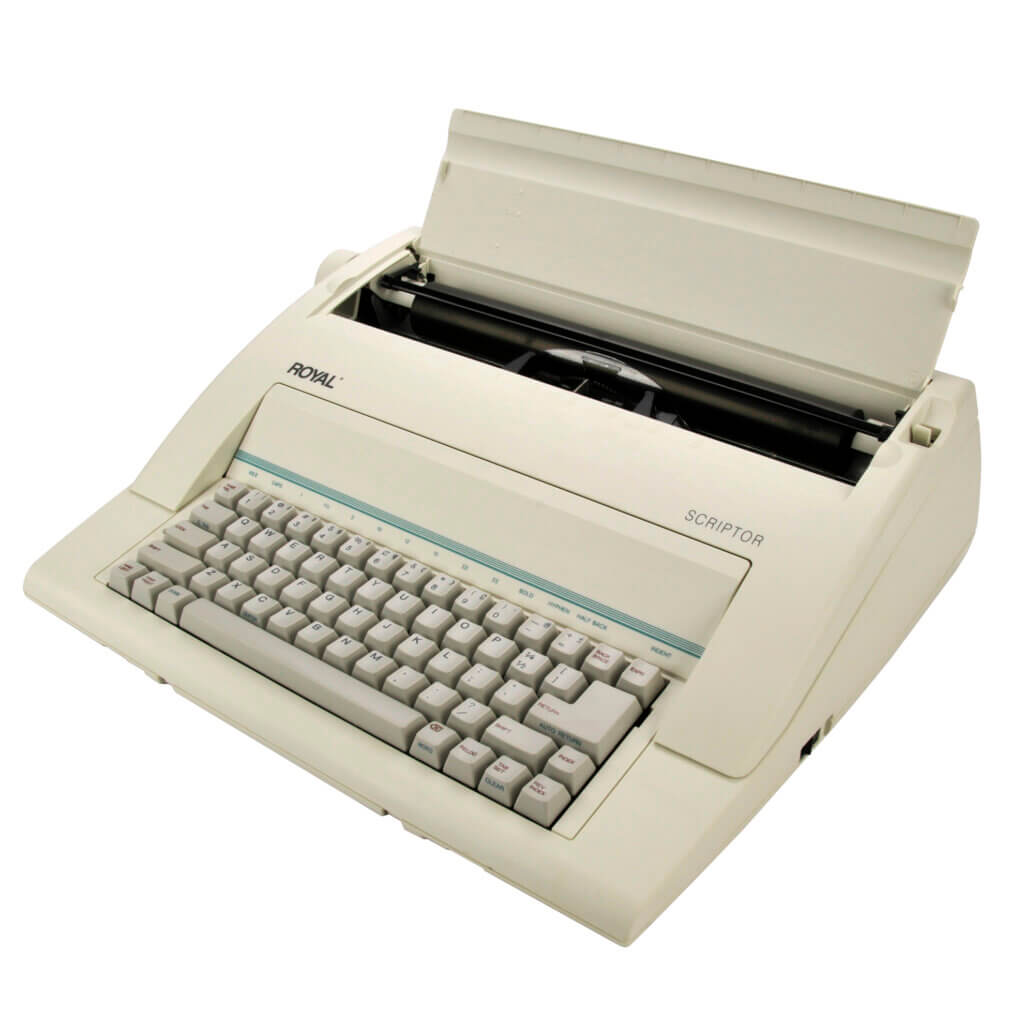
Royal Consumer Information Products sells a machine built for a world in which the internet is optional. Its Scriptor electronic typewriter has a full-size keyboard, a small display and a price tag of $399.99. Put paper in. Press keys. Receive words. No notifications, no subscriptions, no cloud. It is charming until you look one aisle over and notice that Royal also sells microcut shredders, electronic cash registers, safes, locator tags, standing desks, bathroom scales, jump starters and correction tape. This is not a neatly curated design shop. It is the supply closet of a small business given corporate form.
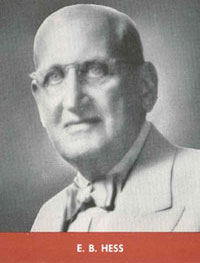
That sprawl is the point. The original Royal Typewriter Company was founded in a Brooklyn machine shop in January 1904 by Edward B. Hess and Lewis C. Myers. The present company, headquartered in Bridgewater, New Jersey, no longer depends on the machine that made its name. It follows the same buyer instead: the person trying to get practical work done at a desk, counter or home office. Royal's modern product is less a device than a promise that the dull hardware will be understandable, available and supported by a phone number.
The first pivot cost $220,000
Royal began with a technical argument. Hess designed a typewriter with a ball-bearing, single-track rail to carry the carriage, a better paper feed and a lighter typebar action. The founders had a prototype and dwindling cash. In 1905 they showed it to financier Thomas Fortune Ryan, who put up $220,000 in exchange for financial control. Adjusted for inflation, that is several million dollars today. More important than the conversion is the shape of the deal: Royal's first survival move was not a slogan. It was capital attached to a visible mechanical advantage.
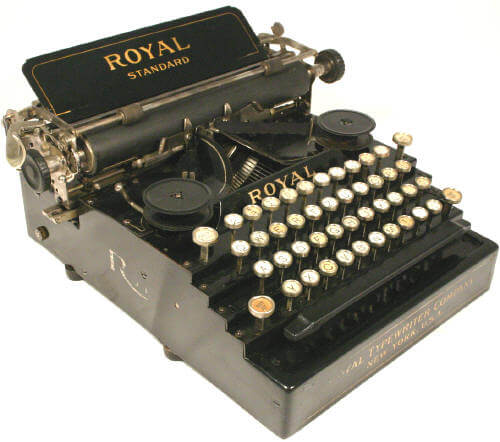
The Royal Standard reached customers in 1906. It was a flatbed, unlike the upright competition. Demand justified a purpose-built factory in Hartford, Connecticut, where manufacturing began in 1908. By 1914 the Royal 10 adopted the upright form and became a hit. Portable machines followed in the late 1920s. The company's marketing was pleasingly unhinged: it used an airplane to drop crated typewriters by parachute to dealers, making durability into a public stunt. A machine that survived falling from the sky did not need a long spec sheet.
Royal's original trick was simple: make the proof of quality impossible to ignore.A lesson from the parachute era
What failed first was the category
Royal did not glide through history untouched. It merged with accounting-machine maker McBee in 1954, became Royal McBee, and was acquired by Litton Industries in 1965. Volkswagen took a stake through Triumph-Adler in 1979. Olivetti bought Triumph-Adler and Royal in 1986. These were not cosmetic changes. They show a business being bundled into larger office-machine portfolios as electronics and computers rearranged the market underneath it.
The useful answer to “what failed first?” is not the ribbon or the carriage. It was the assumption that typing required a dedicated typewriter. Once word processors and personal computers made text editable, searchable and transferable, the old machine lost its central job. Royal's North American business was still described in a 2003 securities filing as serving consumer and small-business markets with office equipment, accessories and electronics. In April 2004, Olivetti's parent signed an agreement to sell the North American operation to local management. By September, Royal was a private American company again.
Strategic dependence - editorial model, not revenue data
What changed management's mind is visible in the ownership history and catalog, even if the boardroom conversation is private: typewriters could no longer carry the company. Royal followed the office outward. Cash registers solved checkout. Shredders solved privacy and disposal. Postal scales solved shipping. Safes solved storage. Time clocks solved attendance. Supplies and spare parts extended the relationship after the initial sale. Each category is mundane; together they form a survival system.
The catalog makes sense from behind the counter
Look at Royal from Silicon Valley and the range appears random. Look from a family shop, a school office or a spare bedroom and it becomes coherent. These customers still handle paper, cash, packages, keys and records. They often want a dedicated device because dedicated devices are legible. A cash register does not need an app-store account. A shredder does not push a firmware update. A typewriter cannot leak a draft because it has nowhere to send one.
Royal sells directly through its ecommerce site and appears across major retail and specialist channels. The model mixes one-time hardware sales with consumables, accessories, parts and refurbished equipment. Public customs records also point to international sourcing. A 2024 shipment record tied a large load of Vietnam-origin paper shredders to Royal and QVC. That makes Royal less like the vertically integrated Hartford manufacturer of old and more like a product developer, brand operator, importer and distributor.
The borrowed crown
The clearest modern partnership is with HP. Royal says it is licensed by HP Inc. to design, manufacture and sell HP-branded shredders, calculators, laminators, binders, locators and related office equipment. This is an elegant inversion. Royal, an old name that needed new categories, now operates physical products under another old technology name. HP contributes recognition and design expectations; Royal contributes category execution, sourcing, retail distribution and support.
That is also the most copyable part of the story. A heritage company does not have to invent a breakthrough every decade. It can become infrastructure for trust. Start with a customer you understand. List the adjacent physical problems that customer still pays to solve. Add categories where your distribution, warranty operation and brand permission transfer. Use licensing when a partner's name reduces buyer hesitation. Keep parts and consumables nearby. The move works because the operating muscles travel even when the hero product does not.
Follow the customer into adjacent chores, not into random trends. The test is whether the same buyer, retailer, support desk and brand promise can serve the next product.
Nostalgia raises the bar
Royal's hardest product may still be the typewriter. The electronic Scriptor is listed at $399.99 and the Scriptor II at $499.99 on Royal's site. Modern manual Royal Classics sold through retailers have drawn genuinely mixed reviews. Some buyers praise the offline calm and the look. Others report ribbons that fade or tangle, uneven impressions, keys that fail to strike cleanly and carriages that misbehave. Retail ratings do not prove every unit is faulty, but they identify the failure points that matter first: ribbon path, alignment, key action and carriage movement.
The brand makes those complaints sharper. A no-name retro prop can be forgiven for being decorative. A Royal arrives carrying the memory of metal machines built to be repaired. The historical logo implies mechanical continuity, even when the modern supply chain and economics are completely different. Royal's support operation responds with troubleshooting and warranty help, and its site maintains manuals, spare parts and model-specific advice. Still, nostalgia is a promise with teeth.
The same reality appears in shredders. Royal's support pages say prolonged use can trigger thermal protection, requiring a 30-to-60-minute rest. Feeding beyond rated capacity can strip or wear gears. Labels can damage the mechanism. A current CX112X lists a five-minute run time followed by 30 minutes off. None of this is scandalous for home-office equipment. It is a reminder that a familiar badge cannot repeal duty cycles.
Heritage lowers the cost of the first purchase. Product quality decides whether it earns the second.The constraint behind the comeback
When the playbook does not work
Royal's strategy fails under three conditions. First, adjacency becomes clutter. If products do not share a buyer, channel or support capability, the brand becomes a sticker and the catalog becomes a flea market. Second, sourced hardware underperforms the memory attached to the name. The older and more beloved the brand, the less patience buyers have for preventable defects. Third, software absorbs the job completely. A dedicated cash register can be appealing, but a merchant who needs integrated inventory, ecommerce, loyalty and analytics will probably choose Square, Clover or another connected system.
Royal fits best between anonymous marketplace hardware and enterprise systems. It is for buyers who want a known name, a finite job and someone to call when the machine beeps. Its expertise is not a single frontier technology. It is the less glamorous craft of packaging, distributing and supporting practical office devices across a fragmented market.
There is something pleasantly stubborn in that position. The company that once sold the future of writing now sells equipment for the physical residue software has not eliminated: paper that must be destroyed, cash that must be counted, packages that must be weighed, keys that must be found, and occasionally a sentence that deserves to exist without Wi-Fi. Royal survived because it stopped confusing its most famous product with its actual customer.