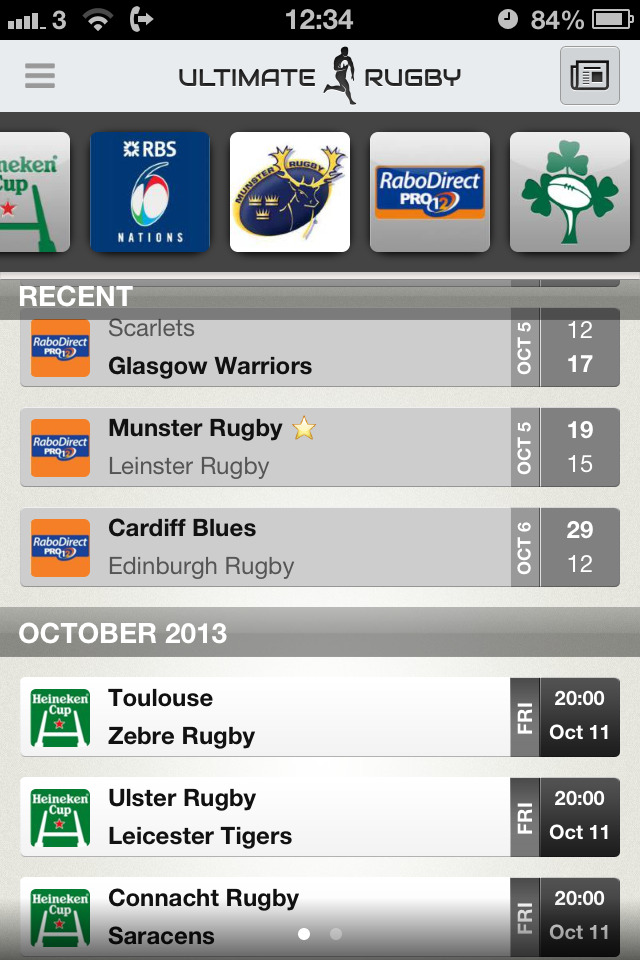
A rugby match is a machine for producing noise. The whistle blows and out come scores, carries, tackles, kicks, territory, possession, substitutions, errors and arguments. The numbers are precise. Their meaning is not. In 2013, Ross Peevers helped build a way through that clutter. Working with Richard Evans on the Ultimate Rugby mobile app, he used Opta data to create post-match infographics and a weighted player-action system. The idea was to show where a game had been won and lost, then calculate a statistical player of the match from positive and negative contributions.
It was an early exercise in a problem that would follow Peevers from Dublin to Chicago: information has value only after somebody decides what deserves attention. A pile of events is merely a pile. Give the events hierarchy, context and a clean interface, and a fan can see a match again with sharper eyes.
The work won the Overall Grand Prize in AIG's Rugby Innovation Challenge. It also won Popular Choice. The combination is unusually tidy. Judges rewarded the product's idea, implementation and likely effect; users simply wanted it. One prize approved the machinery. The other approved the experience.
Before the dashboard, there was the clubhouse
Peevers studied at Dublin City University from 2008 to 2013, first earning a Bachelor of Business Studies and then an MSc in E-Commerce. The course list on his profile is a small portrait of the internet at that moment: digital business beside Java, information access beside entrepreneurship, regulation beside web design. Commerce and code were learning to share a desk.
He was not confined to the computer lab. As outgoing chair of DCU Force, Peevers addressed the club after a season in which all three teams reached their league semifinals. It is a modest episode, but a useful one. Years before chief-of-staff work appeared in his title, he had occupied the familiar operator's position between a group, its season and the account it gives of itself.
His master's practicum also mixed small organizations with systems. CraftBeoir.ie was conceived as a centralized online shop for Irish craft beer and cider, with a later business-to-business service that could reduce paperwork for producers and trade partners. The proposal counted gaps: breweries without websites, producers without Facebook pages, a fragmented catalogue with no common storefront. The idea was less romantic than the label on a bottle. It was about distribution, records and making a scattered market navigable.
“As part of a two man team we designed post match infographics.”
The long apprenticeship in useful numbers
After university, Peevers's work moved through a series of software companies whose products had analytics, feedback or data close to their core. He worked at Kissmetrics in 2014 and 2015, then at Glassdoor as a senior operations analyst in 2017. At Glassdoor, the work included KPI frameworks and market-performance analysis. A KPI is a tiny sentence about what an organization believes matters. Choosing one well takes more judgment than its neat cell in a spreadsheet suggests.
At Qualtrics, from late 2017 into 2020, he worked in marketing and sales-development strategy and operations. Here the unit of analysis widened. An isolated campaign number is easy to admire and easy to misunderstand. Strategy and operations have to connect the campaign with the sales motion, the pipeline, the people responsible and the calendar on which any result arrives.
Early work inside a product-analytics company.
Operations analysis, KPI frameworks and market performance.
Marketing and sales-development strategy and operations.
Head of demand generation and B2B marketing efficiency.
Director of go-to-market operations.
Chief of Staff - Marketing, with strategy and analytics in his remit.
Peevers became Head of Demand Generation at Talend in 2020. The role brought a broad team and a practical brief: improve how B2B marketing operated. Demand generation can be made to sound like a faucet. Turn it and prospects appear. In practice it is closer to plumbing a large, inhabited building. Channels behave differently. Sales capacity has limits. Definitions leak. A forecast can be mathematically sound and organizationally useless if nobody agrees on its premises.
A merger puts the operator inside the story
By February 2024, Peevers was Director of GTM Operations at Tegus in Chicago. His responsibilities included revenue operations and fiscal-year pipeline forecasting. During that period, a new leader for Tegus's inbound business-development team thanked Peevers and three colleagues for bringing her aboard. It places his work in the ordinary, consequential business of assembling teams as well as modeling their output.
Then the corporate map changed. AlphaSense announced its plan to join forces with Tegus in June 2024 and completed the acquisition in July. The fit was clear on paper. Tegus brought expert interviews, private-company coverage, financial data and research workflows. AlphaSense brought AI search and a broad library of business material. Two systems for helping professionals understand companies became one larger system.
Integration is where a tidy announcement meets the furniture. Teams, tools, measures and stories have to be reconciled. A pipeline label in one company may hide a different definition in another. A familiar customer promise may need to stretch across a wider product. The product logic was clear; Peevers's subsequent move supplies one human line through the combination.
The operating route from evidence to action
Chief of staff, translated into plain English
In January 2025, Peevers became Chief of Staff - Marketing at AlphaSense. His remit also includes the title Senior Director - Marketing Strategy & Analytics. The pairing matters. “Chief of staff” describes proximity to an executive and responsibility across boundaries. “Strategy & Analytics” says what he brings to that proximity: a way to test the plan against the numbers and the numbers against the plan.
At AlphaSense, the marketing task carries a pleasing echo of his earliest project. Ultimate Rugby promised to help supporters follow multiple matches through one application. AlphaSense promises to help business and finance professionals search across a large universe of company filings, earnings calls, expert interviews, news and internal material. Both products begin with abundance. Both have to persuade a user that more information can produce less confusion.
The scale is different. The standard of trust is different too. A fan can survive a muddled match chart. An investor, lawyer or strategist needs to trace a claim back to evidence. AlphaSense emphasizes citations and enterprise security because its customers make expensive decisions. Marketing such a product is partly an exercise in precision: enough clarity to be memorable, enough qualification to remain true.
Peevers's LinkedIn activity is consistent with that role. He has shared AlphaSense's brand work, product releases, hiring posts and company recognition. There is little performance of personal celebrity. The visible emphasis stays on the system around him: the team being hired, the product being explained, the company integrating a broader set of capabilities.
Good operations makes the machinery quieter and the decision clearer.
A career made of translations
It is tempting to turn a career into a grand design. The evidence here supports something more interesting and more human: repeated contact with the same kind of problem. A student sees small producers scattered across Ireland and sketches a common marketplace. A rugby fan sees raw event feeds and makes a graphic. An analyst sees performance numbers and builds a framework. A demand-generation leader sees channels and teams that need a common operating rhythm. A chief of staff sees a marketing organization from the point where its many specialties have to become one agenda.
The connective tissue is translation. Technical information into a fan experience. Market measures into an operating plan. A newly combined company's capabilities into language customers can understand. Translation is often mistaken for simplification, as if detail must be discarded. The better version preserves the important detail and removes the needless friction around it.
That is why the two awards from 2013 still make such a useful opening scene. The judges and the crowd were answering different questions. Is the system good? Is the system useful? A durable operator learns to live between those answers. Thirteen years later, Peevers is still working in that narrow, consequential space, where a clean signal becomes a shared decision and the spreadsheet finally meets the room. The 2020 change-practitioner certification on his résumé adds one more piece to the pattern: measurement matters, but adoption decides whether a plan survives contact with people.