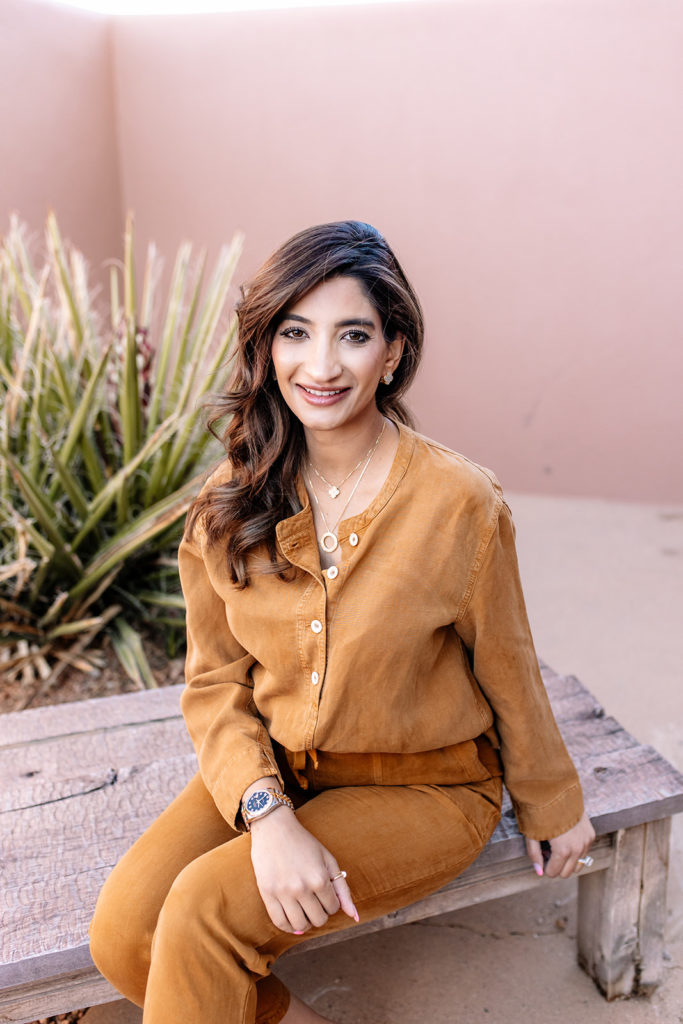
The first useful thing to know about Roohi Jeelani is that she likes the part where the answer is still missing. Research gave her permission to stay there. Medicine gave the uncertainty a deadline. Company-building has now given it a budget, a staff and a rather crowded calendar.
Her career has moved through rooms that tend to speak different dialects. In the laboratory, a claim needs evidence. In a clinic, an answer must also be timely and intelligible. In an executive meeting, every good intention eventually meets staffing, software and cost. Jeelani has spent enough time in all three to notice a pattern: the most consequential failures often happen in the corridor between them.
Onto Health is her attempt to redesign that corridor. In January 2026, the company named her Founder and Chief Executive Officer while announcing its Chicago expansion. In April, Onto closed a $20 million Series A backed by ARTIS and Humania. In July, it acquired LEVY Health, a clinical decision-support business whose intake and diagnostic infrastructure is intended to help clinicians move earlier and with more precision. Three announcements in seven months. The pace is brisk; the thesis beneath it has been forming for years.
April 2026
lab · clinic · company
Colorado · Illinois
A very early cold call
Long before she had a title with the word “chief” in it, Jeelani was cold-calling fertility offices. She wanted exposure to reproductive endocrinology and was unwilling to wait for a formal invitation. At the Reproductive Genetics Institute, she persuaded experienced figures including Yury Verlinsky to let her shadow the work. This was career design by telephone: find the room, call the room, ask to enter.
She carried that focus into Ross University School of Medicine, where she graduated in 2010. During medical school breaks she analyzed data, wrote abstracts and helped prepare presentations for international meetings. She also modeled for the title of Miss India while helping pay her way through the program, an improbable extracurricular that suggests she has never been especially interested in looking like the standard version of a medical trainee.
At Wayne State University and Detroit Medical Center, she completed an obstetrics and gynecology residency followed by a fellowship in reproductive endocrinology and infertility. She worked with physician-scientist Michael Diamond and became an NIH Women's Reproductive Health Research Scholar with K12 support. The through-line was translational research: knowledge that could survive the walk from a paper to a practice.
“Fertility is a young field. You have the opportunity to do research that can change.”Roohi Jeelani, in a 2021 alumni interview
Jeelani has published across medical imaging, toxicology, medical education and clinical questions. She also co-authored a paper proposing patient advocacy as one response to physician burnout. The idea has an elegant reversal inside it: speaking beyond the clinic can restore some of the purpose that paperwork drains from work inside it. Advocacy is often described as one more obligation. Her paper treated it as a possible source of professional meaning.
Jeelani's compounding loop
The clinic as field research
After training, Jeelani left the academic track and joined Vios Fertility Institute in Chicago. The move was a calculation about reach. A clinical organization would let her see more patients, test how communication worked in daily practice and participate in faster operational change. When Vios combined with Kindbody in 2021, Jeelani was named Chief Clinical Research Officer in the expanded leadership group. She later held a senior medical role spanning growth and business development.
This period made the invisible architecture of a clinic hard to ignore. A patient may remember a conversation with a physician. The experience is also shaped by everything around it: the intake form, a delay, a surprise bill, a pharmacy question, the interval before someone answers. No single glitch looks like a grand strategic problem. Together they become the product.
Jeelani's answer has been unusually operational for someone whose résumé begins with medicine. Reduce the intervals. Make costs more legible. Create appointment types that allow conversations when they are most useful. Use software to remove clerical friction, not to put a shiny screen between two people. The point of the backend is that a patient should feel less of it.
A tolerance for uncertainty, respect for evidence and the habit of turning assumptions into testable questions.
A calendar, an owner and a workflow. An insight only becomes care when somebody can deliver it repeatedly.
Her public education work became another window into the system. Across social platforms, Jeelani built an audience reported at more than a million people. She talks about complicated medical subjects in plain language and has joined podcasts, interviews and online discussions. Yet her most revealing comment about the audience is almost anti-influencer: the number matters less than “the quality of the relationship.”
That is a useful founder's metric. Reach can be rented. Trust has to be accumulated, explanation by explanation. A recurring question in a comment section is not merely content fodder; it is a clue about what formal care has failed to make clear. Public education, viewed this way, doubles as product discovery.
From thesis to infrastructure
Onto Health began with ARTIS Ventures and launched first in Denver. Under Jeelani, it opened in Chicago and laid out a broader ambition: a physician-led specialty-care platform that combines evidence-based medicine, individualized planning, clinical automation and a longer view of the patient relationship. The phrase “patient-centered” has been polished smooth by corporate use. Onto's test is whether that phrase can become a set of observable operating choices.
The Series A supplied fuel for clinical expansion in the United States and into the Gulf Cooperation Council region. The LEVY Health acquisition supplied a different asset: decision-support infrastructure. LEVY's tools are designed to streamline intake and help identify relevant diagnostic paths sooner. In less careful hands, automation becomes a way to hurry people through. Jeelani's stated model treats it as a way to give clinicians more attention for the decisions that require judgment.
“It doesn't matter how many followers you have. It's the quality of the relationship.”Roohi Jeelani, on building a medical audience
The acquisition also reveals a founder willing to buy a missing capability rather than romanticize building every component from scratch. The mythology of startups favors invention in a garage. Healthcare tends to reward the less cinematic work of integration. A tool must fit the clinical pathway, communicate with the people around it and behave reliably on an ordinary Tuesday.
Jeelani has assembled a network around that work. ARTIS partner Omair Khan has backed the company and described her role in shaping it from inception. Operators Daniela Gonzalez and Staci Gorson sit on Onto's leadership team. Her research and advocacy have connected her with physicians including Michael Diamond and Serena Chen. In public conversations, she is generous about collaborators. The company may carry a founder's thesis, but clinics are emphatically team sports.
The useful kind of ambition
Ask Jeelani for advice and the answer arrives without decoration: start early, make a plan, be bold, keep emailing. “What is the worst that could happen?” she once told medical students. It is the sort of sentence that sounds obvious until the moment one must actually send the message.
Her own career makes the advice credible. The cold calls became shadowing. The shadowing became research. Research informed clinical practice. Clinical practice exposed operational gaps. Public education showed how widespread the confusion was. Onto Health is not a sudden pivot away from medicine. It is those experiences compressed into a company.
The next challenge will be less photogenic than a funding announcement. Expansion tests whether a culture can travel, whether a workflow can bend without breaking, and whether technology makes service feel more human at larger scale. The Gulf region will add new regulatory and cultural contexts. More U.S. clinics will add hiring and quality-control demands. Every new location introduces another corridor where information can get lost.
This is also where Jeelani's mixed training becomes most useful. A scientist expects a result to be revised. A clinician knows the individual case resists the average. An operator understands that consistency is built from a thousand small decisions. A creator knows that nobody trusts what they cannot understand.
Onto's story is still early. Its capital, acquisition and geographic plans are evidence of intent, not proof of the finished model. But Jeelani has chosen a productive measure for the work: look closely at where a person waits, wonders or repeats herself, then redesign that moment. Grand visions often arrive dressed as simple fixes. The trick is making each fix hold when the doors open Monday morning.
There is something bracingly unfashionable about that standard. It does not reward a clever demo or a perfectly burnished slogan. It rewards the appointment that starts with the right information, the question answered before it becomes a problem and the clinician who has enough time to listen. Those are small scenes, difficult to photograph and even harder to scale. They are also where a care company earns its name. Jeelani's bet is that rigor and warmth can share the same workflow. If Onto succeeds, its most important innovation may feel less like technology than the welcome absence of needless difficulty.