The missing information was in a mother’s notebooks. Nell Meosky Luo’s younger brother had common variable immune deficiency, and their mother had spent years observing his health. She knew things that a brief appointment could scarcely contain. Luo, studying public health, was looking for better information about how treatments worked for different people. Eventually, she recognized that part of it was sitting at home.
- Folia makes symptoms, treatments and flare-ups easier to record and discuss.
- The app is free; research partnerships fund the business.
- Eligible contributors can receive payments for sharing observations.
01 / The data was already there
That recognition explains Folia Health better than any market-size slide. The family was already doing the work. The trouble was getting its knowledge into a form someone else could use. A notebook is excellent at remembering Tuesday. It is less obliging when a researcher wants to compare six months of Tuesdays across people with very different symptoms.
Luo advertised for a technical co-founder who understood chronic-condition management firsthand. Daniel Toffling, a software professional and father of a child with Down syndrome, answered. Folia was incorporated in March 2016. Its starting premise was that patients and caregivers possess expertise that medicine needs to capture more carefully.

02 / Ninety seconds, then a better question
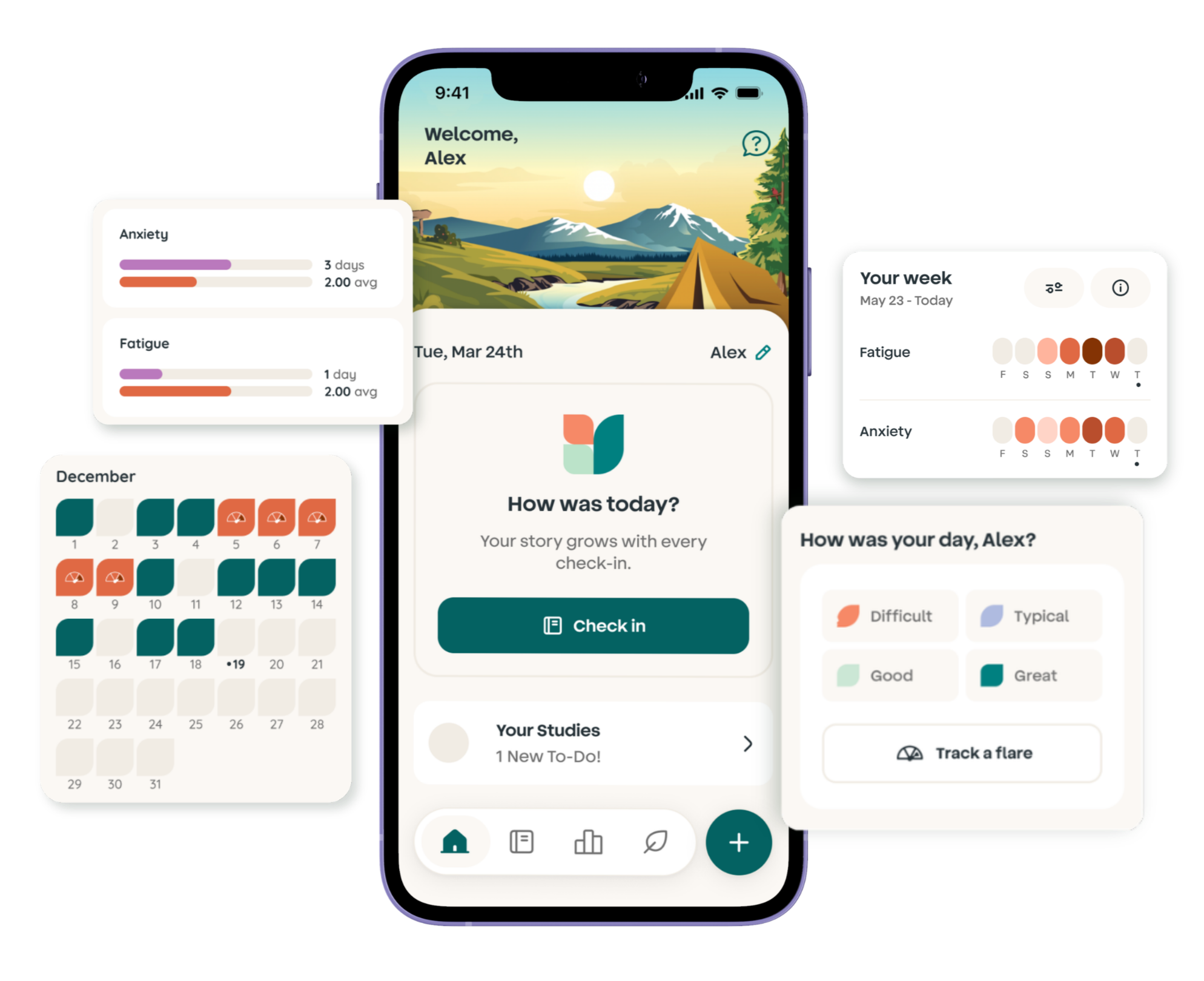
Folia gives that knowledge a structure. In its free app, people record symptoms and treatments using questions they can customize: yes or no, a scale, a count, tags. The company aims for tracking in 90 seconds or less. The task is deliberately modest. Someone managing fatigue should not need a second reserve of energy to document the first.
The resulting observations are called home-reported outcomes, or HROs. Folia says it coined the term in 2018. Individual questions can stand independently, rather than arriving only as a fixed survey. That flexibility lets a person record something meaningful to them even when it was absent from an investigator’s original list.
After recording comes interpretation. The app offers graphs, calendar filters and reports that can be shared with a care team. Symptoms can be viewed alongside treatment use. Instead of arriving at an appointment with a heroic act of recollection, a patient can bring a record. Folia’s provider tools are also free, according to the company.
The competitive starting point is refreshingly ordinary: notebooks, spreadsheets and journaling apps. Conventional electronic patient-reported outcome tools provide another approach, particularly for standardized research. Folia sells a combination of personal usefulness and research services, and explicitly offers validated ePRO measures alongside HROs. Its argument concerns what additional observations can reveal.
03 / The free app has a paying customer
The patient uses the tool; research partners fund the business. Folia offers life sciences companies protocol design, recruitment, electronic consent, hosting, analysis and help with scientific publications. It can link home observations with medical records, claims, wearables or registries. This is a research operation with software attached, requiring considerably more work than collecting an app download.
In September 2019, Folia introduced Data Dividends. Before launch, Luo describes a two-month validation effort involving members, disease-community voices and ethicists. The team examined existing tracking patterns and designed rewards around them. Its intention was to recognize useful contributions without making good trackers change their habits to qualify.
“Their knowledge is incredibly valuable.”Nell Meosky Luo, writing about Data Dividends in 2019
The published general-program terms are specific: eligible U.S. patients and caregivers must participate in general research sharing and track at least weekly. They can earn up to $48 annually, paid quarterly. Active participants in condition-specific Folia studies are excluded from that general program. Individual studies have their own payments; a PNH recruitment page, for example, advertises up to $190 in gift cards.
Research partnerships fund the service. Eligible contributors receive payments under program terms.
04 / Rare diseases are awkward averages
Two people with the same diagnosis may experience quite different burdens. Folia’s pitch is to preserve those differences over time. In March 2025, it announced an IgA nephropathy study with Novartis: an initial six-month observational period, patient-selected symptoms and reports participants could export. The study was entirely remote.
Inspire became a partner the following month. The collaboration proposed combining Folia’s longitudinal observations with Inspire’s community reach and linked data sources. The attraction is complementary information: what happened in the health system alongside what a person experienced at home.
On October 1, 2025, Folia announced a $10.5 million Series A led by S3 Ventures, with Crosslink Capital and Create Health Ventures. Its announcement also described Mosaic, a community initiative through which participants could ask questions answered using aggregated data from people with similar conditions. Eczema and PNH were its initial active groups.
S3 Ventures · Crosslink Capital · Create Health Ventures
The studies kept expanding in 2026. An argenx collaboration focused on CIDP. Soleno Therapeutics sponsored BRAVE-PWS, which follows caregivers of people with Prader-Willi syndrome and measures their well-being and household experience. In August, Folia launched FSGS PULSE for a rare kidney condition. Each puts daily life closer to the research question.
05 / Borrow the habit, understand the bargain
A reader can copy the simplest practice immediately: choose observations that matter, record them consistently and bring the pattern to an appointment. The business lesson is equally concrete. Give contributors something useful before asking them to supply a dataset. Then test the incentive against how they already behave.
The method still depends on context. A graph showing symptoms alongside a treatment does not establish that the treatment caused a change. Personally chosen questions may capture overlooked burdens, while standardized measures make different comparisons possible. Folia’s offering includes both. The useful question is which evidence a particular decision requires.
Research sharing is optional, Folia says, and its privacy policy provides for consent through sharing settings and opting out. Payment requires participation and eligibility. Those choices deserve attention. The company’s founding insight remains appealingly practical: an observation does not become more valuable merely because it was made under fluorescent lights. Sometimes the person at home has the detail everyone else needs.