Ronald Dixon’s alternative career is easy to picture in one respect: it would have involved music. Asked what he might have done with a fresh start, the CareHive founder said he would have studied it. He plays piano and trumpet. Two instruments, one chief executive’s job, and a useful reminder that a person’s chosen profession does not occupy every room in his life.
There is another revealing detail in Dixon’s account of himself. As a child, he became frustrated when things failed to turn out as he wanted. His Jamaican mother responded with familiar advice about trying again. The saying survived childhood. Years later, he was still returning to it when discussing entrepreneurship.
That gives this founder’s story a different starting point from the usual company announcement. There is a boy who wants something to work, an adult telling him to persist, and a lesson whose usefulness outlasts the original disappointment. The details of those childhood attempts belong to Dixon. The habit he describes is recognizable enough to need no embellishment.
A second try, learned early
Persistence is a comfortable word once an outcome is known. Before that, it asks for another investment of time without supplying a receipt. A founder can explain an earlier attempt with the benefit of hindsight; doing the work at the time is considerably less tidy.
Dixon’s professional history has room for that untidiness. Before CareHive, he founded Healthcare 360 and worked at Onduo, a venture associated with Verily. His career crossed established institutions and younger companies. A list of employers makes those transitions look orderly. Each name occupies roughly the same amount of space, regardless of how much work happened underneath it.
The chronology of CareHive adds a small corrective. Dixon partnered with Jeremy Gabrysch, the founder of predecessor company Remedy, in 2020. CareHive emerged in 2021. The new name belonged to a business with earlier work behind it, including Dixon’s own platform. A launch date marks a public beginning; it does not necessarily mark the first useful thought.
- BuildHealthcare 360
- Work togetherOnduo colleagues
- Bring it forwardCareHive, 2021
Selected chapters in Dixon’s professional story. The sequence shows continuity, not a scale of company size.
Montreal, then a longer map
Dixon was born and raised in Montreal. His education includes McGill University, graduate work at the University at Buffalo, and Dartmouth. He later served on the Harvard faculty. These are distinct institutional settings, spread across a route that begins in Canada and continues into the northeastern United States.
The geography helps separate the person from the company. Dixon’s public professional profile lists Needham, Massachusetts. Remedy’s history, meanwhile, runs through Austin. A founder’s location, an organization’s origins, and the places where colleagues first met can all be different. A biography becomes clearer when those pins stay in their proper places.
His education also preceded the current company by years. That long interval matters. Startup introductions tend to hurry toward the present, as if everything before the latest venture were a collection of prerequisites. Dixon’s earlier institutional work had its own responsibilities, collaborators, and audiences.
At Massachusetts General Hospital, he held leadership and project roles; at Harvard, he taught. Later came Onduo and CareHive. The settings changed, along with the kind of organization around him. The useful question in a career like this is what carries forward: experience, certainly, and sometimes the people who helped acquire it.
The company comes with colleagues
CareHive’s founding account names Daniel Moloney and Michael Erickson among the people whose paths crossed with Dixon’s at Onduo. Moloney brought a background in analytics. Erickson brought engineering and software experience. These were professional relationships with some history already attached.
That is a more interesting detail than the familiar picture of a founder standing alone beside an idea. Software companies require people who can understand different parts of the same problem. A shared workplace gives future colleagues an opportunity to see one another working before the next venture begins.
It does not remove the difficulty of starting again. Familiarity cannot write the software, set the budget, or make the next decision. But it changes the starting conversation. The participants have more to draw on than a résumé and an agreeable first meeting.
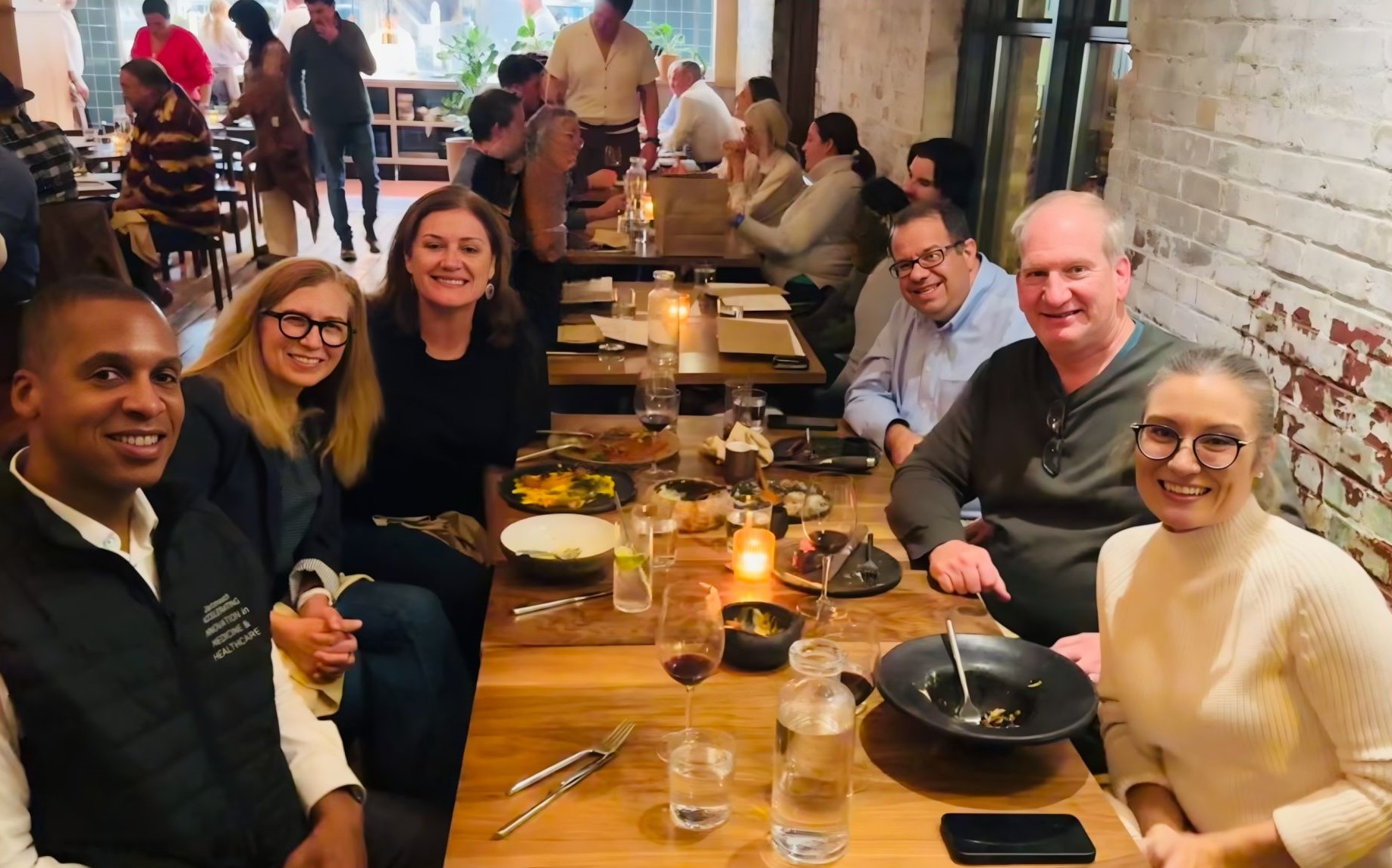
In a photograph of CareHive’s leadership, Dixon sits at the left of a restaurant table. Colleagues face the camera across plates, glasses, and the remains of a meal. The scene needs no invented dialogue. Its appeal is its ordinariness. A company’s leadership can also look like people making room for one another over dinner.
There is a temptation to turn every such photograph into evidence of a company’s culture. A picture cannot carry that burden. It can, however, widen the frame around an executive. Here are other people in the story, sharing the table rather than appearing as names below an organizational chart.
A place in Boston beyond the office
Boston appears repeatedly in Dixon’s biography, including in his volunteer work. His public profile records service with the Boston Symphony Orchestra’s Board of Overseers beginning in 2009 and with the Boys & Girls Clubs beginning in 2014. Those dates belong to a separate timeline from the founding of CareHive.
The distinction is useful. Volunteer involvement gives a person responsibilities that a company title does not describe. An orchestra and a youth organization have their own reasons to exist, their own audiences, and their own institutional memories. Their place in a biography should be allowed to stand without being converted into a networking strategy.
The Boys & Girls Clubs of Boston’s 2020 annual report also lists Ronald Dixon among its leadership names. It supplies a dated point in the record of his involvement. Alongside the symphony connection, it puts local organizations into a career otherwise easy to tell through employers and ventures.
A city becomes part of someone’s life through more than an address. Institutions receive time, attention, and service. Dixon’s Boston ties offer that wider view: a professional career running alongside commitments to organizations whose work continues beyond any one executive’s tenure.
Two instruments, no business case required
Piano and trumpet are an appealing pair to find in a founder’s biography. One gives a player an entire keyboard; the other has a way of ensuring that nobody mistakes practice for silence. Dixon’s interest in both makes the musical alternative he once described feel less like a throwaway answer.
It is tempting to make music explain everything else. The piano could become a metaphor for strategy; the trumpet could be drafted into a lesson about leadership. A biography need not work that hard. Playing an instrument is already an interesting use of a person’s time.
The same restraint makes room for pleasure. Executives are often introduced through utility: what they built, what they manage, which organization employs them. An instrument has another kind of claim on attention. A passage can be worth returning to because someone wants to hear it played properly.
“Listening is better than speaking.”
Ronald Dixon, on entrepreneurial advice
Dixon’s advice about listening fits comfortably beside this musical detail, though the connection is an editorial observation rather than an account of how he works at the keyboard. Listening has value in either setting. It also happens to be a useful interruption to the assumption that a chief executive must always have the next word.
Books add another small window into his interests. At the time of one interview, Dixon named four he was reading: Adam Grant’s Think Again, Colson Whitehead’s The Nickel Boys, Alejandro Cremades’s The Art of Startup Fundraising, and The Autobiography of Malcolm X. The list moves between an argument about reconsidering assumptions, fiction, a practical business subject, and a life story. It is a reading snapshot rather than a permanent syllabus. Still, there is pleasure in the range. An executive’s bedside pile is allowed to contain a novel; every book need not arrive carrying a proposed improvement to the quarterly plan.
The work after the announcement
In August 2025, Dixon discussed privacy and security while CareHive’s compliance partner marked the company’s HITRUST i1 certification. His remarks treated those responsibilities as an operating standard. The recognition provided an occasion to talk about the work behind it.
Certification is one of the less glamorous subjects in a founder’s career. It involves standards, processes, and the ability to show that requirements have been met. It seldom supplies the most entertaining sentence in a company introduction. It does give an executive something concrete to answer for.
By July 2026, company announcements continued to identify Dixon as CareHive’s founder and CEO. The present title sits at the end of a longer record: Montreal, several universities, institutional leadership, an earlier venture, colleagues who crossed paths again, and commitments outside the office.
That record leaves room for both continuity and a second attempt. Dixon’s mother’s advice has lasted; so has his interest in music. The company occupies the professional foreground. Elsewhere in the portrait, there is still a piano, a trumpet, and a reason to return to something that has not quite come out right.