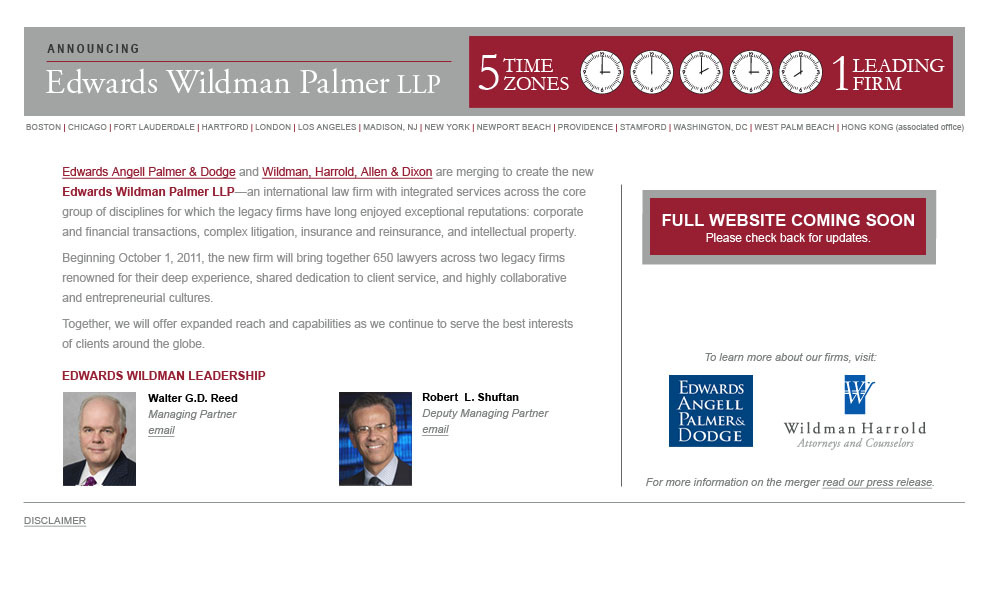
The launch page had five clocks. Each showed a different time zone. Beside them sat the promise: one firm. In October 2011, Edwards Wildman Palmer arrived with 650 lawyers and an appealing proposition for businesses whose problems refused to stay in one city. Three years later, the partnership was preparing to join another firm. The clocks make a useful place to begin. They measured reach. They could tell you very little about whether the combination would pay.
- The offer: transactions, disputes, insurance and intellectual property under one roof.
- The squeeze: falling revenue, departures and a costly gap between forecasts and results.
- The outcome: a January 2015 combination with Locke Lord, carrying practices into a larger partnership.
Five clocks. One firm.
Edwards Wildman was assembled from Edwards Angell Palmer & Dodge and Chicago’s Wildman, Harrold, Allen & Dixon. Both brought histories longer than the new name. Edwards & Angell, one branch of the family tree, began in Providence in 1894. The combined business belonged to a recognizable part of the legal market: a large commercial partnership selling access to several kinds of expertise.
At launch, managing partner Walter G.D. Reed described clients seeking a full range of legal services
across different geographies. The formation announcement identified four central disciplines: corporate and financial transactions, complex litigation, insurance and reinsurance, and intellectual property. Fortune 500 companies, governments, nonprofits and private businesses were the intended customers.
The paperwork behind the promise
The services become clearer when attached to a client’s problem. Thomson Reuters and Stanley Black & Decker wanted captive insurers in Connecticut. Edwards Wildman represented them in establishing the state’s first two. A captive is an insurance company created to cover risks associated with its owner. Setting one up requires more than incorporating a business; it puts corporate structure and insurance regulation in the same conversation.
That work captures the firm’s practical appeal. An acquisition can involve financing, intellectual property, employment questions and regulatory approvals. Buying those capabilities together can reduce the client’s coordination burden. The firm competed for such assignments with other commercial law partnerships and, for narrower jobs, specialist boutiques. Its combination of insurance knowledge, private equity work and transaction counsel gave the broad offering a particular shape.
Its positioning also had a visual expression. Branding agency Slack and Company described the idea as “business minded”. Red and gray lettering and angular graphics accompanied a pitch built around commercial problems. It was a distinctive presentation of professional advice; the underlying business still depended on lawyers winning and completing paid work.
A different clock for startups
Young companies have a timing problem. They need advice about ownership, contracts and intellectual property before they necessarily have much money. Edwards Wildman’s Helping Innovators Thrive program addressed that mismatch. A guide published by the World Intellectual Property Organization described a $2 million annual commitment delivered through discounts, deferrals and grants of legal services.
A discount lowers a bill. A deferral changes when it becomes payable. A grant supplies services. Treating the whole commitment as cash investment would misunderstand the offer. The program gave qualifying entrepreneurs a way to obtain advice while conserving scarce early resources. For the partnership, it also created a way to begin relationships with companies before they became established legal buyers.
The first warning was in the numbers
The early public warning signs concerned profitability. In April 2013, responding to questions about the firm, a spokesperson said profits per partner had fallen six percent between 2011 and 2012 while revenue per lawyer was flat. The firm disputed suggestions of a broad exodus and described its profitability decline as modest. By spring 2014, reporting documented 52 lawyer and staff layoffs.
The final independent year exposed a sharper problem. Bloomberg Law reported, citing internal documents, that an initial 2014 revenue forecast of $298 million was reduced to $274 million. Actual revenue finished at $257 million. Partners had drawn compensation beyond what the results supported, prompting repayment requirements or an arrangement tied to staying with the combined firm through 2016.
The interpretation is straightforward: when a partnership distributes money against expected earnings, an optimistic budget can become a personal financial problem. Expansion alone supplies no protection against that arithmetic.
Why the next merger made sense
The practice strategy had kept expanding. In September 2013, Edwards Wildman opened in Istanbul, working with Turkish M&A boutique Ismen Gunalcin to pursue cross-border corporate and private equity transactions. This was geographic growth with a stated transaction focus. It also illustrates the operational demands behind each additional point on an international map.
In September 2014, the firm and Locke Lord announced their intention to combine. The case emphasized complementary practices and broader coverage. Edwards Wildman’s private equity base offered a connection to Locke Lord’s energy clients. Contemporary reporting also recorded concerns among some Locke Lord partners about culture, billing rates and compensation differences. Agreement required addressing those differences, alongside the strategic pitch.
A larger map can help a client. The partnership still has to make the work pay.
The combination took effect on January 10, 2015, creating Locke Lord Edwards with more than 1,000 lawyers across 23 cities. That was the announced combined footprint, not Edwards Wildman’s independent headcount. Its separate life ended through consolidation. The disappearance of a name does not tell you that all its practices or client relationships disappeared.
Read the work, then the map
For anyone running a professional-service business, the copyable idea is to connect adjacent expertise around a real client need. Captive insurance work makes the case concrete. Flexible startup billing offers another useful mechanism. Both depend on conditions: clients must value the connection, and the economics must support the service. A small, self-contained matter may give a buyer little reason to purchase an international platform.
Today, the successor lineage leads to Troutman Pepper Locke, formed in January 2025 when Locke Lord combined with Troutman Pepper. Edwards Wildman’s short history leaves a useful question for the next merger presentation: after the clocks are synchronized, who makes sure the budget works?