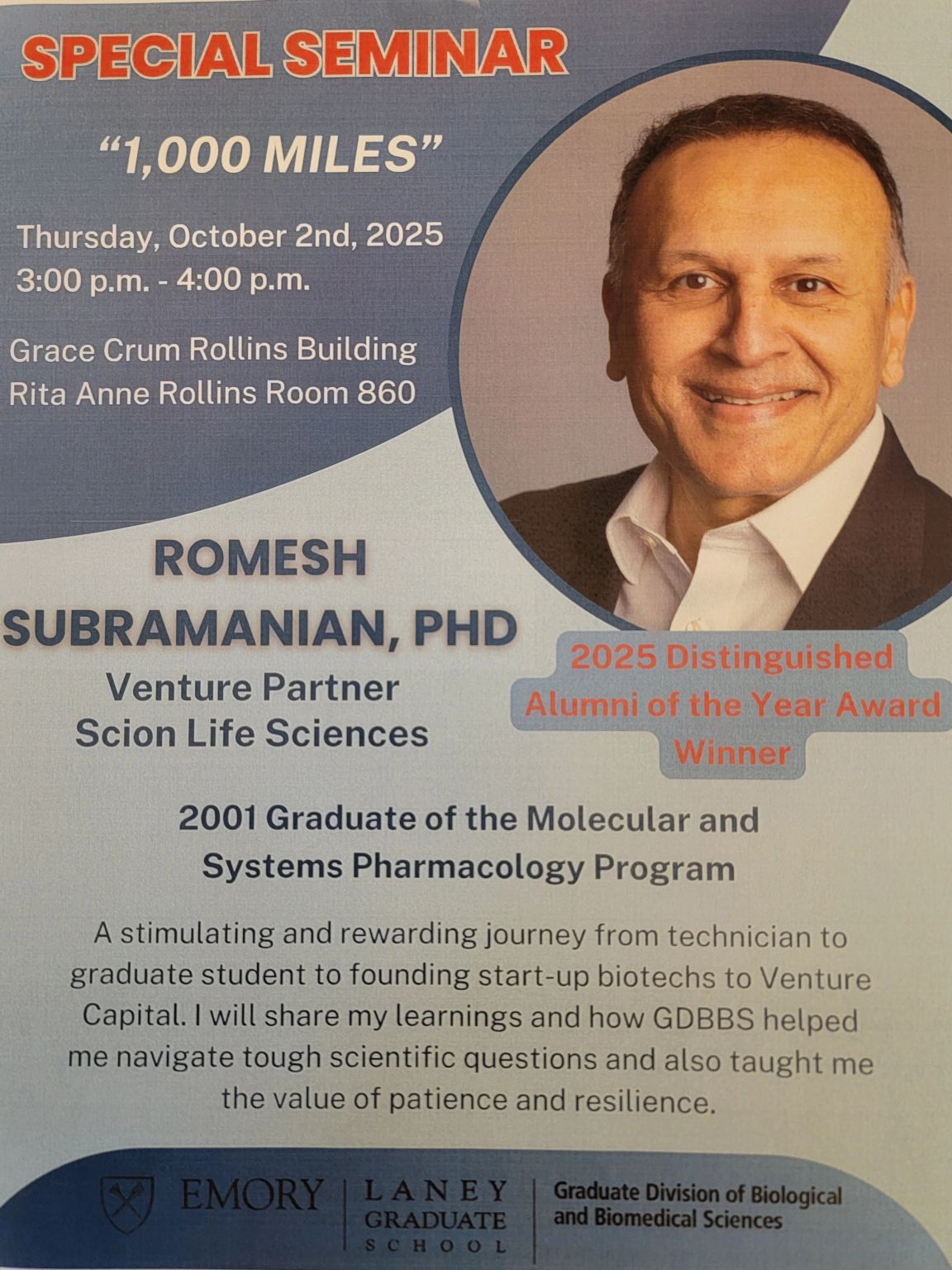
The invitation called it “1,000 Miles.” Beneath that title, Romesh Subramanian’s return to Emory was described as a journey from technician to graduate student, from founding biotechnology companies to venture capital. A career that could have been presented as a succession of imposing titles had acquired a rather more useful unit of measurement: distance travelled.
The seminar was scheduled for October 2, 2025, at the university where he completed his doctorate in 2001. He was returning as that year’s Distinguished Alumni Award recipient from Emory’s Graduate Division of Biological and Biomedical Sciences. The announcement promised lessons about difficult scientific questions, patience and resilience. Even on an award occasion, there was work to discuss.
By then, Subramanian was a venture partner at Scion Life Sciences. Behind him were research roles at Pfizer and Alexion, the co-founding of RaNA Therapeutics, the founding CEO’s job at Dyne Therapeutics and a turn leading Ascidian Therapeutics. The itinerary looks busy. Its recurring activity is surprisingly consistent: join people around an idea, give it an organisation, then begin again.
The return ticket to Emory
There is a useful distinction between an impressive career and a remembered colleague. When Haian Fu celebrated Subramanian’s alumni award, another former laboratory colleague, Erinn Hoag Goldman, recalled his conduct among people who knew him before the executive titles. She described leadership accompanied by “humility, hard work, kindness and grace.” A laboratory has plenty of opportunities to test all four.
Subramanian’s reply returned the compliment to Emory’s faculty and students. He praised the science and enthusiasm he had encountered on the visit. In a separate exchange with Goldman, he credited the students in Fu’s laboratory as colleagues who had made the experience rewarding. The emphasis is small but telling: people appear in his account of progress alongside institutions.
His academic route included a bachelor’s degree from Loyola College and a master’s degree from Duke University before Emory. Those three names now occupy a short line in executive biographies. The seminar’s technician-to-founder description supplies a less compressed view. It makes room for the earlier work, before a doctorate or a company could serve as an introduction.
An alumni award invites a person to look backwards. His response ended with “Onward and Upward.” The phrase suits the record, though the record also contains sideways moves, returns to research leadership and fresh starts. Career ladders are convenient illustrations. This particular career needs a few more arrows.
A scientist before the stationery
In April 2000, Subramanian appeared alongside Fu and Shane C. Masters as a co-author of a review on 14-3-3 proteins. Its subject was the structure, function and regulation of a family of proteins involved in cellular signalling. Long before the venture-partner biography, there was a shared byline and a detailed scientific argument.
The publication supplies an early point of connection with Fu, who would later present the Emory award. It also puts the research training in view. Discussing a scientist’s subsequent companies can make the underlying scientific work disappear beneath financing rounds and appointments. Here, the paper and the later reunion sit twenty-five years apart, joined by a continuing professional relationship.
Subramanian went on to hold positions at Thrasos Therapeutics and Pfizer. By 2011, he was co-founding RaNA Therapeutics, where he served as a senior director through 2014. The move introduced a responsibility that would recur: helping create the organisation as well as contributing to its research. A new company requires both a proposition and people prepared to work on it.
RaNA later became Translate Bio. Sanofi completed its acquisition of Translate Bio in September 2021. By that stage, Subramanian had moved through other roles. The long interval between co-founding and acquisition is part of the story: companies keep evolving after an individual founder’s day-to-day chapter has ended. The original name on the door may go, too.
Bachelor’s → Master’s → Doctorate
Fifty million dollars, ten colleagues
From 2014 to October 2017, Subramanian led new-modality discovery research at Alexion as a senior director. He then became an entrepreneur-in-residence at Atlas Venture. Moving from a research organisation to venture incubation brought him back to the work of forming a business. Dyne was the next company to emerge from that period.
Its public launch came on April 3, 2019, with a $50 million Series A financing. Atlas had founded, seeded and incubated the company; Forbion and MPM Capital joined the round. Subramanian was president and CEO. The announcement assembled the usual cast of a new venture: a scientific idea, a leadership team and investors willing to finance the next stretch.
At launch, Dyne had ten staff members. That figure gives the financing a human scale. Fifty million dollars makes a substantial headline; ten colleagues make a small organisation. The company said it intended to strengthen its capabilities through hiring and investment in its platform. Much of what the money was meant to buy was the capacity to do more work.
The early group included Catherine Stehman-Breen, Bruce Wentworth, Mohammed Qatanani and Jonathan McNeill. Jason Rhodes was executive chairman. Their backgrounds crossed established companies and younger ventures. Subramanian’s position placed him among a collection of experienced people with different responsibilities. Founding is a crowded verb, however solitary the portrait accompanying it may look.
The details matter because a launch photograph can suggest a finished institution. Dyne was still a small team with a large task ahead. Its investors, executives and advisers were participating in the construction of that institution. Subramanian had moved from helping found RaNA to holding the chief executive’s responsibility at another beginning.
April 2019
at launch
The founder changes chairs
In October 2019, Dyne appointed Joshua Brumm president and CEO. Subramanian became chief scientific officer, a position he had also held before becoming chief executive. The sequence is unusually revealing: scientific leader, CEO, then scientific leader again. A title changed while his involvement in the company continued.
Brumm brought experience in finance and operations. The appointment placed a different executive background at the head of the organisation as it prepared for its next phase. Subramanian’s own work returned to scientific leadership. The corporate announcement recorded a redistribution of responsibilities inside the business he had helped create.
The sequence gives this period its particular shape. Subramanian helped lead Dyne through its early formation, occupied the CEO’s chair at its public launch and then continued with responsibility for science. Across those assignments, the company remained the same enterprise while his part in it changed. For anyone following his career, the dates offer a useful reminder to pay attention to the job as well as the title.
In June 2021, he stepped down as chief scientific officer and moved into an advisory role. Oxana Beskrovnaya succeeded him. He spoke warmly about the team in place and expressed support for the company’s continued progress. His executive chapter at Dyne had ended; the next appointment would take him into another organisation.
- APR 2018Chief scientific officer
- NOV 2018President & CEO
- OCT 2019Chief scientific officer
- JUN 2021Advisory transition
Another beginning, another cast
In March 2022, Ceptur Therapeutics appointed him to its board. The announcement pointed to his experience founding companies and leading research. A board appointment draws on accumulated judgement, and this one followed several years in which he had worked on both the scientific and organisational sides of a young business.
Later in 2022, he became president and CEO of Ascidian Therapeutics. Apple Tree Partners had incubated the company and provided its $50 million Series A funding. Michael Ehlers, the founding CEO during incubation, became board chair. Another company was moving between stages, with responsibilities being rearranged as it came into public view.
The repetition is part of what makes Subramanian’s career distinctive. He has joined established research businesses, helped found new ones, led a company, returned to scientific leadership and taken board responsibilities. The roles overlap in knowledge but differ in daily demands. His record contains repeated encounters with the question of what an organisation needs next.
Radar Therapeutics also lists him on its board of directors. Alongside executive work, these appointments extend his involvement to other founding teams. They put him in contact with businesses whose day-to-day leadership belongs to other people, a different vantage point from the CEO’s desk.
“Humility, hard work, kindness and grace.”
Erinn Hoag Goldman, recalling their laboratory days
Back to the beginning business
Scion announced his appointment on April 17, 2025, together with fellow venture partners Lalo Flores and Huw Nash. The three were joining to help build the firm’s first wave of internally incubated companies. The assignment made company formation an explicit part of the job, rather than an incidental benefit of an experienced investor’s address book.
Scion described its venture partners as people who often take founding management roles. It said more than $140 million had been committed by the firm and its syndicate partners to that first group of companies. The figure belonged to the group collectively. Subramanian was arriving inside a broader effort to turn early ideas into operating businesses.
His own response singled out the chance to “work with Aaron on another company build,” referring to Scion co-founder Aaron Kantoff. The word “another” does quiet service. It places an existing working relationship inside a new appointment and gives the forward-looking announcement a little history.
That brings the career back to the Emory seminar. “1,000 Miles” left room for the technician, the student, the scientist, the founder and the venture partner in one account. Patience and resilience were the lessons he chose to advertise. After years of appointments and transitions, he still had a new company to help build and students to talk with. The next beginning already had company.