Graham Gardner had a plan for the iPad. His company’s software would run on the new device, someone would find the person they wanted, and then they would call that person directly. He explained this vision in several demonstrations for prospective customers. There was a small difficulty with the presentation: he had overlooked that an iPad wasn’t a phone.
It is a useful opening scene for a technology founder. The equipment was new. The ambition was considerable. The person selling the future had a question or two still to ask about the hardware. Gardner later told his employees the story to make asking for help easier. His own ignorance had earned a permanent place in the company’s teaching materials.
There is something disarming about a chief executive volunteering his least impressive demonstration. It lets the rest of the room breathe. Gardner’s career has involved an unusual combination of credentials, capital and a willingness to be the beginner again. The iPad episode gives that last quality a practical, slightly expensive-looking illustration.
A family habit of starting again
Gardner grew up with Scottish immigrant parents and a father whose work at Merck brought business into the family conversation. He had wanted to become a physician for as long as he could remember. Then his father started a company late in his own career. Here was an example close enough to inspect: a professional life could contain another beginning.
That detail helps explain why Gardner’s eventual departure from practice was less abrupt than it might appear on a résumé. Entrepreneurship was already part of the family’s experience. A new company offered a way to work on unfamiliar ideas, and unfamiliar ideas appealed to him. His later description of himself as a “learning curve enthusiast” has the ring of a person admitting to a recurring habit.
He also developed a suspicion of universal business advice. Looking back in 2019, he questioned whether the lessons from starting Kyruus years earlier would necessarily help someone starting it that day. Circumstances change. Advice ages. A founder who treats every past success as a permanent instruction manual may eventually find himself operating the wrong machine.
History, biology, and the other side of the table
At Brown, Gardner studied history and biology, earning an undergraduate degree with honors. He also earned his medical degree with honors. He later completed his training in Boston and served as chief medical resident at Beth Israel Deaconess Medical Center. An MBA from Harvard Business School added another set of questions to the ones he already knew how to ask.
His move into investing brought him to Highland Capital Partners. Through the Kauffman Fellows program, he worked with mentor Bob Higgins. The sequence matters: before building Kyruus, Gardner spent time learning how companies were funded and assessed. He had experience on the side of the table where an interesting idea must become an investment decision.
He co-founded Generation Health and stayed through its acquisition by CVS Caremark. Kyruus followed in 2010. By then, starting a company involved both an appetite for novelty and some acquaintance with the machinery behind it: mentors, financing, management and the long passage from a proposal to a functioning organization.
- BrownHistory, biology, then an MD
- Harvard & HighlandBusiness school, investing, mentorship
- 2010Kyruus begins
- 2025-26Acquisition, advising, teaching
Two founders, different kinds of knowledge
Gardner and Julie Yoo met in graduate school while pursuing different fields. Yoo brought software engineering and experience with large collections of data. Gardner brought experience inside the organizations they wanted to serve. Their backgrounds gave them different things to notice and different ways to test an idea.
The division is worth remembering in a story about a founder who champions individual strengths. Kyruus itself was an exercise in combining them. Knowing an industry and knowing how to build software are separate forms of expertise. A company needs a way for the people holding each kind to understand one another.
By June 2018, the business they had co-founded was working with more than 400 hospitals and 30 large systems. Those figures belong to that stage of the company’s history. They also show how far the partnership had traveled from a graduate-school connection to an organization with customers who expected it to work.
The baseball idea that followed him into the office
Gardner repeatedly returned to Moneyball, the story of baseball executives using statistics to recognize abilities that conventional judgments missed. He saw an appealing principle in putting people in situations suited to their particular talents. The attraction was personal as well as commercial: he believed people had different gifts worth understanding.
He carried the idea into management. In 2017, he said he still personally introduced every new employee to Kyruus, even when he hadn’t participated closely in hiring them. These introductions included the company’s stories and purpose. The chief executive was making time to explain the organization to the people expected to build it.
He borrowed from apprenticeship, too, and spoke about “team-liness,” his term for balancing responsibility with cooperation. The word has the homemade quality of office language that has escaped a meeting room. Its underlying difficulty is familiar: people need to own their work while remaining willing to help with work that crosses the borders of a job description.
“We all must rely on each other’s skills to perform best as a team.”
Graham Gardner, 2017
Getting past the demonstration
Early Kyruus had completed three small pilots when a prospective enterprise customer interrupted its usual presentation. An executive asked the team to try a search outside the prepared demonstration. The result satisfied him enough to commit to a full rollout. Gardner remembered the meeting as a break that helped the company win further business.
That is the other side of the iPad story. A demonstration can expose what the founder has misunderstood. It can also give a customer enough evidence to take a larger chance. Either way, the unscripted moment has a habit of being more informative than the slides.
As the organization grew, Gardner found that the heroic individual efforts useful in its early years could interfere with dependable operations. Work now had to move between teams. Kyruus introduced a Moneyball award that recognized collaboration across functions. The baseball reference had become a way to reward behavior inside the company, with attention paid to how people helped one another deliver.
The patience behind the pitch
By 2019, Gardner had developed a less cinematic account of entrepreneurship. Survival occupied a prominent place in it. Large organizations moved slowly, new categories took time to earn budgets, and a young company needed enough support to keep going while potential buyers worked out their priorities.
He described a counterintuitive sales lesson: a larger commitment could sometimes produce a better implementation. A small pilot might be easy to approve yet attract too little attention to succeed. A substantial purchase could bring the relevant people together and give the project organizational weight. Getting through procurement was only one part of getting something used.
Gardner also recalled standing amid the vendors at a major industry conference and recognizing what a buyer’s inbox must feel like. Every booth had an urgent argument for being noticed. The experience helped him appreciate customers who had already chosen a few clear priorities. Their clarity gave both sides a better chance of doing useful work.
An easy approval can still leave a project without the attention it needs. Gardner’s experience made him look for commitment across an organization.
Sunday night, a note from the CEO
Company culture becomes easier to inspect when it appears on a calendar. In 2020, Gardner instituted a weekly Sunday-night email to stay connected with employees working remotely. Kyruus’s account of its workplace also described flexible schedules and blocks without meetings. Caring, ownership, respect and empowerment were used in hiring and onboarding.
Those are ordinary words, and their usefulness depends on what follows them. A recurring message from the CEO gives employees a predictable point of contact. A block without meetings gives them time. Both are more concrete than another adjective attached to a company’s culture.
Kyruus appeared among Inc.’s Best Workplaces honorees in 2021. The practices described alongside that recognition offer a glimpse of Gardner’s management at a particular moment: regular communication, an emphasis on families, and an attempt to make the working week less entirely available to everyone else’s invitations.
A founder learns to convene
By early 2025, Gardner was describing another part of the job: bringing people into the same room. Kyruus’s annual gathering had evolved into the E3 Executive Summit. He characterized the company as a “pollinator of ideas across multiple organizations.”
The image is a cheerful choice for an executive discussing institutional cooperation. It also describes work that a software demonstration cannot finish. People from separate organizations have to exchange information, discover shared priorities and decide whether they trust one another enough to act.
For Gardner, the gathering extended an interest visible throughout his management story. An individual’s contribution depends partly on the people around them. A founder can spend years developing a product and still need to arrange a conversation before it can do its work. The meeting invitation retains a surprisingly durable business model.
Fifteen years, then a different seat
On September 23, 2025, RevSpring announced an agreement to acquire Kyruus Health. The financial terms were undisclosed. The proposed combination brought together companies with complementary software businesses, giving Kyruus a new corporate home after fifteen years of building independently.
When Gardner subsequently announced that the transaction had closed, he said he would serve as a board advisor. Brandon Spring would become general manager of the legacy Kyruus business. The change separated the founder’s continuing involvement from the daily operating role he had held for much of his career.
His farewell included thanks to investors who had backed an initial ten-slide deck and stayed through missed projections and repeated mistakes. More than 1,000 people had worked on the company over its history, he wrote. That was a cumulative count of contributors, a long roster rather than a single company photograph.
He ended with his family. His wife, Sandhya, and their two sons belonged in the account because they had lived with the enterprise’s ups and downs. The founder’s story had required more participants than the capitalization table could hold.
Back where the questions are new
Gardner’s next chapter includes an executive partnership at Flare Capital Partners and an executive fellowship at Harvard Business School. He also holds board roles at Smart Health Network, Koda Health and the Schwartz Center. Advising, investing and teaching now give him several places to put his experience to work.
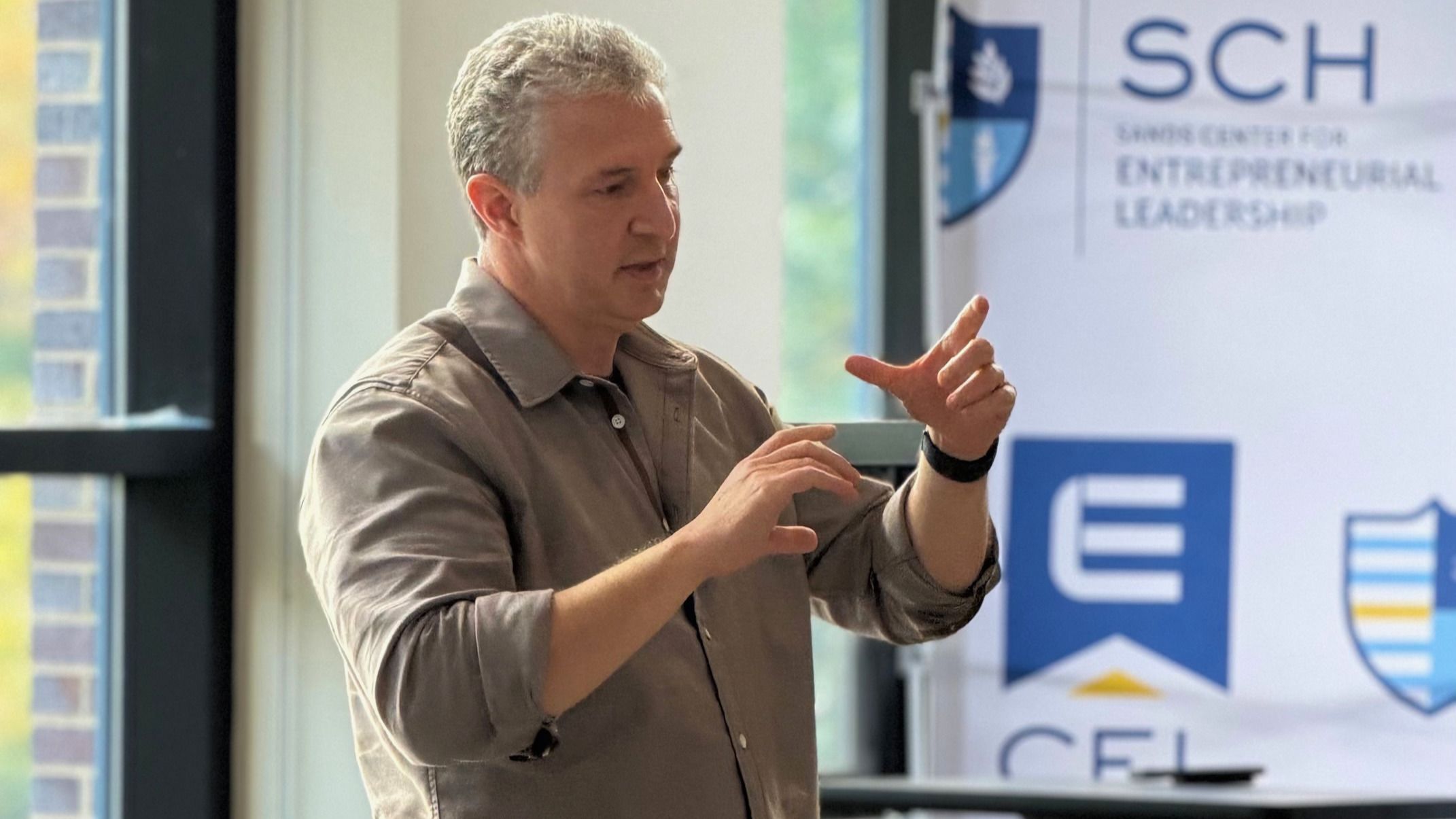
In October 2026, he returned to his former school to speak with students about entrepreneurship. Their questions concerned customers, prototypes and the decisions that alter a business. He described learning from feedback and changing direction, including the difficult work of closing existing activities to pursue a more promising focus.
“Do not be afraid of failing,” he told them. Coming from someone who had once tried to sell a phone call on an iPad, the advice had an accompanying exhibit. Gardner had spent years learning how to build a company around other people’s abilities. He could still contribute a useful mistake of his own.