Jean-Baptiste Rudelle thought he had an unusual idea. At Agoranov, the Paris incubator, he pitched his project as something nobody else was doing. Someone pointed out that two people on the other side of the door were working on much the same thing. One of them was Romain Niccoli. The other was Franck Le Ouay, his former flatmate and Microsoft colleague. A few weeks later, the projects came together. Criteo began with a useful correction to a founder’s sense of uniqueness: the competition was practically next door.
Niccoli would spend the next dozen years helping that company grow, including its arrival on Nasdaq in 2013. Then he would leave, help build a carpooling startup, and begin again with Pigment. His career offers an interesting answer to the question of what follows a successful company. In his case, another problem worth opening a laptop for.
Before the opening bell, Windows
Niccoli studied at École des Mines de Paris from 1997 to 2000, earning a master’s degree in computer science. He then went to Microsoft in the Seattle area, working on Windows. His time there ran from October 2000 to May 2005; he became a lead software design engineer. Before he had a startup to scale, he had worked inside a company where software already operated at enormous scale.
The return to Paris brought a change of proportions. At Criteo, he helped build the platform. The business applied predictive technology to online advertising, working out which advertisements might interest a particular internet user and how likely an impression was to produce a click or purchase. For an engineer, that meant turning predictions into a working service.
His responsibilities eventually stretched well beyond the machinery. He served mainly as chief technology officer, also held the chief product officer role, and spent a period leading human resources. In a startup biography, these can look like a collection of impressive initials. In practice, they describe rather different working days: designing a system, deciding what it should do, and helping assemble the people who would make it happen.
- 2000MicrosoftWindows engineering
- 2005CriteoAdvertising platform
- 2017LessUrban carpooling
- 2019PigmentBusiness planning
A short detour, with passengers
He left Criteo in early 2017 and joined the adventure at Less. The new business addressed an altogether more physical problem: helping people share rides within cities. Software could identify a match, but the match would have to get into a car. It was a shift from the largely invisible calculations behind advertising to the daily logistics of getting somewhere.
Less developed a real-time urban carpooling app and launched it in beta in December 2017. On April 27, 2018, BlaBlaCar announced its acquisition. The entire Less team would join the buyer. The company’s explanation emphasized the difficulty of building a marketplace at scale and the value of combining with an established operator.
The episode belongs in Niccoli’s story precisely because it is brief. A long spell at a public company had been followed by a much shorter experiment. By 2019, he was working on another company, in another market. The next partnership would take a more deliberate route than the encounter at Agoranov.
A hundred pages, then two words
Éléonore Crespo wanted an experienced technical cofounder. Before approaching Niccoli, she spoke to people who knew him. She arrived with a hundred-page book of possible projects. They spent three afternoons together around Christmas. In her account, his answer was economical: “Let’s go.” A considerable amount of homework had produced a very short approval.
They founded Pigment in 2019. Both had studied at Mines Paris, though in different years. Crespo had worked at Google and then at Index Ventures, where their paths crossed. Niccoli brought the experience of building Criteo’s technology and watching an organization change as it grew. The pairing gave the new business a first-time founder alongside someone who had already been through several company stages.
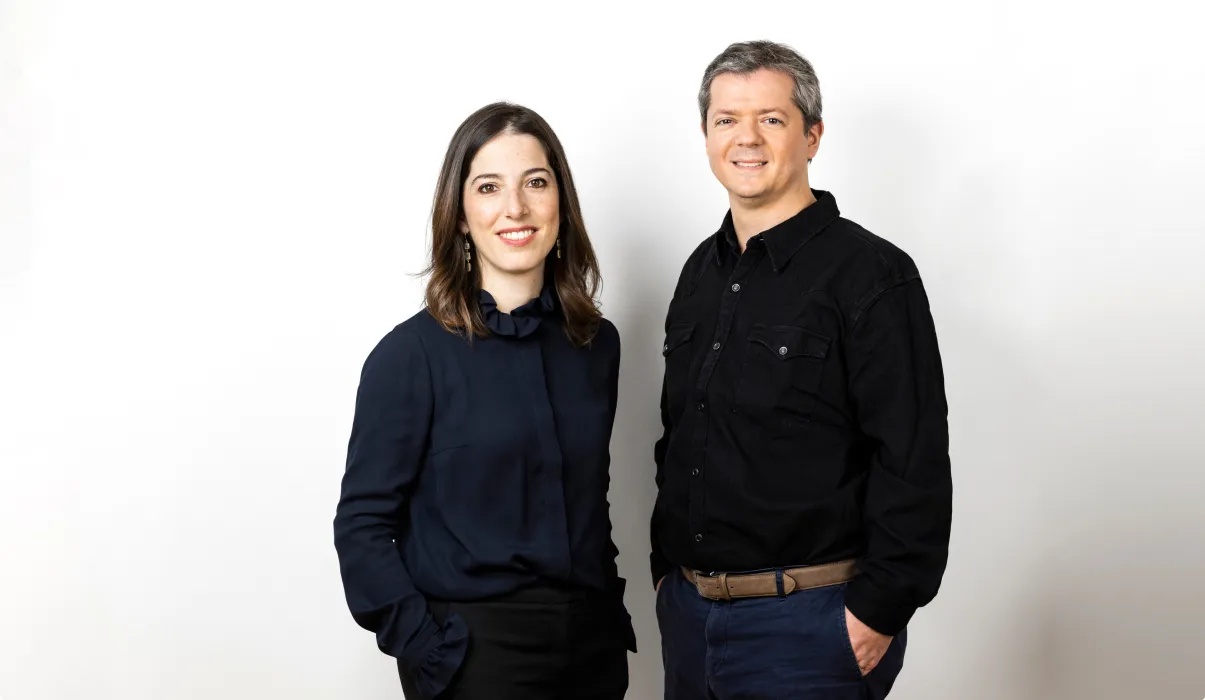
They also chose to share the chief executive title. Their division of work is clear: Niccoli leads technology, product and human resources; Crespo handles the other functions. They make tactical decisions within their own areas and come together for major strategic choices. Sharing a title still leaves a need to know whose decision a particular decision is.
Crespo has described their use of individual ownership for specific topics. It is a practical arrangement for two people whose company sells a tool for coordinating other people’s plans. Their own management structure has to survive contact with an ordinary working week.
The trouble with the company spreadsheet
Pigment’s subject is business planning: budgets, forecasts, sales capacity, staffing and the connections between them. These are questions with consequences for everyone inside an organization, even if few people would choose them as a dinner-party opening. A hiring plan changes costs. A sales forecast changes the hiring plan. Someone must make the numbers agree before the next meeting.
Crespo’s experience at Google helped shape the opportunity. Large organizations had sophisticated technology and still relied on spreadsheets and laborious planning processes. Pigment set out to let teams work with financial and operational data together, model different outcomes, and change their assumptions as circumstances changed.
Niccoli’s contribution included recruiting engineers from his network. Crespo has said those early recruits helped attract others. The technical challenge mattered too: a planning product had to handle complicated calculations behind an interface that business users could actually use. There is little comfort in an elegant system if changing a forecast requires finding the one colleague who understands it.
“Everything we do from a product perspective is designed to simplify decision making and increase agility at scale.”
Romain Niccoli · April 2024
By April 2024, Pigment had raised a $145 million Series D led by ICONIQ Growth. It said more than 90 percent of customers used its platform across several departments. That breadth matters to the original problem. Finance can produce a tidy plan on its own; a useful company plan must also connect with the people selling products, hiring staff and managing supply.
Let the person describe the problem
Niccoli’s writing about Pigment’s early AI features is revealing in its choice of examples. In a May 2024 product preview, he described generating charts with ordinary language, investigating the reasons for a budget variance, building a profit-and-loss statement from text prompts, and forecasting from historical data. These were familiar working tasks with a different way of asking the software to perform them.
The emphasis was on letting people with less technical experience work with the same planning tools. A user could adjust an AI-generated result and publish it to a dashboard. The result still needed to fit into the shared work. A clever answer in a private conversation has limited value if colleagues cannot inspect it or use it.
An illustration of the workflow, rather than a product performance claim.
That thinking continued with Frames, announced in September 2026. Frames generates custom interfaces inside Pigment, connected to the live planning model. A person can describe the screen they need, then revise it in words. The interface inherits access rights, and entries can flow back into the model. A regional manager and a finance leader can use the same application while seeing the information each is permitted to see.
The distinction is easy to appreciate without writing code. A handsome dashboard can become misleading as soon as the underlying plan changes. Keeping the display and the calculations connected is the less photogenic part of the job. Niccoli’s career has repeatedly involved that part.
An old question for a new kind of AI
AI was already part of his professional vocabulary long before the current generation of chat interfaces. In 2018, he and Le Ouay coauthored an essay on artificial intelligence and advertising. They explained how measurable feedback and large volumes of data made online advertising suitable for machine learning. They also distinguished execution from the ability to devise a sophisticated marketing strategy.
That earlier distinction makes Pigment’s present ambition particularly interesting. Forecasting, explaining a change and deciding what to do about it involve different responsibilities. Each extra step asks more of the software and the organization using it. The distance between producing a number and acting on it is where much of the work now sits.
At Pigment Catalyst Paris in October 2026, Niccoli argued for shortening the time between a signal and a decision. The proposed foundations were shared data, models people could build, and more automation of recurring planning work. His focus remained on the conditions under which AI could become useful across a company.
Another beginning, on a larger balance sheet
On October 21, 2026, Pigment announced a $250 million Series E at a $2.3 billion valuation. Scaleup Europe Fund, managed by EQT, led the round. The announcement described NVIDIA’s participation as planned. Pigment also said it had passed $100 million in annual recurring revenue earlier in the year. These are company figures, describing the business Niccoli and Crespo have built together.
Pigment’s announced Series E funding.
A company milestone in Niccoli’s third founding venture.
The founders’ stated destination is autonomous planning: agents that can eventually run planning workflows from beginning to end, within the limits a team sets. They describe more investment in Graphite, Pigment’s calculation engine, and the agents built around it. This remains an ambition extending beyond generating a forecast or assembling an interface.
There is another, quieter thread alongside the companies. Niccoli has invested in startups and served as mentor for the Fondation Nationale Entreprise et Performance’s 2022 mission on digital sovereignty. He and Crespo received the honorary Mines Paris PSL - Transvalor entrepreneurship prize in 2023. Building has also made him someone other builders can consult.
What ties the stages together is the habit of returning to work that needs doing. Windows, advertisements, shared rides and company plans are an eclectic collection. In each, the useful idea depends on a system that people can rely on. Niccoli has kept choosing to help build that system. The next door has continued to be worth opening.