The most revealing thing about Eléonore Crespo’s career may be that her apparent turns all point in the same direction. Physics, advertising, Google, venture capital, enterprise software: each looks like a fresh page until one notices the recurring question in the margin. How do intelligent people make decisions when the available picture is incomplete?
Crespo’s answer is not to wait for certainty. It is to improve the map. At Pigment, the company she co-founded with Romain Niccoli in 2019, that map takes the form of a business-planning platform: finance, sales, HR and supply-chain teams can bring their data and assumptions into one system, test alternatives, and see what a change in one corner does to the rest. The ambition sounds tidy. The corporate reality it confronts is anything but.
The spreadsheet is still the quiet sovereign of modern business. It is brilliant, familiar and almost comically overemployed. A tool designed for rows and cells ends up holding hiring plans, revenue forecasts and the consequences of a boardroom promise. Links break. Versions multiply. Someone names the decisive file FINAL_v7_really_final, which is less a filename than a cry for help.
Crespo’s GPS comparison is useful because it preserves human agency. A route is a recommendation, not a commandment. She has described companies as needing at least three: the motorway for speed, the country road for cost control, and the alternative route when an accident changes the journey. Planning, in this view, is not an annual ceremony. It is the ongoing practice of being less surprised.
The three-route company
01 / Learning to see the system
The physicist leaves the laboratory
Crespo grew up in Aix-les-Bains, in the French Alps, in a family of teachers and doctors. Curiosity had respectable company. She entered ENS Paris-Saclay to study physics and later pursued quantum physics, a discipline in which intuition learns to behave itself around evidence. A placement at Cambridge’s Cavendish Laboratory contributed to a co-authored scientific paper. Yet she found herself wanting results that moved on a shorter clock.
At Mines Paris, where she joined the Innovation and Entrepreneurship option, theory met the machinery of organizations. One education taught her to identify relevant data and accept that knowledge changes. The other taught her how decisions get made in companies populated by incentives, budgets and deadlines. She later summarized the combination neatly: ENS supplied rigor; Mines supplied the practical approach to private-sector problems.
Her first job took her to New York with JCDecaux. The French family business had built a large American operation, making it an education in crossing borders without losing the plot. Google followed in 2015. Crespo worked in product and financial analysis and close to EMEA finance leadership, where scale made planning both more important and more awkward. The company famous for organizing the world’s information still relied on spreadsheets for consequential internal work.
Then came Index Ventures in 2017. On the other side of the table, Crespo worked with founders and investments including Alan, Spendesk, Swile and Slite. She could observe not merely the pitch but the years after it: how leaders hired, sold, allocated capital and discovered that a convincing forecast is merely the beginning of an argument with reality.
02 / The partner before the product
Choosing the person who would share the difficult years
When Crespo decided to found a company, she began with a choice many entrepreneurs postpone: the co-founder. Before the precise product had settled, she made a list of people with whom she could imagine building for decades. Romain Niccoli stood out. A former co-founder and CTO of Criteo, he combined technical range with an absence of theatrical ego. Crespo knew him through Index and had seen him work.
Their shared problem arrived with the force of recognition. At Google, Crespo had watched planning strain under the weight of sprawling sheets. Niccoli had encountered the same frustration while scaling Criteo. Companies had bought software for nearly every function, yet when the numbers had to meet - when a sales forecast altered a hiring plan, or demand changed an inventory decision - the spreadsheet returned like a beloved but unreliable uncle.
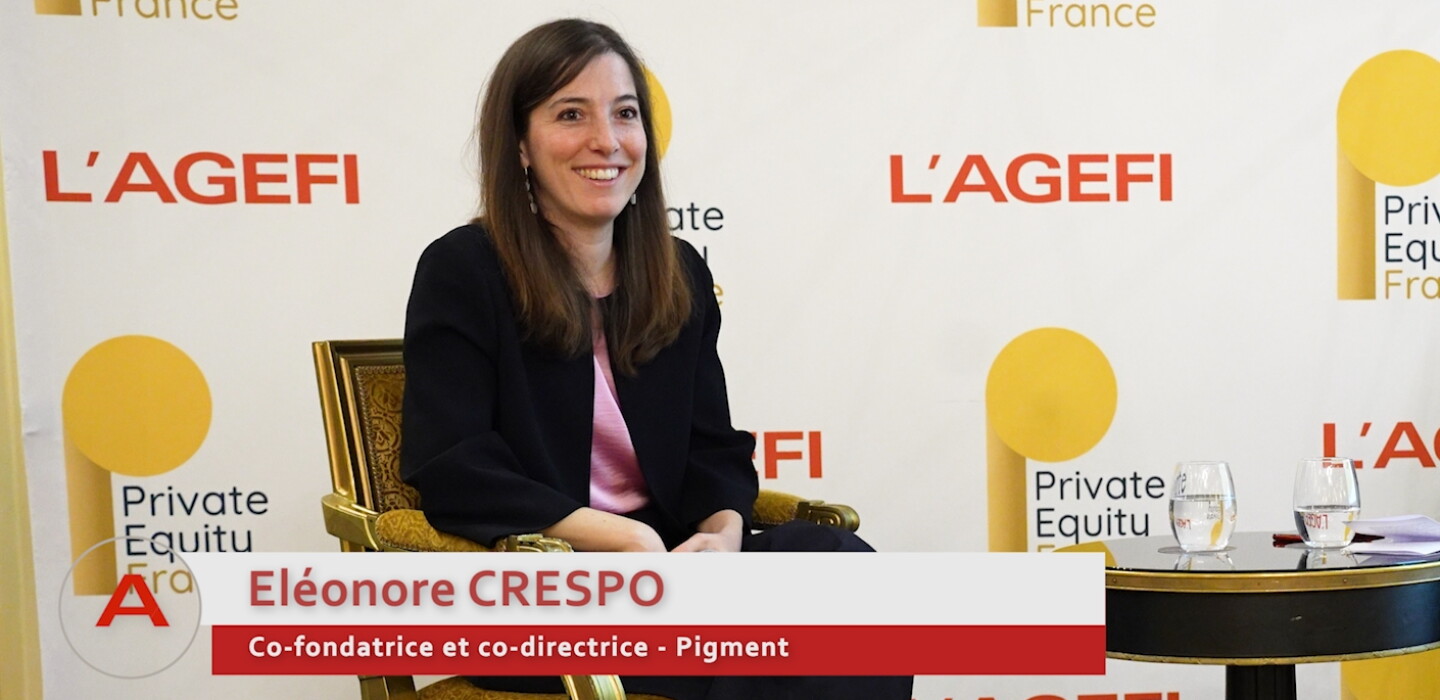
They founded Pigment in 2019. Even the name was planned with unusual patience. The team spent four months on it. A pigment is one constituent of an image; combine distinct colors and the complete picture emerges. It fit the founding idea: bring scattered data, people and processes together, but make the experience humane enough that people would actually use it. Enterprise software is littered with powerful systems that users approach like tax audits. Beauty, here, was not decoration. It was adoption strategy.
The founders chose the harder market early. Rather than begin with a lightweight tool and climb slowly upward, Pigment pursued enterprises whose requirements included security, governance, performance and substantial complexity. It meant competing with established planning vendors and proving that a young company could be trusted with consequential numbers. It also gave the product a demanding education from the start.
03 / The label and the work
A unicorn is an equation, not an ending
Pigment’s growth brought the usual markers. In 2023, Crespo became the first woman leading a company admitted to France’s Next40 program. That year she received BFM Business’s Révélation de l’année award. In April 2024, a $145 million Series D led by ICONIQ Growth took total funding to about $397 million and the company’s valuation beyond $1 billion.
Crespo did not confuse the new noun with a business model. “The valuation remains a simple economic equation that is no guarantee of success,” she said. The line is not false modesty; it is almost aggressively literal. Valuation describes the terms on which investors bought a portion of the company. It does not ship a feature, renew a customer or settle an argument about priorities.
The better measure was what customers were doing. At the time of the Series D, Pigment said its annual recurring revenue had tripled over the previous year, its enterprise customer count had tripled and 90 percent of customers were using the product across more than one department. Planning had escaped the finance office. The original thesis - that the real problem lived between teams - was becoming visible in usage.
Crespo’s own operating manner seems built around high standards made explicit. When recruiting senior people, she has described showing candidates a deck about what will be hard: the unsolved problems, the workload, the values and the disorder they are agreeing to enter. It is a bracing sales technique. It also respects the candidate enough to present the whole map, potholes included.
04 / From dashboards to colleagues
The next plan asks the software to act
The current act is artificial intelligence, though Crespo’s framing is less enchanted than the fashion suggests. A generic chatbot can summarize a file. An enterprise planning system must know which figure is current, who may see it, how it was calculated and what else changes when it moves. The difference is governance - the unglamorous architecture that keeps a quick answer from becoming an expensive mistake.
Pigment began outlining a network of specialized agents in 2025: an Analyst to investigate performance, a Modeler to build and maintain planning structures, and a Planner to simulate alternatives and recommend actions. By 2026, the product included more conversational analysis, custom agents tuned to company terminology and workflows, and Frames, interfaces generated from plain-language descriptions while connected to live planning models. The old spreadsheet had waited for a human to find the right cell. The new proposition is software that can help assemble the question.
Crespo has placed that ambition inside a wider argument about Europe. Pigment kept a strong engineering base on the continent while building a substantial American business and team. She has argued that global technology companies can retain European roots, provided they pursue international markets early and move with sufficient appetite. Her support for Current AI, a public-interest foundation backed by a group of technology leaders, extends the point: AI capacity is not only a company race but an institutional choice about data, research and access.
Yet her most persuasive evidence remains personal and oddly consistent. She reads management books, visits art exhibitions for ideas about user experience, and hosts conversations with planning leaders. The physicist still gathers signals. The investor still looks for durable advantage. The operator still worries about what a team can execute on Monday morning.
A plan, after all, is a story told with numbers about people who have not yet done something. Its danger lies in looking more certain than it is. Crespo’s career has been an extended attempt to make that story more honest: show the assumptions, connect the consequences, keep another route visible.
That is why the second, third and fourth acts matter. Pigment’s first act replaced fragments with a shared picture. Its next asks whether software can become an active participant in maintaining that picture without relieving humans of judgment. There will be no final version. For Crespo, that may be the point. The future is not a cell to be completed. It is a model that should remain alive.