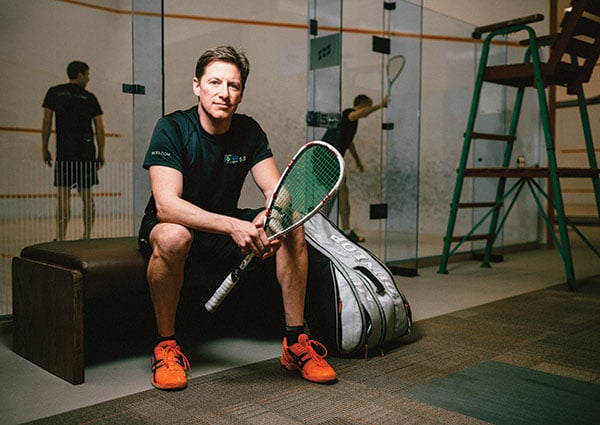
Roger Hardy worked his way from Division 9 to Division 1 in Vancouver squash. This took roughly five or six years. The reward for getting better was a room full of people who could beat him. He recalled losing more than he won. Promotion, it turns out, can be an excellent way to arrange a more sophisticated defeat.
He had started playing around 2000, when his daughter was born and spare time became scarce. After putting the children to bed, he could get to the court, play and be home in about an hour. Business partner Jeff Mason helped him improve by running him around. Friendship has its privileges; apparently one of them is making your friend chase a small rubber ball.
That sporting history offers a useful way into Hardy’s working life. He has built an eyewear company, sold it, moved into footwear, watched that venture fail and returned to eyewear. His career contains enough wins to make the losses easy to edit out. Doing so would leave a much less interesting person.
A credit card against a credit line
Hardy was born in Toronto, graduated from Bishop’s University and headed west, drawn by skiing. British Columbia became home. His later business life would stretch well beyond it, but Vancouver remained the place from which he built.
In 2000, he and his sister Michaela Tokarski founded Coastal Contacts. Selling a familiar, replenishable product online offered a practical proposition: spare customers another shopping trip. The business began with modest equipment and credit-card financing. The internet supplied access to customers; it did not supply a forgiving bank balance.
At one point, Hardy learned that an American competitor had a $40 million credit line. Coastal had his $10,000 Visa limit. He and his sister questioned whether they had chosen the right business. It is a more believable founding moment than the retrospective certainty that tends to arrive once somebody has bought the company.
They persisted. By 2010, Coastal’s annual revenue was close to $150 million, with employees in Vancouver and Europe. The small parcel had become a substantial international operation. Behind the website sat manufacturing, assembly and distribution: the decidedly physical work required to make an online promise come true.
Essilor agreed to acquire Coastal in 2014 at an approximately C$430 million net equity value. The offer was C$12.45 per share. Those are company transaction figures, rather than a measure of Hardy’s personal proceeds. They nevertheless mark a considerable distance from a credit-card limit and an anxious conversation between siblings.
The microphone could wait
A smaller scene, a year before the sale, says something about Hardy’s manner. At the opening of a Clearly Contacts showroom on Vancouver’s Robson Street, he made brief, unscripted remarks, thanked the people involved and invited visitors to try the glasses. Then he put the microphone away.
The consequential concession had come before the party. An online retailer opening a shop had initially struck him as an awkward fit. His team helped persuade him otherwise. He had also needed persuading about moving from contacts into glasses. In both cases, an idea survived his first objection.
“There are no bad ideas here,” he said. That is an easy sentence for a boss to utter. A physical shop is a more expensive way to demonstrate that colleagues can change the boss’s mind. The episode leaves a useful impression of someone whose appetite for action could include revising his own position.
His approach also had a timetable. Coastal used quarterly priorities and short daily gatherings tied to its plans. There was even a cheer. The opening-night speech might be brief; the business would have plenty of opportunities to hear from itself the following morning.
The chapter with the shoes
After Coastal, Hardy moved into footwear. Hardy Capital brought together ShoeMe.ca and OnlineShoes.com in 2014; Shoes.com joined the combination later that year. It was an attempt to bring online convenience to another large consumer market. It also required people, warehouses and acquired businesses to work together quickly.
The venture closed in January 2017. A biography that leaps directly from the Coastal sale to the KITS launch misses this interruption, and the public thinking Hardy did afterward. His 2018 essay about failure resisted the cheery assurance that a collapse automatically improves the people involved.
He wrote about leaders struggling with accountability, acquisitions that brought mismatched cultures together and a board unable to make decisions at the speed the business needed. These were his explanations, written after the event. They offer a view of what he believed had gone wrong, rather than a complete accounting of every participant’s experience.
He also said he had left the daily operation six months before the bankruptcy. Distance from the operating role did not make the ending painless. His argument was that useful learning requires deliberate examination. A company can fail quickly while its people spend a long time making sense of the wreckage.
“Failing fast” didn’t make me a better entrepreneur
The title of Hardy’s June 2018 essay
Read alongside his earlier experience, that reflection complicates the usual account of a repeat founder. Knowing how to sell online had not solved the problem of combining organizations. A previous exit could provide money and credibility. It could hardly make a new set of colleagues agree with one another.
Coffee, then a climb
In 2017, Hardy met Joe Thompson at a Vancouver board meeting. Thompson brought experience from Procter & Gamble and Amazon. They began having coffee near Kitsilano Beach, then walking and hiking together. Their conversations eventually became a business.
Thompson found a tactical advantage on the Grouse Grind: ask Hardy open-ended questions and let him do the talking during the climb. It was an economical use of a business partner’s enthusiasm. It also suggests a working relationship formed through repeated conversations, with enough humour to survive a steep hill.
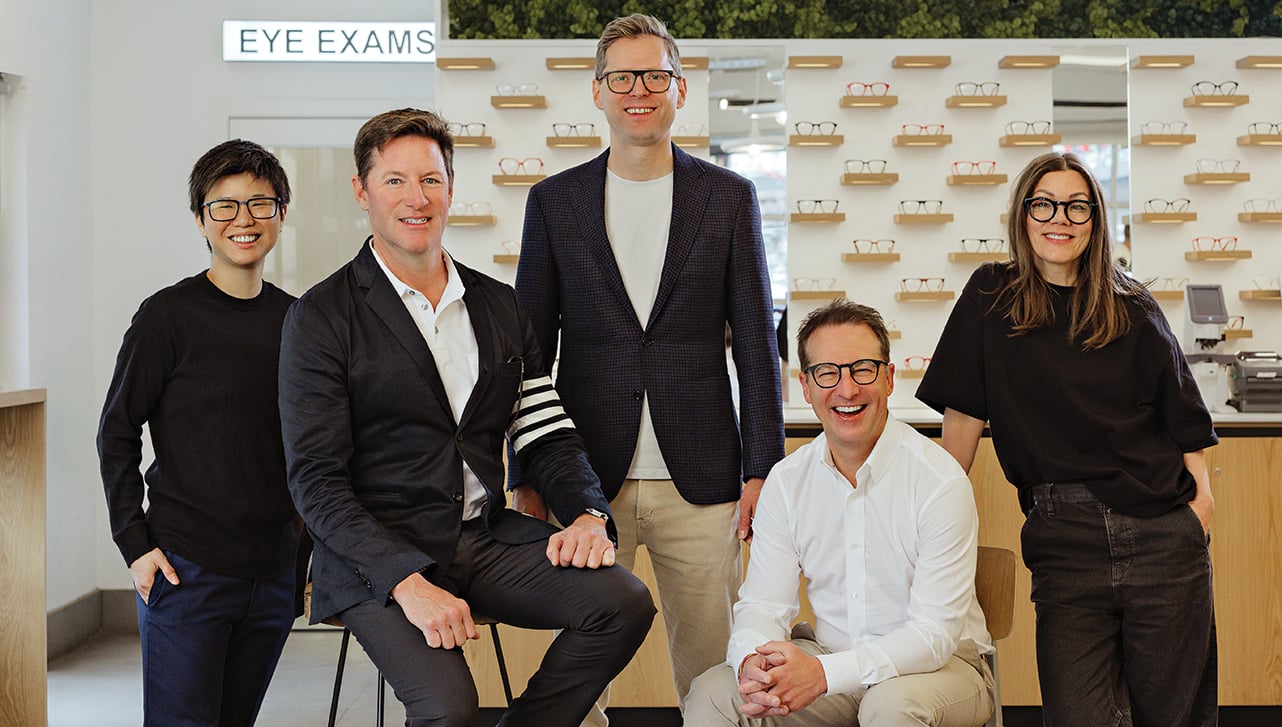
Hardy, Thompson and Sabrina Liak became KITS co-founders. In 2019, the acquisition of LD Vision Group supplied an existing online business and technology foundation. This time, the starting point included customers and operating history. Experience could be brought to bear on something already moving.
The local geography eventually supplied a pleasing twist. The former Starbucks where Hardy and Thompson had met became a KITS café and shop. A pair of founders can spend years trying to turn an idea into something tangible. Here, they could point to the address where the conversations happened and invite someone inside.
What holds when the founders move
KITS completed its initial public offering in January 2021. Public ownership brought a familiar tension back into Hardy’s working life: building for years while being assessed in quarters. The calendar changes every three months whether a warehouse, brand or management team is ready for its examination.
By October 2026, the business had reached another kind of test. Thompson moved from chief operating officer to an advisory role. Hardy remained chairman and CEO, concentrating on strategy, capital allocation, capital markets and longer-term direction. President Tai Silvey led operations. The division of work had evolved beyond the original founding partnership.
That is a personal change as well as an organizational one. Someone who had helped build the operation would occupy a different place in it. For Hardy, the next chapter involves a company whose routines and responsibilities must hold together as the founders’ daily involvement changes.
Preliminary third-quarter revenue, up 21.6% from a year earlier.
All amounts Canadian dollars. Q3 2025 results and October 7, 2026 announcement; 2026 figures preliminary and unaudited.The preliminary third-quarter figures put revenue at approximately C$63.7 million and cash at about C$30.6 million, with no debt. KITS described its annualized revenue pace as exceeding C$250 million. A run rate extends a recent pace across a year; it is distinct from revenue already earned over twelve months.
A quieter figure helps explain the work behind that pace. In the second quarter, repeat customers contributed 65.5% of revenue. For an online seller, each return is a practical judgment on the previous order. The customer has already seen how the promise travels through the system.
A quieter sort of horsepower
Hardy’s life away from that system contains another rebuilding project. He bought a 1991 Humvee at a US military auction and, with his son and local specialists, converted it to electric power. The work took a year. A vehicle associated with a considerable racket became conspicuously quiet.
There is something amusing about choosing such an enormous object for a family project. It makes the domestic question of where to put the unfinished work rather more interesting. The documented result, though, was practical: an older vehicle given a different way to move.
Family also appears in his philanthropic work through the Hardy Family Foundation. His connection to Bishop’s continued through an endowment supporting students. These are commitments outside the company reporting cycle, with their own measures of usefulness and their own timescales.
Back on the squash court, reaching Division 1 had not delivered a life of easy victories. It had delivered tougher matches. The comparison has limits, as any former employee or investor could reasonably point out: a business loss involves much more than a bad evening with a racket. Still, the sporting detail supplies an honest ending to a career that remains in progress. Hardy got better, found more demanding company and kept playing.
Keep the conversation going
Explore Hardy’s work, public writing and longer interviews.