A branding executive might be expected to welcome a very large sign. More visibility, more recognition, more people remembering the name. Roger Byrom had a different response to the illuminated letters proposed for the roof of Pier 17. The place was the South Street Seaport. The sign would announce the South Street Seaport. He doubted that the neighborhood required quite so emphatic an introduction.
“We know it’s the Seaport,” he said.
The proposed lettering had another complication: viewed from the Manhattan side, the name would read backwards. New York has always offered visitors a challenge, but deciphering the destination from inside it seemed an unnecessary addition. The Landmarks Preservation Commission approved the sign anyway. Byrom’s committee had an advisory voice, and an opinion is not a veto.
That episode catches something interesting about his working life. Byrom led Addison, a creative agency whose business included helping companies present themselves. He also chaired Community Board 1’s Landmarks Committee, where a presentation could end with a request to make something smaller, quieter, or more sensitive to its surroundings. The same city contained his clients, his neighbors, and buildings that had been speaking for themselves for a century.
Two kinds of headquarters
Byrom grew up in rural northeast England near the Scottish border. He studied economics at the London School of Economics, then began his career at Accenture during the expansion of personal computing. He joined creative entrepreneur Steve Smith and became an Addison board member at 29. In the late 1980s, he moved to New York to lead the firm’s American business; in 1994, he bought it with partners.
There is a useful distinction in those beginnings. His route into a creative company ran through economics and consulting. A business has to make its numbers work, and a design has to make its meaning work. Leading an agency puts both problems on the same desk. The reader of an annual report is unlikely to thank anyone for an elegant page that makes the answer harder to find.
In 2012, Addison chose offices at 48 Wall Street. Byrom’s explanation emphasized the combination of historic New York and adaptable, airy working space. The address put a communications business inside the district whose physical character occupied so much of his civic attention. Old buildings could accommodate contemporary work. That was a practical proposition, with desks and clients attached.
- Late 1980sMoves to New York to lead Addison’s U.S. business
- 1994Purchases the business with partners
- 2022Addison joins Sia’s creative network
- 2026Honored for immigrant achievement in Lower Manhattan
The sign that outstayed the shop
A year before that office move, another sign had attracted his attention. Borders had closed its bookstore at 100 Broadway. Its enormous illuminated name remained on the American Surety Building, a landmark with an ornate facade. Byrom wanted the letters removed carefully, before the company’s bankruptcy made the task more difficult to resolve.
The committee had reluctantly supported the sign before the store opened in 2003. Lower Manhattan needed retail activity after September 11. That earlier decision makes the later objection more revealing: the priorities had changed as the neighborhood recovered. A compromise made to bring people back downtown did not have to become the permanent standard for the next tenant.
There is an unglamorous side to preservation in that sequence. It involves identifying who will take a sign down, who controls the building, and what permissions the next occupant will need. The discussion can sound small until the remaining sign is twelve feet tall. A street’s character is partly the accumulation of such decisions, including decisions nobody revisits until a business closes.
Byrom was also concerned about the treatment of Pier A during restoration in 2011. With windows being replaced, preservationists worried about exposure to the elements. He urged the Landmarks Preservation Commission to follow up. Approving an attractive future for an old building did not finish the job of looking after the building while that future was under construction.
“How do we retain that sense of place?”
At a Seaport planning meeting in 2014, Byrom challenged the way a redevelopment proposal was being presented. The pieces inside the historic district were under discussion. A proposed residential tower outside the district was not part of the same landmarks review. He wanted a master plan that would allow the committee to consider the neighborhood together.
Individual components might be attractive, he argued, while their combined effect remained difficult to judge. His question was about the experience of the whole place. A boundary on a regulatory map can divide applications neatly. It cannot oblige a person walking through a neighborhood to experience one side of the boundary without noticing the other.
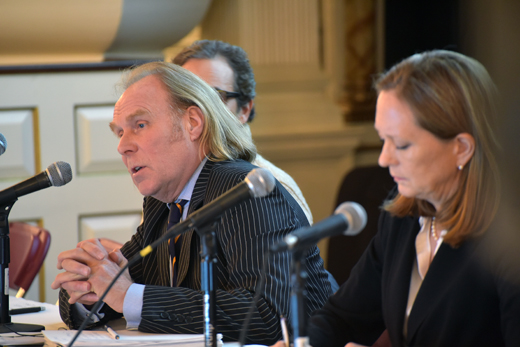
In 2013, he had supported a renewed effort by Tribeca Trust founder Lynn Ellsworth to expand the neighborhood’s historic districts, while expressing skepticism about the prospects. He remembered an earlier campaign that had produced protection for only twelve buildings. The recollection gave the discussion a dose of experience: an argument could be carefully prepared and still achieve less than its advocates wanted.
His civic work also included participation in a 2018 study of the Stock Exchange district’s public realm. The project brought together business, cultural, property, and community voices to consider changes around Wall and Broad Streets. Preservation and everyday use were sharing the agenda. Streets needed to function for people who worked there, lived there, visited, or made deliveries.
A brushstroke gets a welcome
Byrom’s objections can make him sound allergic to additions. The proposed Nobu interior at 195 Broadway provides a useful counterexample. In 2016, a suspended wooden sculpture inspired by Japanese calligraphy was presented to the landmarks committee. It would sweep above the restaurant’s circular bar and continue toward the stairs.
Committee co-chair Bruce Ehrmann considered the sculpture discordant with the designated interior. Another member, Vera Sung, admired it but questioned its scale. Byrom welcomed the character it would bring to the space and judged its impact on the landmark to be minimal. The committee approved the proposal despite the disagreement.
The distinction is worth keeping. A landmark can host a restaurant; a restaurant can have a recognizable presence. The argument concerned whether this particular intervention suited this particular room. Byrom’s positions did not always line up with the simplest caricature of a preservationist. One conspicuous sign met resistance. One conspicuous sculpture found a supporter.
“put some character into the space”
Roger Byrom, on the proposed Nobu sculpture, 2016
An agency changes hands
Addison’s own next chapter arrived in July 2022, when Sia Partners acquired the business. The announcement described an agency of about fifty people, working in digital financial and ESG communications for clients including BlackRock, Brookfield, and PepsiCo. Its expected revenue that year was approximately $12 million.
Those figures belong to the business at the time of the transaction. They help establish the scale of the company Byrom was leading. Addison became the eleventh design center in SiaXperience’s network and brought a fourth service line focused on ESG communication. Byrom joined the network’s global management team.
He welcomed the opportunity to combine the agency’s strategic and creative experience with new technologies and services. The continuity mattered as well as the change. Corporate reporting, branding, and sustainability communication remained part of Addison’s work. Its present services still connect those disciplines, with the agency operating as Sia/Addison.
The lawn crew has hooves
At Headquarters Farm near Stockton, New Jersey, Byrom’s environmental interests take a more physical form. He raises grass-fed sheep, sells farm products at local markets, and rents out his flock to graze solar farms and control invasive vegetation. The machinery producing electricity is modern. The equipment trimming the vegetation has been available for considerably longer.
The farm received River-Friendly certification in 2017. In 2012, Byrom had installed streambank protection, planted a buffer, and erected fencing to keep livestock away from sections of the watercourse with assistance from the Natural Resources Conservation Service. He fenced the remaining riparian areas in 2017. Caring for a historic property included caring for what flowed through it.
That work makes an instructive companion to the corporate sustainability communications associated with his agency. At the farm, the intervention can be walked along: a buffer, a fence, a stretch of protected river. It gives the word stewardship something firmer to stand on than an attractive cover.
History with something cooking
The farm also gives Byrom a place to explain the past. A 2016 open-hearth luncheon paired his discussion of the property’s history and restoration with cooking by Margaret Quinn and colonial entertainment by Anne and Ridley Enslow. Visitors ate in an eighteenth-century cellar kitchen. The meal included stewed beef, vegetables, bread, and small fried doughnuts. Architectural history had acquired a lunch menu.
His work as president of the Delaware Township Historical Society continues that public role. A talk scheduled for October 25, 2026, explores the Loyalists’ perspective during the American Revolution. It is an apt subject for someone raised in England who has spent decades helping American communities consider what their history means.
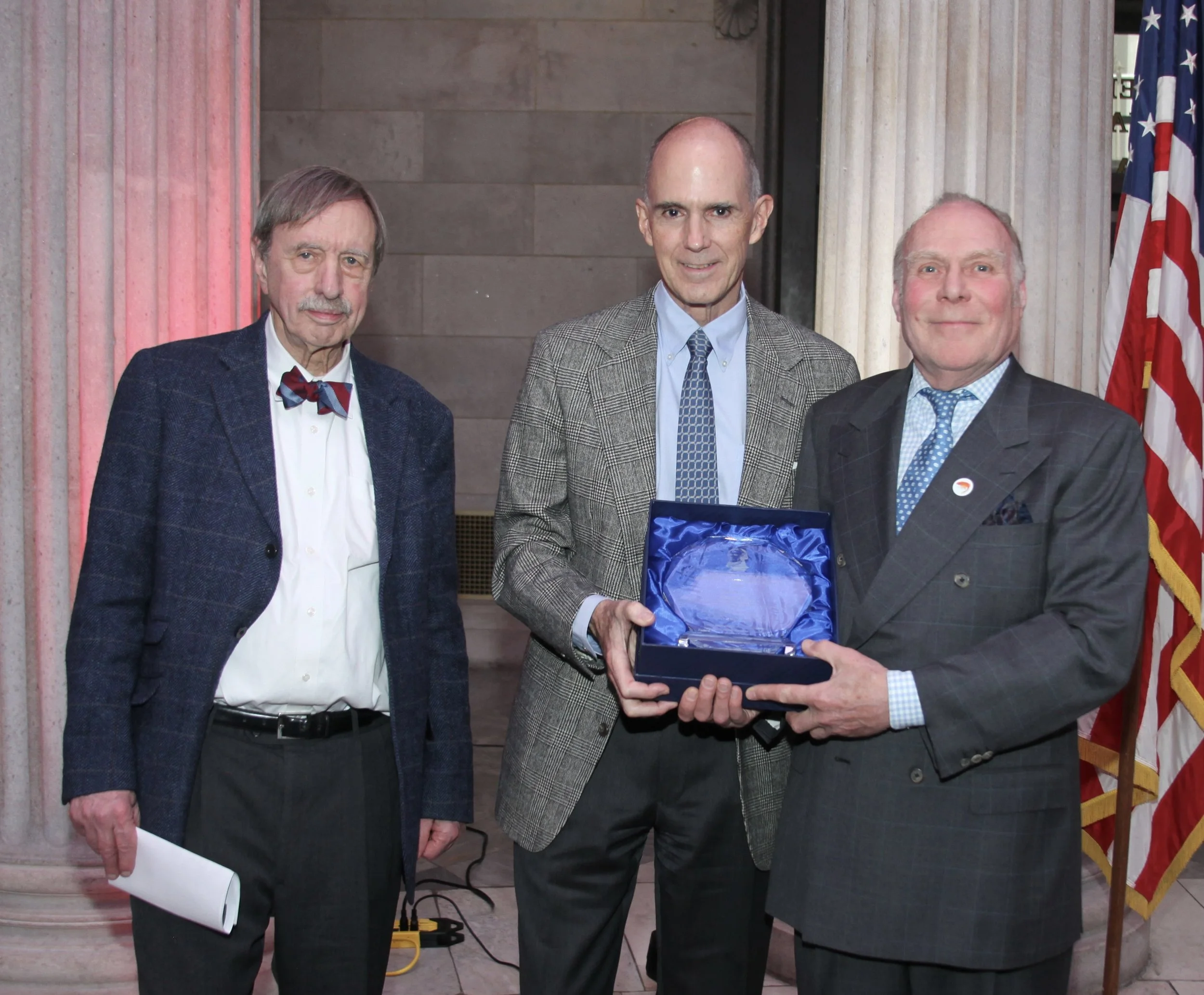
In March 2026, the Lower Manhattan Historical Association recognized him with its Alexander Hamilton Immigrant Achievement Award. The honor brought his business and civic lives into the same frame. By then, its description named him as Addison’s former CEO and a former chair of CB1’s landmarks committee.
The sheep, the restaurant sculpture, the bank building, and the Seaport proposal make an unusual set of career markers. Taken together, they suggest a recurring question about use: what can a place accommodate while remaining itself? Byrom has answered it in meeting rooms and on a farm. Sometimes the answer requires a new owner. Sometimes a fence. Sometimes the neighborhood already knows its name.