Kelli Parsons has a way of counting achievement that makes a conventional executive biography feel a little cramped. There are the jobs, of course: communications chief, global agency leader, now chief executive of Avōq. Then there are the people. Roughly 25 former members of her teams, she says, have gone on to become chief communications officers, agency CEOs or founders. Their names sit elsewhere on the organization chart. Their careers belong to them. She counts their progress among the things that make her proud.
It is an appealing complication for a profession so accustomed to keeping score through visibility. A chief executive appears in the announcement. A mentor’s contribution can be harder to isolate. Someone gains confidence, takes a larger assignment, leaves for a role with more responsibility. The manager loses a capable colleague and gains something that will never fit neatly into the next quarterly presentation.
Parsons’s own career has crossed journalism, finance, aerospace and public relations. She has repeatedly worked with institutions whose circumstances demanded more than a polished announcement. Alongside that work, she has kept an interest in what other people might become. Her arrival at Avōq in February 2026 gives those two strands a new setting.
“My job is to inspire our people to do their best work.”Kelli Parsons
An education before the newsroom
Before the corporate titles came Murray, Kentucky. Parsons grew up on a family farm and finished Calloway County High School as the class of 1987’s valedictorian. She graduated magna cum laude from Murray State’s journalism program and earned a master’s degree in journalism at Northwestern University’s Medill school. It is a route that began close to home and then widened, with reporting as the first professional destination.
She credits farm life with teaching practical habits: finding a solution when the available tools are imperfect, fulfilling obligations when the weather makes them unpleasant, helping neighbors when her own schedule is already full. The examples are ordinary, which gives them some force. A fence is an unusually candid performance review. It either holds or requires more work.
Her television career began in Paducah and included work for network affiliates. Reporting supplies its own version of those practical demands. A story has to be understood, shaped and delivered on time. The audience has little reason to indulge confusion just because the underlying subject is complicated. The work gives someone frequent practice in deciding what matters and what a listener needs first.
Moving into communications gave Parsons a different position in relation to the story. She would work inside institutions as well as advise them. The perspective changed from describing decisions to helping an organization explain them to people with different interests. Her early agency career included a decade at Hill & Knowlton, which she left in 2008. Roles at Warburg Pincus and Fannie Mae followed.
A company has to believe its own story
Fannie Mae brought her into an institution facing a financial crisis and a difficult task of rebuilding confidence. As communications chief, Parsons worked on how the company explained its turnaround. The audience was unusually broad: employees, policymakers, financial institutions, investors and the people whose ability to buy or rent a home depended on a functioning housing market.
For an institution in that position, internal understanding matters alongside external reputation. Employees have to carry out the changes that a company announces. They also need a reason to believe that the work has a purpose. An elegant public message can coexist with a confused workforce; the workforce will still be the one answering questions on Monday morning.
Parsons developed an employee change program called “All In.” Its ambition was to create a shared sense of purpose and make communication more open during Fannie Mae’s transformation. The reported employee survey results offer a concrete glimpse of that effort. Eighty-eight percent understood the company’s purpose. Eighty-two percent felt good about working there. Seventy-nine percent said the new communication tools encouraged transparency and dialogue.
Fannie Mae employee survey results, reported in 2015
Reported employee responses, not a measure of financial performance or proof of causation.
Those figures cannot explain a company’s recovery on their own. They do show what Parsons’s assignment looked like below the level of a corporate headline. Purpose, confidence and the ability to have a conversation were things to work on and observe. Fannie Mae’s communications team received PRWeek’s Team of the Year recognition in 2014.
When the organization chart moves
In November 2014, New York Life announced that Parsons would become its chief corporate communications and marketing officer, reporting to CEO Ted Mathas. The move brought her to another financial institution, with responsibility for the way a long-established business presented itself to customers, employees and other stakeholders. The role joined communications and marketing in the same remit.
At New York Life, her work included an integrated marketing strategy and a consumer brand program intended to connect with millennials reaching decisions about homes, marriage and families. There is an everyday quality to those subjects that the size of the company can obscure. A financial brand meets people at consequential points in their lives. Relevance has to reach beyond institutional history.
In 2016, she offered a short piece of career advice: “Strive to do what interests you. The rest will work itself out.” It is a relaxed sentence from someone whose assignments were rarely relaxed. It leaves room for curiosity as a legitimate reason to make a professional choice, alongside responsibility and advancement.
Her next major corporate appointment came in 2017, when she joined United Technologies as senior vice president and chief communications officer. That year she also launched the reputation and marketing consultancy Blue Sky Advisors. At United Technologies, her responsibilities ranged across corporate marketing, internal and external communications, media relations, public affairs and social media. The company itself was about to change substantially.
Parsons led communications through the acquisition and integration of Rockwell Collins, the spin-offs of Carrier and Otis, and the $74 billion merger with Raytheon. Each transaction had its financial and legal architecture. Each also changed the story that employees and other stakeholders needed to understand about the business. Familiar corporate names were becoming separate companies or parts of a newly configured enterprise.
That work asks for both scale and specificity. An investor wants to understand the logic of a transaction. An employee wants to understand where the job fits. A customer needs continuity. The announcement is a shared starting point, but the questions quickly diverge. A communications leader has to make the same business decision intelligible in several different rooms.
- 2014New York Life
Communications and marketing - 2017United Technologies
Corporate transformation - 2020Hill & Knowlton
Global corporate affairs - 2024Hill & Knowlton
Global CEO - 2026Avōq
CEO and board member
In June 2020, Parsons returned to Hill & Knowlton as global chair of corporate affairs. Her portfolio included reputation, financial communications, crisis work and employee engagement. She brought the experience of working inside client organizations back into an advisory firm. A proposal from an agency can sound rather different once someone has been responsible for making it work inside a company.
She became Hill & Knowlton’s global CEO on July 1, 2024, as the firm entered the Burson group following the combination of Hill & Knowlton and BCW. Her earlier agency responsibilities had included the New York and Washington markets and a major global client relationship. The appointment joined that history with her years as a corporate communications leader.
The work travels through other people
Professional service runs alongside those operating roles. Parsons chaired the Page board of trustees beginning in 2024. Under her leadership, the association expanded global engagement, invested in resources for members including the Page Navigator benchmarking system, and completed a CEO transition. Darcy Keller succeeded her as chair in January 2026. Parsons also serves as a trustee of the Institute for Public Relations.
These roles place her in a wider community of communications executives, with responsibilities extending beyond the next client assignment. They also make her interest in developing people more visible. In March 2026, the Martin Center for Mentorship in Communication recognized her with its Distinguished Mentor award. She discussed mentoring with Tom Martin on his podcast that month.
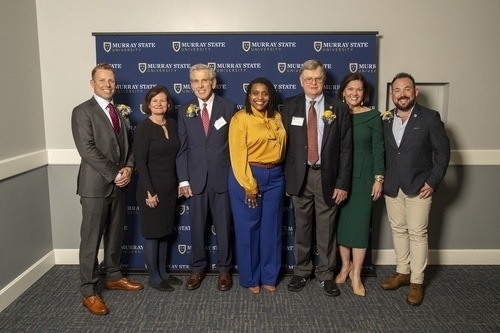
Her connection to Kentucky has remained practical, too. In 2010, Parsons and her husband Scott established a Murray State scholarship for international study. The idea was to make study abroad more attainable for students. She has also supported opportunities for students at the University of Kentucky. The scope of her career expanded while a connection to her own educational beginnings continued.
Murray State recognized her as a Distinguished Alumna in 2025. The ceremony offers a different kind of career photograph from a CEO announcement: Parsons standing among fellow graduates whose working lives took them into other professions. The shared institution comes back into view. Professional reach and a connection to home can occupy the same frame.
A new office, a familiar question
Avōq appointed Parsons as CEO and a board member effective February 2, 2026. The Washington-based firm combines communications, bipartisan government relations, creative work, research, data analytics and paid media. Her task involves bringing those capabilities together for clients dealing with business decisions, public scrutiny and policy. The agency draws on firms with their own histories and established ways of working.
That gives her another transition to lead. Her appointment announcement emphasized the perspective of a former corporate communications and marketing chief: someone who understands the pressures inside the organizations an agency serves. The relationship has obligations in both directions. Clients need useful judgment and delivery; colleagues need conditions in which they can do the work well.
In March, Parsons received the Larry Foster Award for Integrity in Public Communication from the Arthur W. Page Center. Fellow 2026 honorees included Kaitlan Collins, Jeffrey Goldberg and Hubert Joly. Journalism, business leadership and communications appeared together in the same event, a fitting intersection for someone whose career has moved through those worlds.
The question she offers people considering their own careers is simple: “What do you want to be known for?” Her record suggests several possible answers: explaining change, leading institutions through it, creating opportunities for students, preparing colleagues for larger jobs. The last answer has a particular charm. Other people’s success keeps growing after they leave your office. A career that makes room for that can become larger than its own list of titles.