The most revealing thing about Rodrigo Martinez is that he did not flee the family business. He took the long way back to it. Buses had been in his life for as long as he could remember. He calls himself a third-generation operator, with roughly 70 years of family history in the trade. Yet his own route ran through computer science, London, India, Prague, Guadalajara and Silicon Valley before returning to the practical business of moving people around Mexico.
That route matters because transport resists the usual mythology of technology. A software release can cross an ocean before breakfast. A bus still needs a driver, a road, a place to stop and enough passengers going in roughly the same direction. It can be late. It can be full. It can be cash-only. Reality has always had an irritating preference for the physical.
Martinez made that irritation his subject. At Kolors, which he founded with technologist Anca Gardea, the vehicle is owned, driven and maintained by a partner operator. Kolors supplies the connective tissue: demand planning, pricing, booking, route optimization, customer support and a recognizable passenger experience. The company is less a fleet than a promise that many separate fleets can feel like one.
“We learned that you can’t just copy and paste a product that works in a more mature market.”Rodrigo Martinez
The inheritanceThe family business, rewritten
Martinez earned a computer-science degree at Kingston University, then studied technology entrepreneurship through UCL and London Business School. By 2008 he was building Inovaz. In 2011 came WePow, a video and mobile interviewing company. Its premise was revealing: technology should make an institutional process feel more human, not merely faster. Major employers used the platform, and Martinez joined the stream of Mexican founders building between Guadalajara and Silicon Valley.
The recognition arrived early. In 2012, MIT Technology Review’s Mexico edition named him among its top innovators under 35. WePow also placed him inside the network of founders forming around Mexico’s young startup scene. Years later, when asked about the TechBA accelerator that had brought Mexican startups north, his warmest memory was not a program metric. It was the people. Several founders he met there remained friends.
A career that kept moving closer to the bus
first company
video recruiting
digital tickets
mobility network
Then the work moved closer to home. As chief executive of Busolinea from 2015 to 2019, Martinez worked on online search and ticket sales for Mexican coach travel. At the time, he said only a small fraction of Mexican bus passengers bought tickets online. The figure looked unimpressive until one remembered the scale beneath it. Mexico’s intercity bus market moved vastly more people than its domestic airlines. A small digital share of an enormous physical market was still an enormous invitation.
The design constraintBuild for the cash in the passenger’s hand
Kolors began from a distinction many startups learn expensively: modern does not mean imported. In Mexico, cash remained important. Operators were fragmented. Traditional terminals were not always convenient. A pristine card-only product, copied from a wealthier market, might look elegant in a pitch deck and foolish at the curb.
So Kolors built around the market that existed. Passengers could book digitally, but staff aboard the bus could also check them in, sell a snack or take cash. Pickup points could sit at hotels, shopping centers and other practical locations rather than requiring a traditional terminal. Small and midsize operators supplied the buses. Kolors used data to decide where and when the network should run, and wrapped the journey in one customer-facing brand.
The persuasionSelling a bus company that was not a bus company
The model was easy to explain and harder to finance. Many venture investors understood software but knew little about intercity buses. Others knew emerging markets mostly through a handful of fashionable consumer categories. Martinez had to sell two unfamiliar ideas at once: that a very old transport industry could support a technology business, and that Mexico could produce a company ambitious enough to reshape it.
Kolors raised a reported $6 million seed round in 2021 and a $20 million Series A in 2022. Its backers included UP.Partners, Toyota Ventures, Maniv Mobility, Moving Capital, Brainstorm Ventures, Bling Capital and Amplifica. Uber co-founder Garrett Camp was also among the investors associated with the company. The roster helped answer a question every marketplace faces: can a platform coordinate enough supply and demand to become more valuable than either side could be alone?
The answer depended on a division of labor. Partner operators already knew vehicles, permits, maintenance and drivers. Kolors did not need to relearn their work by owning a depot. It could concentrate on the parts that fragmented operators struggled to build individually: consumer marketing, a common booking layer, pricing systems, demand forecasts and round-the-clock customer support. The arrangement was not magically free of assets. It simply left each asset with the party best equipped to manage it.
That distinction protects the idea from its own cleverness. “Asset-light” can sound like finance jargon for enjoying the revenue while somebody else handles the difficult bits. In practice, Kolors still lives or dies by difficult bits. If a partner’s bus is dirty, delayed or missing, the passenger remembers the purple brand on the ticket. Martinez’s company does not own the vehicle, but it owns the expectation. The entire network rests on making those two facts coexist.
Martinez likes an airline metaphor. He has called the system an “airline on wheels,” and once described the company as the hypothetical offspring of Uber and an airline. The joke is useful because it points to two kinds of coordination: the digital dispatch and ease associated with ride-hailing, and the yield management, schedules and service choreography of aviation. It also reveals the difference. Airlines generally own or lease the aircraft. Kolors leaves the heavy metal to its partners.
The turnA company follows its commuters
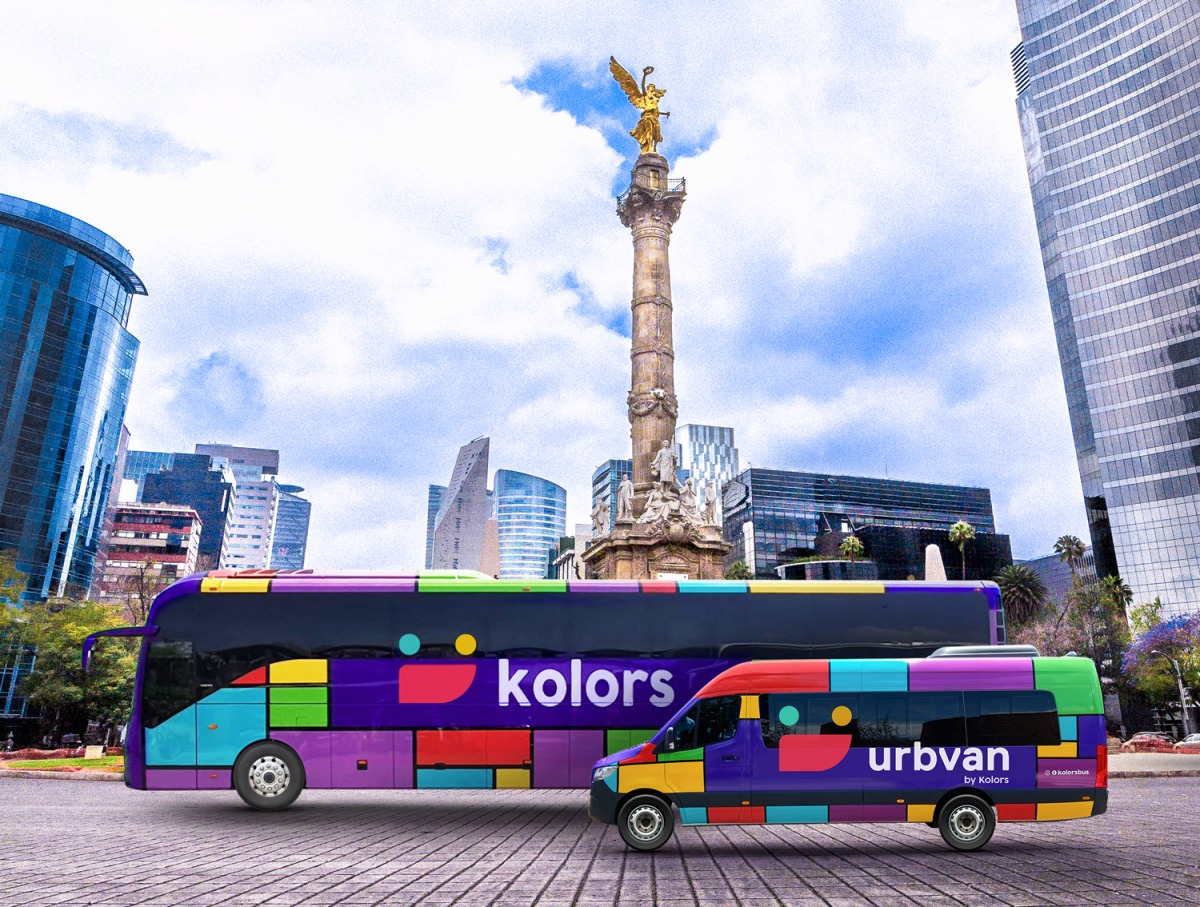
The most consequential route change arrived in 2023. Kolors bought Urbvan, a corporate van-pooling provider, for $12 million in cash. Urbvan brought more than 500 vans and shuttles on its platform, hundreds of business clients and operations across 24 Mexican cities. The acquisition connected Kolors’ city-to-city service to the daily geography of offices, factories, business parks and distribution centers.
The logic was hiding among the passengers. Martinez said 30 percent of Kolors riders traveled for work and had tickets paid by an employer. Every one of those employers could need local transport; every Urbvan commuter could someday need an intercity ticket. The neat categories of “within a city” and “between cities” were organizational conveniences. Commuters did not live inside the boxes.
By March 2026, the company’s center of gravity had shifted. Martinez said employee transportation was now the core business. Kolors was carrying about seven million passengers for hundreds of companies, including manufacturers, consumer brands and technology businesses. Its corporate unit had grown more than 101 percent in the previous year. The intercity origin story had not vanished, but the recurring journey to work had become the engine.
This is the less glamorous discipline of entrepreneurship: allowing the company to become more useful than the original pitch. Corporate transport lacks the romance of reinventing the road trip. It offers something operators adore, however: repeated routes, known demand and clients who value punctuality because an assembly line or a shift change is waiting at the other end.
The horizonGlobal ambition, stubbornly local roads
Martinez has never been shy about scale. In 2021, he spoke of making Kolors an important global intercity mobility company. In a later investor interview, the ambition widened to mass and shared mobility, alongside a long-range hope for zero emissions. By 2026 he had named a more immediate test: enter at least one country beyond Mexico before the year ended. Brazil, Colombia and the United States were being evaluated, in part by following corporate customers already operating across borders.
The strategy sounds simple enough to fit on a napkin. Find underused or fragmented transport capacity. Add demand, software and service. Sell one coherent experience. Repeat elsewhere. The difficulty lives in that final word. Payment habits change. Regulations change. Operators have their own histories. Streets have their own tempers. Martinez already knows that a product cannot be photocopied from one market into another. International expansion will ask whether he can apply that lesson twice.
“We want to become the Uber for mass and shared mobility.”Rodrigo Martinez
His advantage is not simply that he understands technology or buses. It is that he has had to translate between them for years. WePow translated the personality of a job candidate into a digital interview. Busolinea translated routes and counters into searchable tickets. Kolors translates independent operators into a network a passenger can recognize. Different industries, same instinct: the institution may remain complicated, but the customer should not have to feel every complication.
There is something pleasingly circular in the story. Martinez left an old industry to learn the grammar of a new one, then returned fluent in both. He did not inherit a bus company. He inherited the ability to notice what bus companies know, what software people miss and what passengers endure. Kolors is the wager that those three points can share a route.