There is a particular kind of optimism involved in accepting responsibility for a marketing department whose head count is one. The cheerful version says you can build anything. The accurate version says you must first decide what deserves to exist. When Katie Wild joined FreightWise as chief marketing officer in 2025, the assignment arrived with both versions attached. The Brentwood, Tennessee, logistics company had a sales team working in Salesforce, no marketing automation, a website in need of reconstruction, and a recently acquired product brand, Kuebix, carrying years of content and search history. Wild had no internal website crew, CRM team or marketing-operations bench. She did have a telephone and knew whom to call.
The call went to York IE, a group she had worked with before. What followed sounds less like the conventional CMO montage of whiteboards and stirring taglines and more like air-traffic control. FreightWise and its outside partner mapped 510 URLs. They selected 61 useful content assets for migration, constructed more than 150 redirects, and retired 294 legacy pages. HubSpot went in alongside the new website, tied back to Salesforce so sales and marketing could finally look at related information. The site was delivered in 15 weeks, timed to the opening of a new office.
Within six months, total sessions had climbed 68 percent and new users 127 percent. Those are the figures that make a case study travel. The more revealing sentence is Wild's own: “The biggest difference for me was having systems I could trust.” Trust, in this context, is not a poster on a conference-room wall. It is a form submission arriving in the right database. It is an NPS response visible to the people who can act on it. It is a marketer answering a revenue question without beginning, “It depends which spreadsheet you mean.”
“Everything from the website to HubSpot to Salesforce just works together, which makes it much easier to execute and measure what's actually driving results.”Katie Wild
A freight career built at the interfaces
Wild's subject is freight, but her craft is the interface. Logistics is crowded with them: warehouse and carrier, rate and route, shipment and invoice, software and the human being who has to use it before lunch. Marketing has its own junctions. Product must meet language. A useful insight must meet the person able to buy. A promise must eventually survive contact with the service. Wild has spent 15 years near those crossings.
An early public credit lists Katie Fredericks as a marketing analyst who helped compile an OHL economic overview. The document gathered the sort of indicators that make logistics professionals speak in acronyms and everyone else reach for coffee: freight indexes, fuel data, trade flows, employment measures. The job placed her close to the raw material of the industry. Before a marketer can simplify a subject honestly, she has to sit with its refusal to be simple.
The Wild operating loop
At Shipwire, an ecommerce logistics platform, Wild eventually led a marketing group of 18 people across international time zones. It was remote work before remote work became a category of argument. Her recipe was pleasingly concrete: use the technology available, turn cameras on for meetings, travel to be together, and build genuine working relationships. She has credited an annual gathering in Orange County, California, along with what she calls a “get it done” mindset. No manifesto, no virtual water-cooler cosplay. Just habits repeated until distance stopped being the main fact about the team.
By 2021, her Nashville school, Harpeth Hall, introduced her to students as vice president of marketing at Transportation Insight. She returned for a career day organized around what students enjoyed doing rather than which impressive title they hoped to acquire. Wild appeared under two prompts: helping people, and analyzing people or things. It is a surprisingly tidy description of B2B marketing. The buyer is a person. The freight bill is definitely a thing.
Marketing analysis and the economic signals beneath logistics.
An 18-person marketing team connected across international time zones.
Vice president of marketing during a long-running logistics career.
A new marketing foundation for two brands, one website and connected revenue systems.
The office prank that passed the culture test
For all her defense of distributed work, Wild understands the evidence available only in a room. Soon after joining the Tennessee-based FreightWise office, she walked in to find the place decorated in Tennessee orange. “Rocky Top” was playing from a speaker positioned for effect. Wild is a Georgia supporter. The prank had therefore been designed with the care normally reserved for a product launch, though perhaps with a more hostile color palette.
She took the joke, posted the story and added an administrative note: all decorations had been removed and returned to their rightful owners. Colleagues replied with references to an earlier car boot and a chirping cricket. For someone who had spent a decade proving work could happen from anywhere, the episode supplied a friendly amendment. Remote work can be effective, she wrote, but these were the fun moments she had missed. Culture, it turns out, can travel through software. Mischief still enjoys an office.
“Technology, genuine collaboration, and a simple ‘get it done’ mindset made it all possible.”Katie Wild, on leading remotely
Her public comments and recommendations from colleagues draw the same outline from less comic angles. They describe a direct and strategic leader, fluent in product positioning, digital execution and difficult conversations. Wild herself emphasizes women who have supported and challenged her, tracing that conviction to an all-girls education. She names her mother, grandmothers, relatives, teammates and former colleagues. Leadership, in this account, is not solitary elevation. It is a long receipt for help received, followed by a decision to keep the exchange going.
The marketer and the marker
Wild did not dream of marketing as a child, though it was already in the house. Her mother worked in marketing in Nashville's music industry. Young Katie concluded that the profession involved brochures and events. This is forgivable. Many adults with budget authority still believe roughly the same thing.
The correction arrived through her own child. On a preschool “All About Me” poster, her five-year-old son departed from his usual ambition, “banana eater,” and said he wanted to become a marketer. Wild initially heard marker. Marketer seemed less likely. Asked why, he answered that they could work together when he grew up. The remark stopped a person who describes herself as rarely short of words.
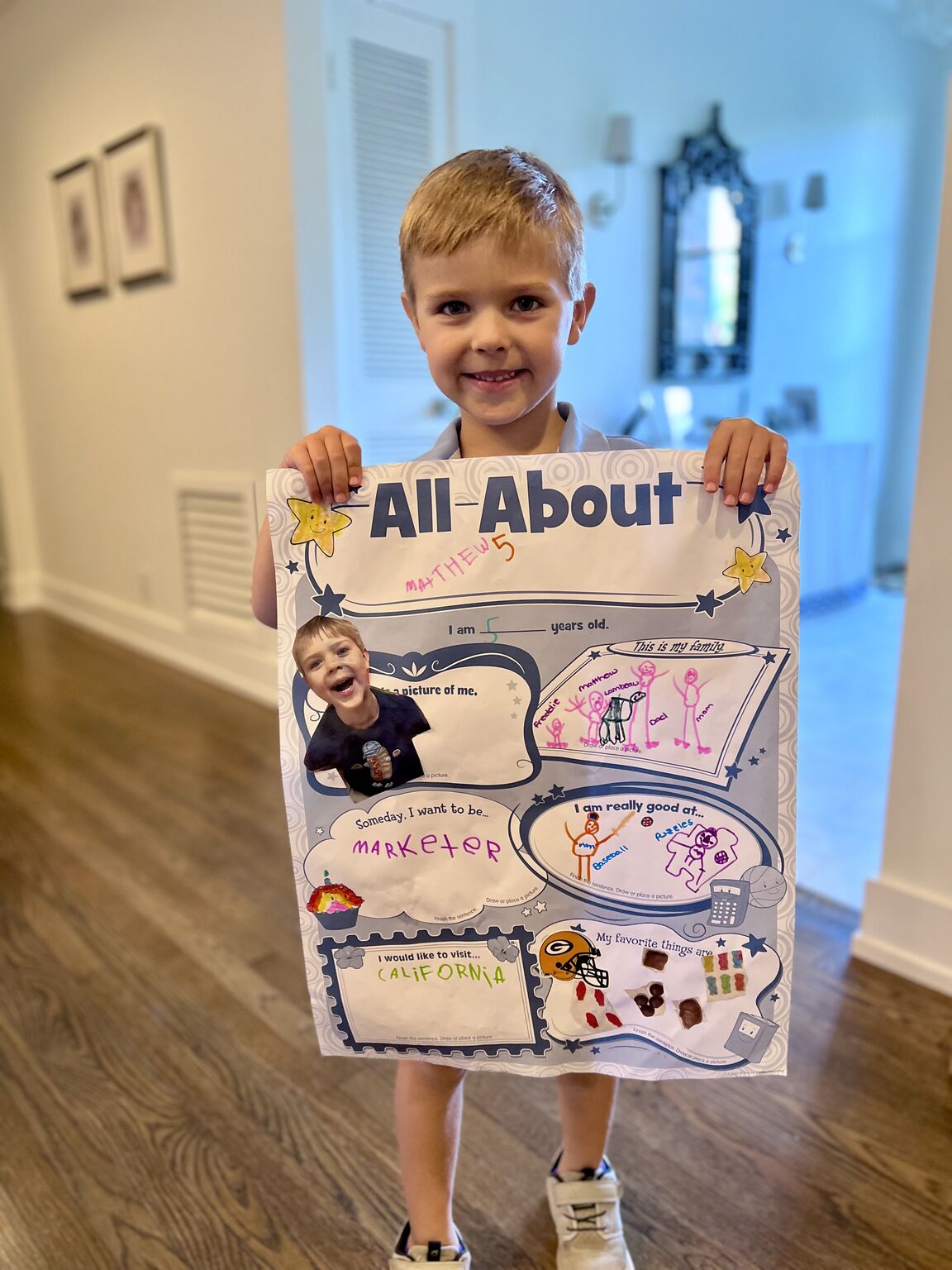
It is easy to make the episode sentimental and miss its sharper point. Work is observable. A child cannot parse an attribution model, but he notices attention, language and purpose. Employees do too. So do customers. Wild turned the moment into a reminder to do the work with purpose because it may inspire someone unexpected. In an industry that tracks nearly everything, influence remains the shipment with the least predictable destination.
Writing for people who have freight to move
At FreightWise, Wild's byline appears on subjects that reveal both the breadth and the practical boundaries of her role: holiday shipping deadlines, parcel-contract negotiations, customer case studies, technology awards, carrier partnerships and product announcements. In June 2026, she published the launch of FreightWise Intelligence, a set of business-intelligence dashboards embedded in the company's transportation management system. The positioning was pointed. Users would not need a separate login to another visualization tool. The information would sit where they already rated and routed shipments.
The idea mirrors her marketing rebuild. Useful information should arrive inside the work, not orbit it. The new dashboards cover multimodal spend, budget control, surcharges and recommendations. Her website project connected marketing and sales systems for much the same reason. Friction has a compounding cost, whether it appears in a parcel contract or between two pieces of software owned by the same company.
Visibility. Not the vague sort measured in impressions alone, but visibility into what people did and what happened next. Connection. Not networking as collection, but systems and teams passing useful context. Measurement. Not a dashboard as decoration, but numbers that alter a decision. Wild works in an industry where a minor rate detail can become a large expense at volume. Her marketing instinct follows the same logic: small disconnects are rarely small for long.
Outside the corporate frame, her record includes a weekly high-school Bible study at First Presbyterian Church of Nashville, elementary-school mentoring through Preston Taylor Ministries, and service as secretary of the Jack C. Massey Graduate School of Business Alumni Board. These commitments fit quietly beside her professional method. They depend on showing up, listening closely and making complexity less intimidating for another person.
The FreightWise assignment is still young. Its first chapter was structural: sort the pages, connect the tools, make two brands legible, build a base sturdy enough for speed. The next is visible in the stream of product and partnership writing appearing under Wild's name. FreightWise is asking smaller and midsize shippers to see their transportation data as a strategic asset. Wild's task is to make that claim clear without pretending freight is uncomplicated.
She has the right biography for the contradiction. An analyst who became a storyteller. A remote-work believer delighted by an office prank. A marketer who once thought marketing meant brochures, now watched by a son who wants the same profession. The systems matter because people rely on them. The story matters because people must decide. And somewhere between a shipping interface and a five-year-old's marker, Katie Wild has found the line she keeps working: make the complicated useful, then make sure it connects.