On February 27, 2025, Oppenheimer announced a change that would require almost no adjustment to the surname on the chief executive’s door. Albert G. Lowenthal would step aside. Robert S. Lowenthal would take over. After forty years under the father, the firm would be led by the son. The announcement was brief enough to fit the familiar outline of a family succession. The preparation had been rather less brief: Robert had joined the business in 1999.
Twenty-six years is a considerable interval between arriving and receiving the top job. It leaves room for several versions of a company, a financial crisis, new technologies and the discovery that a management committee is capable of consuming an afternoon. By the time Lowenthal became CEO in May 2025, his responsibilities had ranged from information systems to bonds to investment banking. The family connection was obvious. The variety of the apprenticeship deserves a look of its own.
The family name, and the work behind it
Robert, usually called Rob, had already supplied a compact description of the relationship. In a 2023 interview, he called his father “my mentor and a demanding boss.” Six words, and a useful correction to the idea that a family business is necessarily a relaxed place to work. The affection and the reporting line occupied the same sentence. Anyone who has worked with a parent can probably appreciate the administrative possibilities.
Bud Lowenthal had led Oppenheimer and its predecessors since 1985. His tenure included fifteen strategic acquisitions. By the succession announcement, the business had become an international financial firm, with wealth management, investment banking and capital-markets operations. He would remain chairman of the parent company and become executive chairman of its principal operating subsidiary. The transition changed the chief executive; it retained the predecessor’s involvement.
Rob’s own public response was measured: “I am honored to be appointed CEO of Oppenheimer.” He emphasized the opportunities ahead and service to shareholders, employees and clients. The language suited a transition planned over years. He had become president in 2021, with the appointment explicitly presented as part of a long-term succession plan. The final promotion had a visible runway.
An education in the machinery
Lowenthal earned his BSBA at Washington University in St. Louis in 1998 and joined the firm the following year. He later earned an MBA at Columbia Business School. His early career at Oppenheimer included serving as senior vice president and chief information officer, overseeing information systems and the modernization of core infrastructure. Before he led businesses that sold advice and access to capital, he worked on the machinery that allowed the organization to function.
That detail changes the emphasis of the biography. Infrastructure rarely gets the flattering photograph. Yet a financial firm’s systems sit beneath its transactions, information and daily work. Having responsibility for them gives a future executive a different point of entry into a business usually described through deals and markets. Lowenthal’s route began with the internal workings as well as the outward-facing services.
In 2007, he became head of taxable fixed income. In 2012, his remit expanded to global fixed income, including public finance and municipal sales and trading. He joined the board in May 2013. In 2016, he became head of investment banking, with responsibility for capital raising and advisory services. The sequence moved from infrastructure to markets to corporate transactions, then toward responsibility for the whole enterprise.
- 1999Joins the firm
- 2007Taxable fixed income
- 2012Global fixed income
- 2016Investment banking
- 2021President
- 2025Chief executive
Six milestones. Several different views of the same business.
These were overlapping forms of education. Fixed income involved sales, trading and research. Investment banking involved companies seeking capital or advice about transactions. Board membership added governance. His committee responsibilities included chairing the Management Committee and co-chairing the Risk Management Committee. Growth and risk appeared in the same job description, which is usually where the interesting disagreements begin.
“my mentor and a demanding boss”Rob Lowenthal on his father · 2023
A firm older than its current name
To understand what Lowenthal inherited, it helps to separate the age of the institution from the name on the building. Oppenheimer traces its roots to Fahnestock & Co., founded in 1881. In 2003, Fahnestock took the Oppenheimer name after acquiring the private-client and asset-management divisions of CIBC’s American business. Rob had already been at the firm for several years when that happened.
Another CIBC transaction followed in January 2008, adding American capital-markets capabilities. The timing supplied its own commentary. The financial crisis soon put pressure on the acquired business. Looking back in his later account of the firm’s history, Bud acknowledged the difficult timing while crediting the people and capabilities that came with the acquisition. Institutional longevity, in that telling, included decisions whose benefits took time to emerge.
Rob’s career in fixed income crossed that period. His eventual CEO appointment therefore followed years inside a business being reshaped by acquisitions and market disruption. The current organization combined private-client relationships with institutional markets and banking. Learning one division could take years; understanding how the divisions belonged together was a larger assignment. His succession story runs through that changing organization.
The presidency added another stage before the handover. When his appointment was announced in November 2021, the board’s approval was unanimous. He continued to lead investment banking while taking on the broader title. This made the succession something colleagues could observe over time: the prospective chief executive was already working across businesses, rather than arriving with a new title and an unfamiliar map. For a company organized around professional relationships, that period of overlap had a practical use. People could know the successor through decisions and shared work before the succession itself became news.
A return to St. Louis
In March 2025, between the announcement of his appointment and its effective date, Lowenthal returned to another institution in his life. Olin Business School recognized him with a Distinguished Alumni Award. The ceremony took place on March 27 at the Missouri Botanical Garden. His BSBA class year was 1998. Twenty-seven years later, the university was recognizing the professional life that followed it.
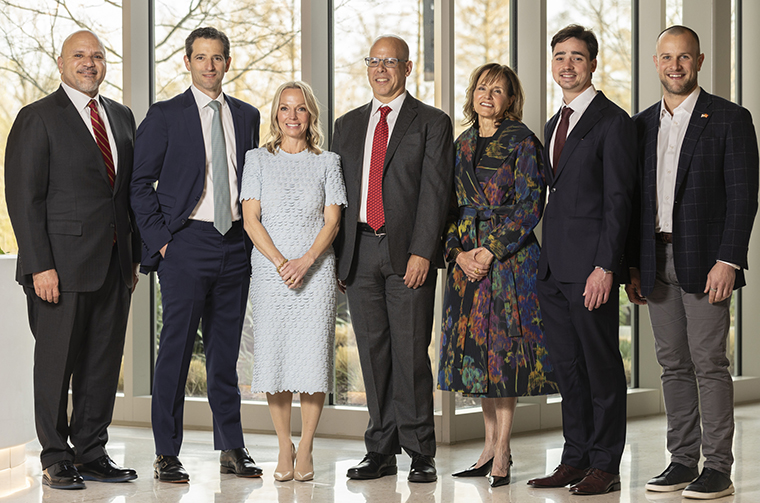
The university connection extends beyond the award. Olin lists him among its National Council members. Its biography also places him on the board of the U.S. Chamber of Commerce and records a domestic detail: he lives in New York City with his wife and two daughters. These are modest coordinates around a career largely documented in appointments, committee responsibilities and financial businesses.
The award photograph offers a welcome change of scale. Here he is among fellow graduates and a dean, rather than appearing as the solitary face of a corporate announcement. The school also produced a video recognizing his career. A university can keep the class year attached to an executive long after the executive’s business card has become considerably more crowded.
The numbers arrive after the title
Lowenthal became CEO during a financially strong year for Oppenheimer. For 2025, the company reported approximately $1.6 billion in revenue and $148.4 million in net income, compared with $71.6 million in net income in 2024. Those are company results for full calendar years. He held the CEO role for part of 2025; the performance also reflected work by teams and investments made before the transition.
Full-year net income
Oppenheimer Holdings Inc. · U.S. GAAP · Years ended December 31.
Lowenthal became CEO in May 2025. Figures describe the company.
The next year brought a more complicated earnings picture. For the second quarter of 2026, revenue reached $454.9 million, up 21.9% from the comparable quarter. Reported net income was $27.4 million. Across the first six months, however, reported net income was $6.8 million, compared with $52.3 million a year earlier. Rising revenue and falling first-half earnings sat beside each other.
The distinction matters. First-half results included a $70 million pre-tax accrual related to settling cash-sweep litigation and expenses tied to stock appreciation rights for financial advisors. The company’s adjusted, non-GAAP first-half net income was $93.2 million, excluding those items. The reported and adjusted figures answer different questions. Keeping both visible gives a clearer picture of the business Lowenthal was now responsible for leading.
Getting the departments to talk
One of his continuing priorities is connecting Oppenheimer’s businesses. In March 2026, the firm named Chris DeFalco and John Hyland co-heads of Equity Capital Markets. Peter Bennett moved to lead Corporate Executive Services. Lowenthal described Bennett’s move in terms of linking investment banking with wealth management as clients’ needs changed. An organization chart became a practical expression of the strategy.
For a firm serving both companies and individuals, those connections have an obvious purpose. A client’s requirements can cross departmental boundaries. Lowenthal has led enough of those departments to know their different responsibilities. The appointment supplies a specific example of his collaboration agenda: assign someone to a role intended to strengthen the connection, then give the teams a reason to work together.
His technology agenda remains present too. The firm’s executive biography emphasizes digital transformation, talent and new revenue streams. His first annual-report letter as CEO discusses better data architecture and the eventual use of AI tools as they become more usable and trustworthy. The former information-systems executive is still concerned with the foundations. Technology changes; the need to make it useful survives.
That is where the long apprenticeship becomes relevant to the next chapter. Lowenthal now leads an institution whose roots predate his arrival by more than a century. He knows several of its working parts, has lived through its changes and has taken over from a father who remains involved. The succession is complete. The daily job is to keep the people, systems and businesses working together when the market declines to follow the plan.