Robert F. Smith reached the end of his Morehouse commencement address with something considerably more useful than advice. It was May 19, 2019. He had talked about work, risk, community and his mother. Then he told the graduating class that his family would make a grant to eliminate their student loans. Most commencement speakers offer a metaphorical door to the future. Smith had brought the money to settle an actual bill.
“And my family is making a grant to eliminate their student loans.” The sentence required a moment to land. Smith had received an honorary doctorate and adopted the graduates as his classmates. Now that ceremonial kinship had financial consequences. He asked them to pay the gift forward. A graduation speech had acquired an unusually demanding sequel.
A graduation present with paperwork
By September, the promise had become a $34 million contribution to Morehouse’s Student Success Program. Eligible education debt held by parents and guardians was included. The distinction mattered: a diploma belongs to one person, but the borrowing that makes it possible can be distributed across a household. Smith’s gift followed those obligations beyond the graduate.
The college specified eligible loans, documentation and balances. There would be principal and interest to reconcile. There would also be a question worth studying: how would graduates’ choices change when education debt was reduced or removed? Morehouse planned research into that freedom. The ceremony supplied the unforgettable scene. The less photogenic work afterward made the promise usable.
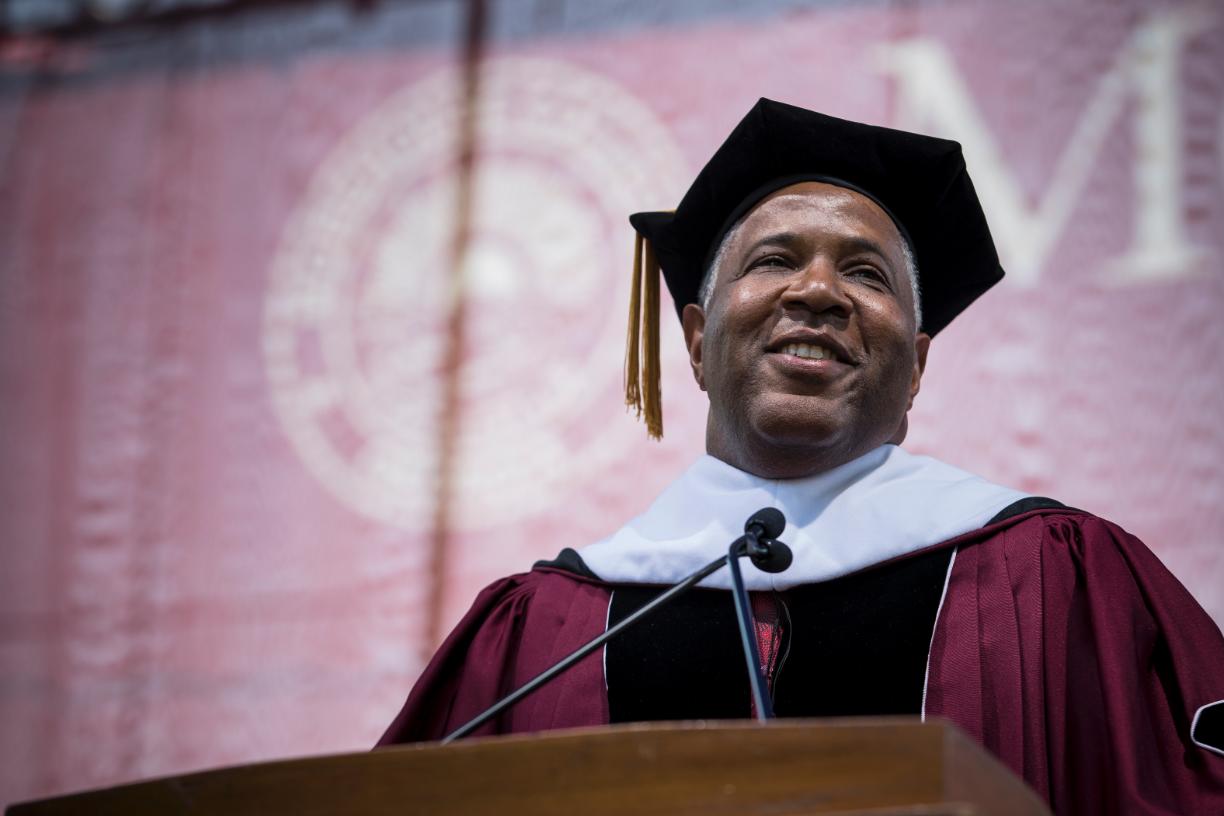
Eligible education loans for the graduating class and parents or guardians.
The household with a standing commitment
Long before the Morehouse announcement, giving had a regular place in Smith’s childhood home. His mother, Sylvia, sent $25 a month to the United Negro College Fund. The amount was modest beside her son’s later gifts. The repetition was the point. Support for somebody else’s education belonged among the things a family did, month after month.
Born in Denver on December 1, 1962, Smith grew up with two educator parents. His account of his neighborhood includes older children tutoring younger ones and adults serving as mentors. Education came with people attached. Opportunity meant access to a school, certainly, but also access to somebody who could show a child what to do next.
His mother took him to the 1963 March on Washington as an infant. He could not remember hearing Martin Luther King Jr. speak; he inherited the meaning of being there through family stories. Six decades later, he spoke at the march’s anniversary. In this family, history was something parents made an effort to put their children near.
As a high school student, he wanted an internship at Bell Labs. The positions were intended for college students. Smith’s account has him calling every week for five months until he secured a place. Persistence is an agreeable résumé word. Five months of telephone calls gives it a less elegant, more useful shape.
“Potential is no guarantee of progress.”
Robert F. Smith, Giving Pledge letter, 2017
An engineer follows the money
At Cornell, Smith studied chemical engineering, graduating in 1985. His working life included Goodyear Tire and Rubber and Kraft General Foods. At Kraft, he obtained two U.S. and two European patents for coffee filtration systems. Before he became associated with the economics of software, he was occupied with the engineering of something people could drink.
He earned an MBA at Columbia Business School in 1994 and joined Goldman Sachs in technology investment banking. The move took him first to New York and then to Silicon Valley, where he worked on technology mergers and acquisitions. His technical education now sat beside another kind of problem: deciding what businesses were worth and how they might fit together.
Smith founded Vista Equity Partners in 2000. Enterprise software became its focus. This is technology encountered in the course of doing a job, often with little ceremony. It helps organizations carry out their operations. A consumer may never know the name of the company behind it; the people using it at work have reason to care whether it functions.
The career changes worried his grandfather. In the Morehouse address, Smith recalled how reassuring a stable engineering position had seemed to the older man. Leaving for graduate school was unsettling. Leaving Goldman to start a firm brought another round of concern. Smith described studying his options before taking those risks. Within the family, the celebrated entrepreneurial journey came with perfectly sensible objections.
Chemical engineering
Goldman Sachs
Enterprise software
Education debt relief
The obligation on the other side of the ledger
Smith’s public record also includes an admitted tax evasion scheme. In October 2020, he entered a non-prosecution agreement with the U.S. Department of Justice. He admitted involvement in an illegal arrangement that used an offshore trust structure and bank accounts to conceal income and evade taxes between 2000 and 2015.
The agreement required more than $139 million in taxes and penalties, cooperation with government investigations, and abandonment of approximately $182 million in protective refund claims. Some of those claims concerned charitable contribution deductions. These were substantial obligations arising from admitted conduct. The agreement’s legal form was non-prosecution; describing it accurately requires keeping that distinction intact.
The Morehouse gift and the tax agreement both belong in an account of Smith’s life. One changed the financial circumstances of graduates and their families. The other established his involvement in evading obligations of his own. Admiration for a donation cannot settle that part of the record. A profile has to make room for both.
After the one-time gift
Morehouse presented an obvious problem of repetition. One graduating class could receive a gift; the next would still need financing. Smith helped create Student Freedom Initiative, contributing $50 million personally to match Fund II Foundation’s $50 million. He serves as the organization’s chairman and is the foundation’s founding director and president.
The initiative offers an education-financing alternative for eligible STEM students at participating historically Black colleges and universities, other minority-serving institutions, and tribal colleges and universities. Its work also includes support intended to help students move toward employment. A recurring organization has a different job from a commencement donor: it must keep operating after the camera leaves.
At Cornell in 2022, Smith announced another $15 million gift for engineering student aid and support. It included attention to undergraduates arriving from urban high schools and graduate students who had attended HBCUs. Scholarships and fellowships addressed the price of entry; a student success fund supported activities such as mentoring, professional development and connections with employers.
Those details make the educational ambition more concrete. Paying tuition gets someone into a classroom. Attending a conference, meeting an employer or finding a mentor can affect what happens afterward. Smith’s Bell Labs story gives this work a personal reference point: somebody eventually gave a persistent young applicant a place to learn.
Who gets remembered, who gets heard
Education is one part of Smith’s public giving. In 2016, he donated $20 million to the National Museum of African American History and Culture. The gift supported digitization, community outreach and curatorial initiatives. Its family history center bears his name. The work makes room for ordinary families’ records and experiences alongside the biographies of people already familiar to the public.
There is a recognizable connection between the software investor and this kind of preservation. Technology can make a record accessible beyond the place where it is stored. The museum’s community-curation work also supports the people who collect and interpret those records. Preserving history requires equipment, certainly, and people who know which questions to ask.
Smith became Carnegie Hall’s chairman in 2016, having joined its trustees in 2013. His involvement includes support for music education. In 2017, he joined the Giving Pledge, committing the majority of his wealth to charitable causes. His pledge letter placed technological change beside the need to broaden participation in the opportunities it creates.
His 2025 book, Lead Boldly: Seven Principles from Dr. Martin Luther King, Jr., pairs King’s speeches with Smith’s reflections. Bernice King wrote the foreword. The connection reaches back to his mother’s journey to Washington with her infant son, then forward to his own attempt to explain what leadership and economic opportunity should mean in practice.
The next calculation
In 2026, Smith’s business attention is on software that can execute work through AI agents. His February outlook argued that enterprise software companies would face uneven prospects as the technology changes. In April, Vista announced a Google Cloud partnership to support AI development and deployment across its portfolio. The announcement included engineering resources as well as access to models and infrastructure.
In June, Vista and Cambium launched Vector Core Compute, an enterprise AI inference cloud. By October, Smith was continuing the discussion in television interviews about agents and software’s place in the AI trade. These developments describe a direction of investment. Their eventual business results will have to emerge over time.
The question of participation remains. Smith has spent his investing career choosing software businesses and his philanthropic career financing access to education, work and cultural institutions. At Morehouse, those interests produced a specific transfer with a specific purpose. Hundreds of graduates could begin the next stage of their lives with different obligations.
The enduring question is what they can do with that room. Smith asked them to help others in turn. It was a generous present with an assignment attached, which seems fitting for the son of two teachers.