Sanish Mondkar went looking for his next chapter and found himself asking questions about other people’s shifts. After leaving SAP, he took a two-month road trip, talking with small-business owners and employees beyond the Bay Area. Owners described the familiar pressures of labor budgets and compliance. Employees described flexibility, or the absence of it, and the suspicion that a manager’s favorites got the better hours. The same schedule looked quite different depending on which side of it you stood.
For somebody accustomed to enterprise software, it was an invitingly awkward problem. A business could count its labor costs with considerable precision while knowing rather less about the experience those costs purchased. The people appearing as rows in the schedule had preferences, availability and reasons to leave. Their lives continued after the spreadsheet closed.
Mondkar had heard customers talk about labor challenges during his SAP years. Those roadside conversations gave the question another dimension. He came back and had a long discussion with investor Ross Fubini, whom he had met before founding Legion. His emerging conviction was that solving the employer’s problem required taking the employee’s problem seriously too.
A desk next to the coffee boss
Legion was founded in 2016. Its early proving ground was Philz Coffee, a setting where an abstract debate about workforce management could meet the next morning’s opening shift. Mondkar approached Jacob Jaber with an idea still awaiting a product. Jaber offered something unusually useful: a customer willing to help him build it, office space and access to the stores.
The former corporate product executive now had managers and baristas close at hand. He worked as a barista himself while researching hourly work. Enterprise software can acquire a rather splendid vocabulary for ordinary difficulties. Behind a coffee counter, a staffing gap has the advantage of announcing itself without a slide presentation.
The pilot was deliberately patient. Mondkar describes an 18-month closed beta with Philz and a desk next to its CEO. Fubini supported the period of concentrated development without pushing the company to start selling to more customers. The challenge was to establish that the product could make a meaningful difference before trying to multiply it.
“I had a desk next to the CEO.”Sanish Mondkar, on building with Philz Coffee
By September 2017, Philz had deployed Legion across 40 locations serving 1,000 hourly employees. That was a concrete test of the proposition. A schedule had to satisfy people who wanted control over their hours while keeping the café properly staffed. Neither side could simply be wished out of the calculation. The coffee still had to arrive.
A working deployment before the wider sales push.
The engineer brings his old tools to a new problem
Mondkar’s education connected computer engineering at Pune University with a master’s in computer science at Cornell. His working career took him through engineering and product leadership at Ariba, where he helped build enterprise products including the Ariba Network. At SAP, he became executive vice president and chief product officer, responsible for procurement and business network products representing more than $1 billion in annual revenue.
That background matters to the sort of founder he became. He had experience making complex business software, with all the connections and operating demands that entails. Legion asked him to apply that experience to a user whose working day might leave very little room for software.
The scheduling problem itself was technical enough to reward the engineer. Before assigning a person to a shift, a business needs some idea of demand. Before making that assignment useful, it needs to know which people are available, which have the necessary skills and what they prefer. Labor budgets and operating constraints enter the same calculation.
Mondkar’s early product work combined demand forecasting with scheduling. Machine learning could estimate the business’s needs; optimization could help fit those needs to the workforce. An employee’s preferences became an input to the system rather than a favor to be negotiated after a manager had finished it.
Conceptual illustration of Legion’s approach; not a performance chart.
In his conversation with Jeremy Weisz, Mondkar explains the flaw he saw in the older category: workforce management had opportunities to give employees something useful in their regular interactions with it. Payroll accuracy and cost control remained necessary. But the software could also help people manage the hours around which they organized their lives.
The arithmetic of staying
There is a practical business argument beneath Mondkar’s interest in the employee. Replacing workers takes effort. Managers need to recruit, train and bring new people into the day’s operations. A labor calculation that treats each hour as interchangeable can overlook what happens when the person providing it decides to leave.
Legion’s proposition makes retention part of the efficiency discussion. Give workers useful control over schedules and the company may improve their experience while reducing the friction that sends them elsewhere. Mondkar has also discussed self-service and access to earned wages as parts of the employee offering. The ambition is to make the platform worth opening from both sides.
That argument attracted capital early. Norwest led a $10.5 million Series A in 2017, with partner Sean Jacobsohn joining the board. Fubini’s involvement extended across fundraising, product focus, sales and hiring. This was a founder with substantial executive experience making his first company, drawing on people who could help with the unfamiliar parts.
In May 2021, Legion announced a $50 million Series C, only nine months after its $22 million Series B. Mondkar’s account of that period emphasizes customer collaboration and the gap between the digital flexibility offered to salaried employees and the tools available to hourly workers. The financing was intended to accelerate product development and growth.
Another $50 million growth investment followed in May 2024, led by Riverwood Capital. The stated plans included research and development, expansion of the employee offering and a European go-to-market team. December brought $50 million in financing from Silicon Valley Bank, taking Legion’s announced total funding to $195 million. Investment and financing are different instruments, even when both enlarge the number in the announcement.
The figures show the resources gathered around his thesis. They cannot, by themselves, describe what a barista thinks of next week’s hours. That distinction keeps the story grounded: Legion’s capital enables work on the problem; the experience of the people using the product is where the proposition must prove useful.
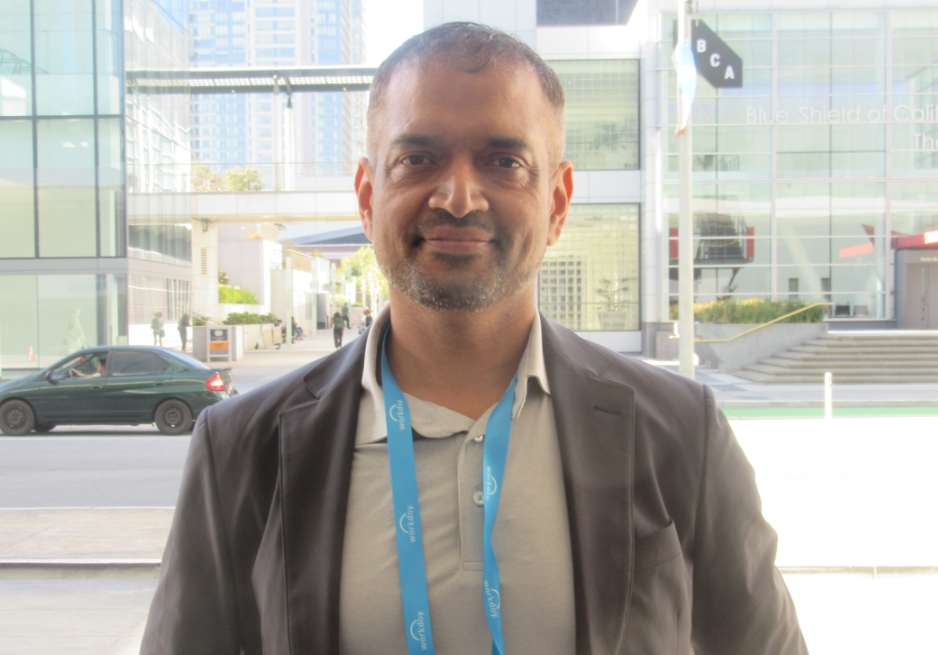
Software for people who are standing up
By the time conversational AI became a regular part of enterprise software pitches, Legion had already been applying machine learning to demand forecasting. Mondkar’s interest in a natural-language interface follows from the setting. Store managers and hourly employees often work away from desks. Learning another sequence of screens competes with the job they are there to do.
At Workday Rising, he described Legion’s integration with Workday employee records and its mobile tools for scheduling, shift changes and employee self-service. The platform was intended to fit into an employer’s existing systems. Its usefulness depended on making daily work easier without requiring a manager to become a software enthusiast first.
Conversational tools offer another route into those functions. An employee or manager can ask a question in familiar language instead of hunting for the right screen. The design opportunity is attractive precisely because the underlying work is complicated. A simple request may involve several constraints; the interface has to carry that complexity responsibly.
In September 2026, Mondkar emphasized that AI must be explainable, auditable and governed, with managers remaining accountable and in control. Legion’s annual hourly-workforce research also found that 53% of employees surveyed named control over their schedule as a top priority, ranking second to pay. It is a company survey, and a useful reminder of the concern that first drew him toward the business.
Ten years later, the question survives
Legion’s tenth-anniversary reflections in April 2026 include a telling early correction. The company had data about turnover, but operators supplied accounts of particular employees and the reasons they had left. Mondkar’s lesson was to pair the numbers with real customer conversations. A clean explanation in a dashboard can become rather untidy when somebody who knows the people starts talking.
He also discussed a verification capability for AI assistants, intended to check numerical answers and the conclusions drawn from them. The priority is understandable. A fluent answer about labor carries little value if it leaves a manager with an unreliable decision. His enduring interest lies in what the tool enables people to accomplish.
“Ultimately, AI is the how.”Sanish Mondkar, reflecting on Legion’s next decade
The business has moved far beyond its first cafés. In February 2026, Wolt selected Legion for workforce management across 20 countries in EMEA, with full deployment planned for that year. A January partnership with Rebus connected warehouse operational data to labor forecasting and scheduling. Different environments bring different demands, while the underlying need to match people and work remains familiar.
Legion appeared on the Inc. 5000 for a fifth consecutive year in 2026, ranked 1,916 with 179% three-year revenue growth. That gives the early pilot a measurable sequel. Mondkar’s ambition for the twentieth year is more personal to the original problem: he wants the company’s attention to employees to improve their experience and reduce turnover across industries.
The route there began with a successful executive giving himself permission to be curious about an ordinary transaction. He asked the person serving the coffee about the working week behind it. Ten years of company building have made the machinery more elaborate. The question remains close enough to ask across a counter.