In April 2020, Rishikkes Pawar had a peculiar shopping decision to make. He could leave Digitalzone behind and start another business. Or he could buy full ownership of the company that had already occupied six years of his life. Starting again offered a clean page. Staying meant accepting the bill for the pages already written.
He stayed. Pawar describes taking sole ownership, assembling six months of financial runway and building a US sales team. The immediate problem was customers: Digitalzone had few direct relationships of its own. He needed to understand the selling as closely as the delivery. A founder can own every share and still have considerable homework.
The choice helps explain the business he leads today. Pawar is Digitalzone’s founder, chairman and CEO, based in New York. His career has become an exercise in deciding what to keep, what to change and, eventually, what to stop.
A business stretched between two cities
Pawar grew up in a village near Pune. He describes beginning his entrepreneurial journey in 2014, after leaving college, with money borrowed from friends. The company’s own history begins in 2013. His involvement and the company’s founding date belong to adjacent chapters.
He hired his first US employees in 2019 and moved to New York in 2020. The international arrangement took shape around a practical division: sales and marketing close to overseas customers, operations in India. Geography became part of the economics of the business.
By December 2023, Digitalzone was serving more than 350 midmarket and enterprise customers. Its presence extended into Europe, including the UK, Spain and the Netherlands. Pawar’s argument was straightforward: businesses still needed help filling their sales pipelines when budgets were difficult, and an operation spanning markets could deliver that help cost-effectively.
That arrangement also gave him a reason to think carefully about automation. Customers were pointing out processes in their marketing journeys that software could simplify. Digitalzone had hired a chief product officer and was adding engineering leadership. A service business was developing more of the machinery behind its work.
Growth requires other names on the door
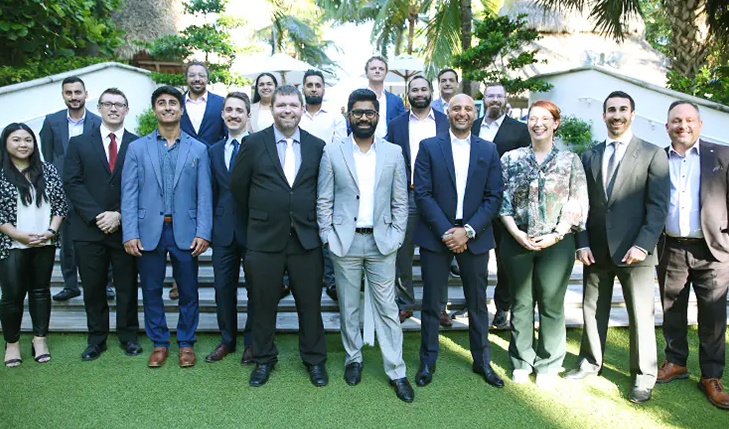
In November 2022, Digitalzone brought its US and India management teams together in Miami for a quarterly review. The company said its workforce had passed 350 people. Eight colleagues received promotions to vice president or director. Another 81 had joined the team during the quarter.
The gathering paired performance reviews with plans for further expansion into Europe, the Middle East, Africa and Asia Pacific. For Pawar, growth included training, sharing knowledge and giving employees new opportunities. The company reported a 96 percent renewal rate at the time. Keeping existing customers was part of the expansion story.
The following April brought a more public statement of intent. Eboni Ryan joined as head of global marketing, Paul Noonan as vice president of US sales and Victoria Tinsdale as senior director of EMEA sales. Their backgrounds included Merkle, Integrate, emedia, Madison Logic and TechTarget.
Those appointments matter in a founder’s biography. They show responsibility acquiring names besides his own. Expanding into a market means finding people who know its conversations, its expectations and the small reasons a potential customer might hesitate.
A refreshed logo and website arrived with the appointments. More consequential was the promise behind the presentation: proprietary data, greater transparency and control over campaign delivery. Digitalzone wanted to own more of the process connecting a client’s marketing plans to the people those plans were supposed to reach.
year over year
during the year
reported for 2023
The operating figures for 2023 made the scale of that work clearer. Digitalzone reported generating more than 900,000 leads for customers, alongside 54 percent revenue growth. It added 130 clients and reported 95 percent client retention. These were company figures, describing a particular year rather than a permanent speed.
Hiring moved faster than the company had planned. Headcount increased 92.6 percent against an initial target of 50 percent. Its reported workforce composition shifted from 33 percent women in 2022 to 48 percent in 2023. Growth was changing who worked there as well as how much work passed through the business.
The person inside the account
To understand Pawar’s product thinking, begin with an ordinary complication. A business buying software contains several people who may want different things. One researches. Another evaluates. Somebody else controls the budget. A company name on a prospect list tells a salesperson very little about which of them is ready to talk.
Pawar’s explanation of Programmatic Nurture, introduced in January 2025, starts with that distinction. Digitalzone aimed to identify individuals showing buying interest inside relevant accounts, then connect campaign activity to those contacts. The unit of attention became the person making or influencing a decision.
He describes a system drawing on Digitalzone’s data cloud and contact identity graph. Its Journey Pixel tracks activity across campaign properties; Journey Reporting brings the touchpoints into one view. The intended benefit is visibility: helping marketers see how a prospect’s engagement develops and helping sales teams decide where attention is warranted.
The product makes a claim about how marketing work should be judged. A delivered campaign produces activity. A useful report helps a customer decide what to do next. Pawar’s emphasis on reducing waste depends on connecting those two things.
That concern also appears in Digitalzone’s later account of its own change in direction. Pawar kept asking whether the business was solving the problems marketers actually faced. Conversations about data, performance and visibility revealed demand for closer partnerships and clearer reporting.
The company calls this the Art of Listening. The name is polished; the underlying task is familiar to anyone who has had to explain a purchase to a colleague. What happened? What did we learn? What should we spend next? Pawar’s business has to make those questions easier to answer.
Four years, four different numbers
Digitalzone entered the Inc. 5000 at No. 750 in 2023. It ranked No. 291 in 2024, No. 1,420 in 2025 and No. 2,324 in 2026. Four consecutive appearances establish a run of recognition. The changing positions also resist the temptation to draw every business story as an arrow pointing obligingly upward.
- 2023750
- 2024291
- 20251,420
- 20262,324
In August 2026, Digitalzone described a business serving more than 500 customers across North America and Europe. It reported a media network of seven B2B publications and more than three million monthly page views. Its expanding data and identity products were becoming a larger part of how it described itself.
Pawar credited employees, customers and the company’s culture. The scope of the operation makes that attribution practical. A founder cannot personally conduct every campaign, maintain every customer relationship and run every publication. At this size, the quality of the business lives in the work other people can do.
The useful art of stopping
His record includes a venture that did not survive. In a May 2026 conversation with Sohin Shah, Pawar discussed putting time and money into a second company, Sweven Infotech, before deciding to close it. He had tried to diversify while Digitalzone was doing well.
The experience sharpened his questions about new projects: why start, what outcome would justify the effort, and could the same ambition be pursued inside the existing business? He also emphasized setting conditions for stopping. Curiosity needs somewhere to go; a new company is an expensive destination.
That lesson complicates the familiar encouragement to keep going. Pawar had once chosen to stay with Digitalzone. Later, he chose to end something else. Both decisions required judgment about where his effort could be useful.
A classroom after the company
Pawar’s education has continued after his departure from college. His public profiles list Harvard Business School’s Driving Digital Strategy program in 2025 and the Owner/President Management program for 2025-2027. He identifies with its OPM 67 cohort. These are executive education programs, encountered with an operating company already in hand.
His interests range beyond marketing. He says he races cars for the concentration they require and travels to widen his perspective. He studies history, energy, financial systems, defense and space. The calendar of a marketing executive seems an inadequate filing cabinet for all of that.
“I think in decades, not quarterly cycles.”
Rishikkes Pawar
A long horizon still has to accommodate an ordinary working week. In public posts about goals, Pawar stresses deadlines, measurement and adjustment. His colleague Jason Habib has described their conversations as moving from ideas into strategy and execution. Friendship, in that account, comes with follow-through.
There is a connection between those habits and the ownership decision. Taking responsibility creates immediate obligations; thinking beyond the next quarter gives those obligations a direction. Pawar’s story contains both scales. It has the urgency of building a sales team and the patience of learning which ambitions to pursue.
The company he bought full control of in 2020 has become a much larger enterprise. The founder’s work has changed with it. He still has to choose where attention belongs, which people should carry responsibility and when a promising idea deserves to remain an idea. Some of the most consequential decisions leave very little to photograph.