The trouble with a bad lead is that it rarely announces itself. It arrives wearing the uniform of a good one: a name, a title, a company, an email address. Everything has its own column. Someone has paid for it. Someone else is about to call it. The spreadsheet has done its job. Whether the person belongs there is another matter.
- Checks contact details and campaign fit before the sales handoff.
- Works inside INFUSE's demand-generation operation.
- Offers a free first look through the Lead Quality Grader.
Let's Verify by INFUSE occupies that small, consequential gap between acquiring a contact and trusting it. Its work is easy to underestimate because the output looks so ordinary. A corrected record. A rejected entry. One fewer duplicate. But these are decisions about where a sales team will spend its time.
The inspection before the introduction
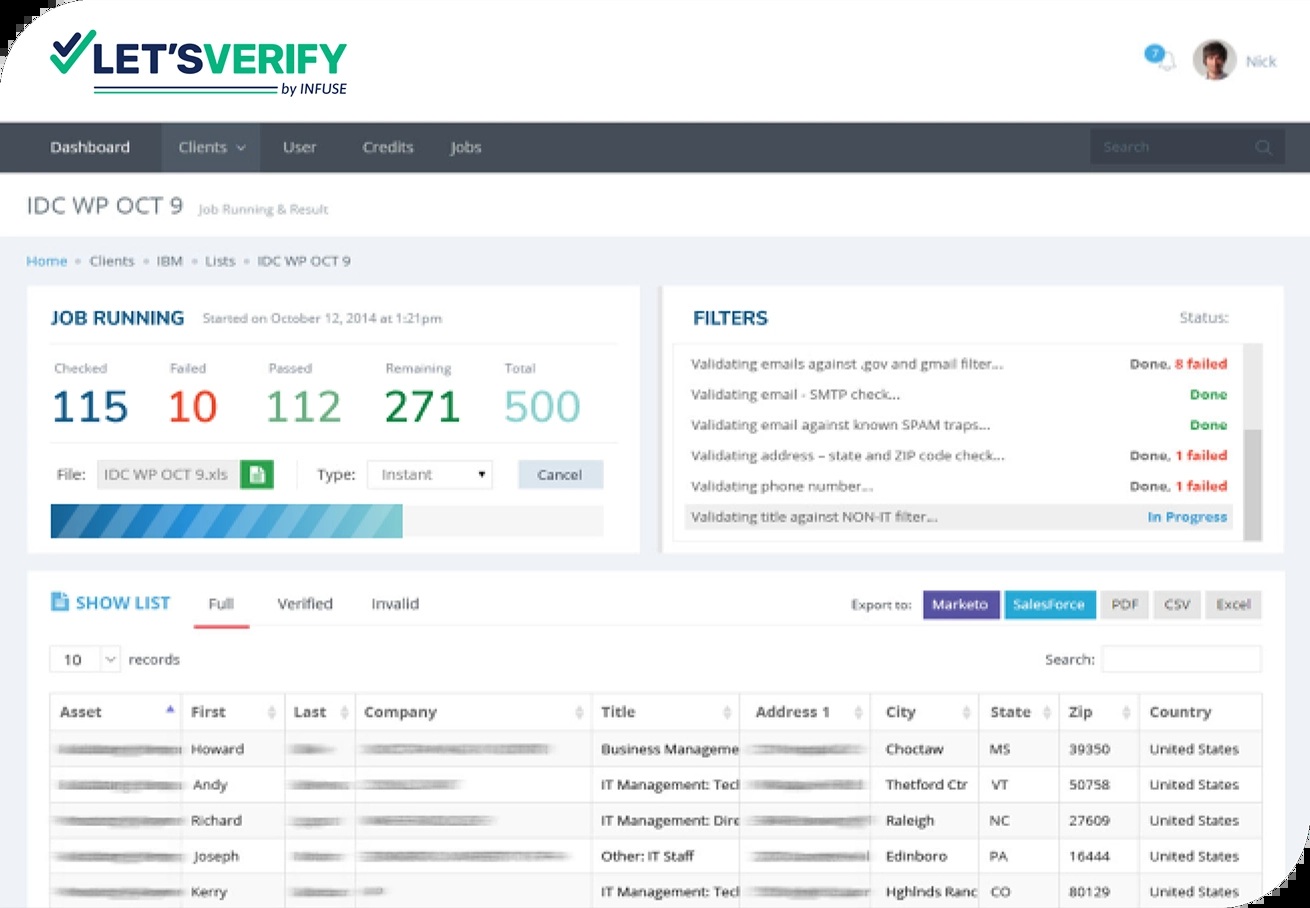
The platform checks names, job titles, telephone numbers, email addresses, company size, industry and location. It also applies a customer's filters. That distinction matters. An email can be deliverable while its owner works in the wrong country or holds the wrong job. Accuracy and eligibility answer different questions.
Data can arrive as a list or through CRM and marketing automation connections; the company names Salesforce and Marketo. It also supports verification and deduplication at the point of entry. Content syndication, webinar promotion, free trials and landing-page campaigns are among its stated uses. The idea is to catch unsuitable records before they acquire a second life downstream.
A hundred little bets
One revealing episode concerns the Lead Quality Grader, INFUSE's free diagnostic powered by Let's Verify. In an account of its early-2021 introduction, INFUSE's Jeff Cleasby describes a targeting problem: the team had a product and needed to discover its audience.
It ran 100 small email-nurture campaigns lasting four to six weeks. The initial hunch favored healthcare or marketing departments in traditional industries. The tests pointed toward marketing agencies, whose client campaigns depended on dependable data. INFUSE subsequently concentrated on agencies and reported winning 69% of opportunities between April and December 2021.
INFUSE's retrospective describes the test. Its reported win rate is a sales outcome, not a validation accuracy score.
The portable lesson is the method: test who feels the problem most acutely. An agency buying leads for another business has a particularly awkward relationship with mistakes. It must explain them to someone who is already paying for results.
The afternoon that disappears
Unifi's experience supplies the human scale. In INFUSE's published case study, the data-discovery company's marketing team had struggled with a thin funnel, data errors and poor communication from earlier agencies. Time intended for attracting prospects was being spent repairing the machinery.
The subsequent INFUSE engagement combined lead generation, creative work, service support and Let's Verify. Marketing director Sara Kinsey described greater confidence in the resulting lead quality and strategy. She also recalled asking the team to add two leads to a suppression list after overlooking the exclusions herself; the response was almost immediate.
“Now that we’re working with INFUSE, I have much more confidence in our lead generation quality and strategy.”Sara Kinsey / Marketing Director, Unifi
That little correction is more instructive than a sweeping promise. Campaign rules can change after the brief is signed. Useful data work includes responding when the customer discovers something new. The engagement addressed both the records and the working relationship around them.
Five became seventeen
West Monroe offers another view. The digital services firm needed to reach named accounts across seven core industry verticals. INFUSE launched five programs at the end of 2021, combining content syndication, nurturing, tailored creative and account targeting.
In 2022, West Monroe expanded to 17 programs. INFUSE's case study reports more than 700 qualified leads and describes Let's Verify as its in-house verification specialists. Those numbers belong to the combined campaign. They do not isolate what validation contributed. Their usefulness is showing where the service fits: alongside the people making the content and finding the audience.
Free diagnosis. Paid execution.
The Grader gives prospects a concrete starting point: a report with rejection statuses, corrections, calculations and clickable source links. Its landing page advertises the analysis as free. That makes the diagnosis useful before a buyer commits to a broader campaign.
INFUSE's commercial programs are scoped around customer objectives. Its pricing page describes cost-per-lead, cost-per-thousand-impressions and fixed-cost arrangements, with proprietary technology included without additional subscription fees. The business therefore has an incentive to make verification part of campaign delivery. The free report also gives its sales team a specific problem to discuss.
For an email-only task, an alternative such as ZeroBounce sells validation through credits and subscriptions. The purchasing question is scope. Does the team need to clean email addresses, or also decide whether contacts meet a campaign brief and coordinate the ensuing work?
The rule worth stealing
My practical reading is simple: write the rejection rules before celebrating the acquisition numbers. Agree on eligible roles, accounts and regions. Distinguish a repeated record from another legitimate person at the same company. INFUSE's dark-funnel guide explicitly warns about losing additional buying-group contacts through mistaken duplicate handling.
A sensible pilot would keep a small, representative sample and record why each entry was accepted or rejected. Review the disputed cases together. If marketing and sales disagree about what qualifies, the disagreement belongs in the brief. Otherwise, a software check simply makes an unsettled argument run faster. This is an editorial recommendation, rather than a reported feature of the product.
Then measure accepted records, correction work and sales follow-up. A verified address cannot establish budget, urgency or willingness to buy. Bad targeting will still produce bad conversations, however tidy the database. Let's Verify's useful promise sits earlier in the chain: give the salesperson a contact that deserves the next question.