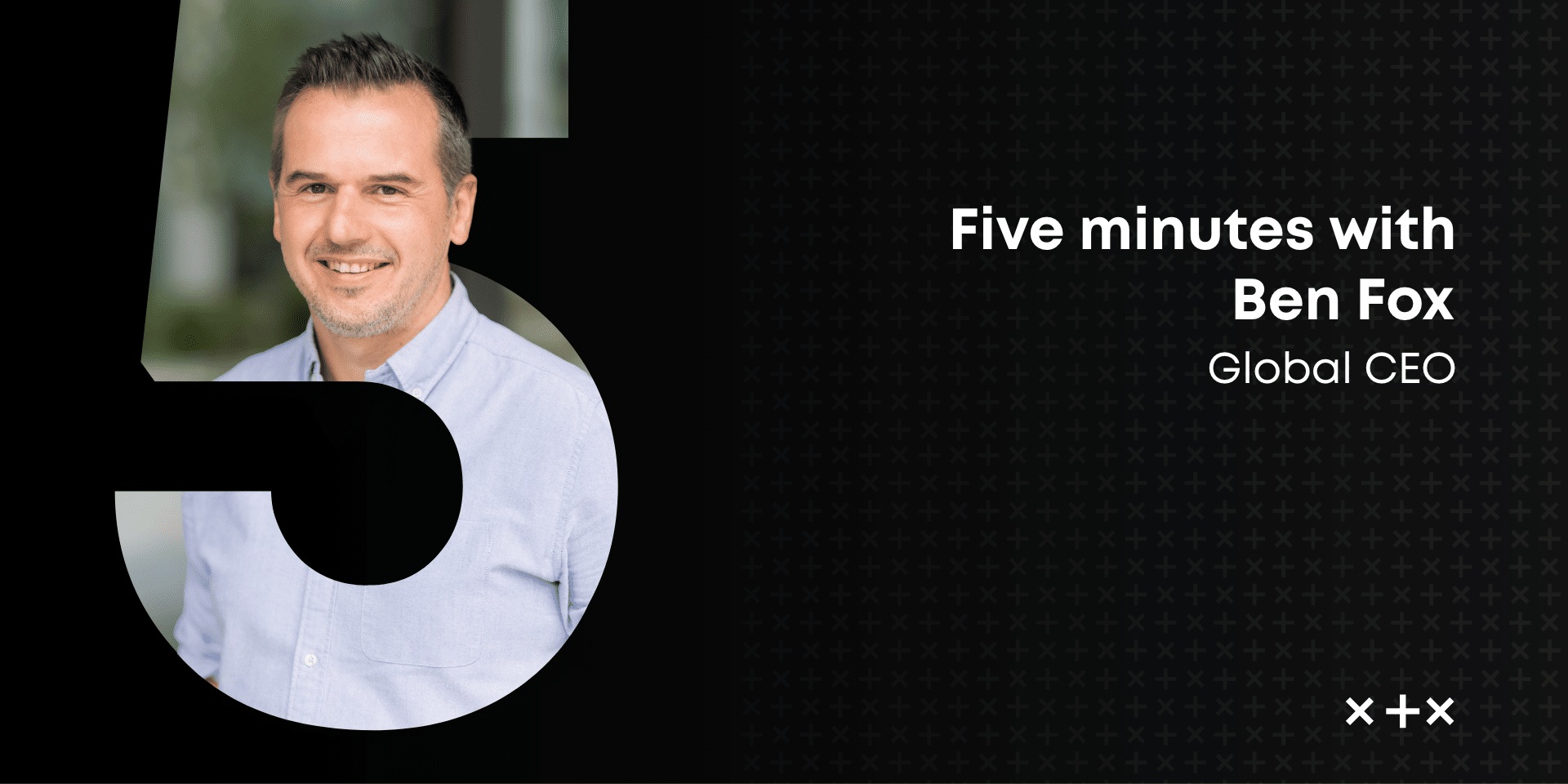
On day one, Ben Fox possessed the traditional founder's inventory: one Dell laptop, one mobile phone and no shortage of nerves. He was at his kitchen table in 2011, excited by freedom and burdened by what he later called a "shedload of fear." There was no mythology yet, merely a man who had spent years looking at agency life from the client-service side and had finally decided to put his own name above the risk.
Fifteen years later, Fox Agency spans the United Kingdom and the United States, employs more than 80 people, and works with international technology businesses. Fox now lives in the New York metropolitan area and carries the title Global CEO. The geography has widened, the laptop has presumably been upgraded, and the central problem has reversed. At the start he had to make the company depend on him. Now he is trying to make sure it does not.
The useful education of client service
Fox entered advertising through media sales, back in what he calls the "dark days before social media." His initial insight was not terribly scientific: the agency people buying space from him seemed to have cooler jobs. He crossed over and climbed the client-service ladder at agencies in northern England, from Account Executive to Account Manager, Senior Account Manager, Account Director and finally Head of Client Services.
This was an apprenticeship in translation. A client says there is a marketing problem; the agency has to locate the business problem underneath it, make the right people care, and deliver something useful before the budget or patience evaporates. Fox learned brands, campaigns, consulting and sales. He also made mistakes, a detail he repeats more readily than the polished founder's retrospective usually permits.
By 2011, the itch to build had become impossible to ignore. His premise was modest and demanding: an agency could be more entrepreneurial, less bureaucratic, closer to clients and kinder to talented people. No revolutionary product, no immaculate plan. Just a belief that good people and genuine partnerships might compound.
Your reputation compounds. Clients come back. Former colleagues become customers. Employees become leaders.Ben Fox
The client that changed the map
The story's hinge arrived in 2018, when Fox Agency won work with BearingPoint, the global business and technology consultancy. Until then, Fox regarded the firm as a strong regional agency. The account offered a larger frame. Here was proof that a business rooted in Leeds could understand a complex international client, navigate technology, and operate across borders.
Many companies respond to such evidence by adding it to a credentials deck and continuing as before. Fox and his colleagues allowed it to alter the company. In 2021 they repositioned Fox Agency entirely around global B2B technology. The choice meant declining the comfort of being useful to almost anyone. It also gave the team a market to study deeply, a reputation to build and a coherent reason for international clients to call.
Five decisions, one widening map
"Focus actually created far more opportunity," Fox has said. The sentence contains a strategy lesson that is easy to admire and unpleasant to practice. Positioning becomes real only when it excludes something. Fox Agency stopped calling itself a general solution and became legible to a narrower group with harder, more specialized problems. That group happened to operate around the world.
The founder becomes the bottleneck
Specialization solved one question and exposed another. How does a founder remain useful when the organization has outgrown the habits that made it possible? Fox describes himself, with economical candor, as a control freak. He likes clients, pitches, growth strategy and possibility. He also admits there is a large difference between being a leader and being a manager, and that people management is not where he is strongest.
That distinction took time to accept. Founders earn their early authority by knowing everything because there is nobody else to know it. Every client worry and hiring decision lands on the same desk. The reflex survives long after it becomes inefficient. What once looked like commitment begins to slow other people down.
The job changes before the title does
At one person, involvement is survival. At 80-plus, the same involvement can become congestion. Fox's answer was to build leadership around the founder, then give it room.
In 2024, Rachel Lofthouse became Managing Director for the UK and Europe, taking responsibility for daily operations there while Fox moved into the Global CEO role. The North American business developed its own senior leadership. Fox could focus on the agency's profile, geographic reach, sector expertise and the connective tissue between markets.
His language about the transition is revealing. Other people, he says, are better than he is at running operations, overseeing accounts and directing the work. He jokes that Lofthouse knows when to listen to his ideas and when to ignore them. Vanity might demand a founder remain the answer to every question. Fox's ambition demands something tougher: a company full of people capable of finding better answers.
Scaling is ultimately less about the founder having more answers and more about building a business full of people capable of finding them.Ben Fox
The American plan gets an address
America had long occupied the plan and, for a while, the category of pipe dream. By 2023, US clients accounted for 30 percent of Fox Agency's global revenue. That July, the agency's work for PHINIA reached the New York Stock Exchange as the automotive company launched its new brand and rang the bell. In November, Fox Agency opened a New York office of its own.
The founder followed in 2025. Fox moved with his family from Britain to the New York area, leaving the UK and European operation with Lofthouse and turning his attention toward US growth. The move made the global title physical. It also created a test of the structure he had been building: could one agency behave coherently across an ocean without routing every local decision through its co-founder?
The early numbers supplied encouragement. Fox Agency reported £11.2 million in global revenue for 2025 and marked its fifteenth anniversary in 2026 with more than 80 colleagues from the UK and US gathered in London. Membership in Worldwide Partners extended its delivery network to more than 90 independent agencies across 50 countries. The company was no longer merely visiting a larger map.
A paper notebook in an AI business
Fox spends his working life around technology brands and expects AI to change agency production, productivity and operating models. His favorite business tool is still a notebook. He calls himself a visual thinker, forever making diagrams and stray sketches that look cryptic to others but clarify a thought for him. There is something pleasingly stubborn in the image: an executive planning technology marketing with ink and paper.
The preference is consistent with his larger argument. As data and automation become abundant, judgment, creativity, storytelling and trust do not vanish. They become the scarce part. His recommended business book is the decidedly pre-digital How to Win Friends and Influence People. When he wants to stop thinking about business, he returns to fiction including Catch-22, The Catcher in the Rye and A Star Called Henry.
He is also willing to puncture the earnestness. After TechRound named him Founder of the Week, Fox compared the distinction with the honor of caring for his primary-school class hamster. The joke does more than make an award bearable. It suggests a useful resistance to founder theater, the performance of always appearing visionary, tireless and magnificently certain.
His actual advice is less glamorous: start before the conditions are perfect; do not confuse bravery with recklessness; protect cash and profitability; pay attention to people; expect to learn by getting things wrong. Success, in Fox's current definition, is not simply a larger agency. It is an agency whose relationships last, whose people become leaders and whose future does not require him to stand in every doorway.
That makes the kitchen table a beginning, not a shrine. The point was never to preserve the founder's heroic centrality. It was to create a place where possibility could outgrow him. Fox Agency's next chapter will involve AI, new markets and another identity. Its co-founder is doing the counterintuitive work of remaining ambitious while becoming less indispensable. For a man who began alone with fear and a phone, that may be the clearest measure of distance traveled.