The employee has not even started, and already six departments want a piece of them. Payroll needs a bank account. IT needs a laptop and a Slack login. Finance needs an expense policy. Security wants permissions. Benefits wants elections. The manager wants all of this finished before Monday. At most companies, the new hire becomes a human packet routed through a relay race of forms, spreadsheets, tickets, and gentle threats.
Rippling's founding observation was that the relay is unnecessary. A person's role, location, manager, start date, and employment status already determine most of what happens next. Put those facts in one dependable record, the company argued, and the surrounding work can fire automatically. A promotion changes compensation and approval limits. A move triggers tax and policy changes. A departure closes app access, retrieves the laptop, and stops the card.
Parker Conrad and Prasanna Sankar started the San Francisco company in 2016. They spent roughly two years building before the product emerged from stealth as an onboarding and offboarding switchboard. The name is the diagram: change one employee record and watch the consequences ripple outward. Today those ripples reach more than two dozen products across HR, IT, payroll, global employment, and finance.
The product is the connection, not the menu
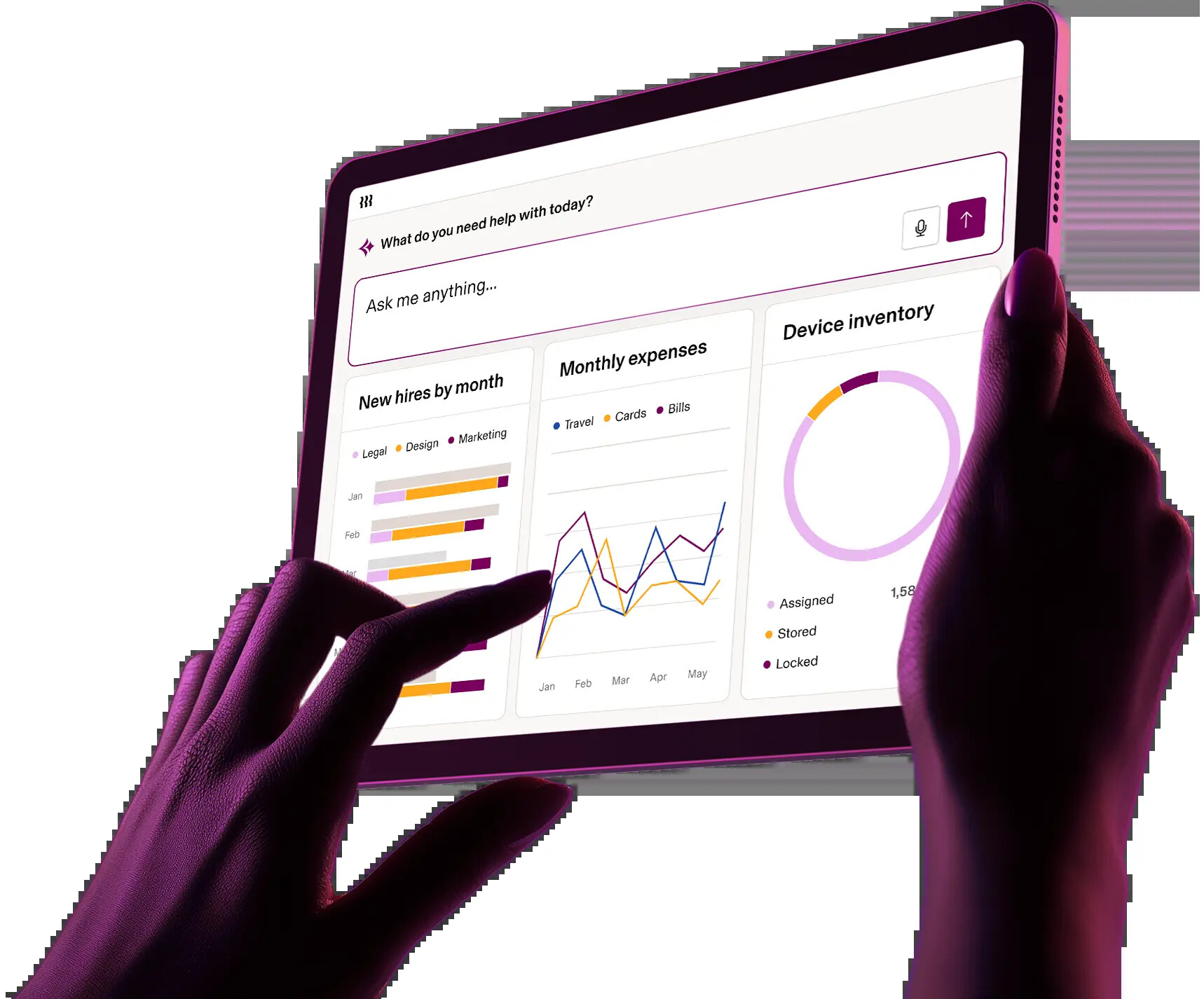
On a feature checklist, Rippling can look like a supermarket. There is an HR information system, U.S. and global payroll, benefits, recruiting, learning, performance reviews, surveys, time tracking, scheduling, employer-of-record services, single sign-on, mobile-device management, inventory, cards, expenses, bill pay, travel, procurement, compliance, analytics, workflows, and custom apps. Competitors sell nearly every item on that list.
The differentiation is underneath. Rippling calls its shared model the employee graph. Products inherit the same organizational context and permission logic instead of maintaining separate versions of the truth. A rule can read like a sentence: give every U.S. engineer at level six or above access to a particular app, a certain laptop configuration, and a spending limit. When the facts change, the rule reevaluates.
That architecture also explains the company's latest move into artificial intelligence. Rippling AI, introduced in March 2026, is pitched as an assistant that can build reports, answer employee questions, and take approved actions. Data Cloud, launched in June, imports operational data from systems including Salesforce, GitHub, Square, and Greenhouse, then joins it to worker identity. The interesting part is not that a chat box can write SQL. It is that the system knows which manager may see which answer, who belonged to which team last quarter, and which action is allowed now.
“We solve a problem most HR, IT, and Finance professionals don't even understand they have.”Matt MacInnis, president and chief product officer
Customers buy back the handoffs
The ideal customer is growing fast enough for coordination to hurt. Rippling says more than 30,000 companies use the platform. Public customers range from Y Combinator and Morning Consult to Chess.com and Barry's, the fitness chain with 1,400 employees across 53 U.S. locations.
Barry's had separate systems for recruiting, HR, scheduling, time, and benefits. Adding a hire after the offer took about 15 minutes of duplicate entry. With connected recruiting and onboarding, the company says the job fell to roughly three to five minutes. Employee status changes became five times faster. More important for an hourly workforce, approved time off, schedules, clock-ins, and employee records stopped living in separate rooms.
Chess.com offers the broader version of the argument. In 2019, it tracked employees in an HR system and contractors - then roughly three quarters of its 200-person team - in spreadsheets. Rippling combined those populations, payroll, benefits, device provisioning, and later global payroll and headcount planning. By 2024 the workforce had grown to about 700. An eight-person people team supported it without a dedicated IT department.
The business model rewards that expansion. Customers subscribe to a platform layer, then add modules. Most products are priced per employee per month; some include monthly base fees. Rippling does not publish a universal quote. An older company-published comparison put the base HRIS at $8 per employee each month plus a $35 base fee, but a present-day buyer should treat that as a historical reference, not a bid. Payroll, devices, recruiting, expenses, global employment, implementation, and services change the total.
Modularity cuts both ways. A small company can begin with what it needs. But the opening quote is not the ownership cost once HR, IT, and finance each add products. Buyers should model today's headcount, the next two years of hiring, module minimums, base fees, implementation work, and renewal terms. The slickest demo is still a spreadsheet problem at procurement time.
The day the abstraction hit a bank
Rippling's clean software model met the physical financial system on March 10, 2023. Silicon Valley Bank, its primary payroll banking partner, failed. Customer payroll funds already moving through SVB froze. The first thing to break was not Rippling's interface or employee graph. It was the banking rail beneath them.
Rippling ultimately advanced about $130 million to cover customer payroll and secured a $500 million financing commitment from Greenoaks in roughly 12 hours. The episode cost real capital, exposed a concentrated dependency, and delayed some paychecks. It also changed the operating assumption. A payroll company cannot treat its bank as somebody else's plumbing. The practical copy is boring and valuable: map the rails below the product, keep a tested alternative, decide who can move money under pressure, and rehearse customer communication before Friday afternoon.
Capital for a “compound startup”
Venture funding has financed the breadth. Rippling raised $7 million in seed capital, $45 million in Series A, $145 million in Series B, $250 million each in Series C and D, the $500 million Series E, $200 million in Series F, and $450 million in Series G. The last round, announced in May 2025, valued the company at $16.8 billion and included up to $200 million of liquidity for current and former employees. Total funding is roughly $1.85 billion.
Funding by round · USD millions
The emergency Series E is the tallest bar. Funding totals are announced amounts and exclude tender offers.
Conrad calls the model a compound startup: build many products on a common substrate rather than acquire a bundle and paint the navigation the same color. The strategy has a strong flywheel. Every added module has less setup because the worker, policy, and permission data already exist. It also has a heavy bill. Rippling openly describes an unusually large R&D commitment for a SaaS company, and its culture prizes direct challenge, source-level investigation, and high accountability. Anonymous employee reviews paint a harsher side - intense pace, moving targets, micromanagement, and burnout. Breadth is not free for the people building or supporting it.
What a buyer can copy - without buying Rippling
Steal the data model before the software stack
- Choose one canonical worker ID and one owner for every critical field.
- Map joiner, mover, and leaver events before automating the happy path.
- Write permissions as policies tied to role, location, level, and manager.
- Measure eliminated handoffs, not logins or workflows created.
- Document bank, identity, and integration fallbacks as first-class product requirements.
Founders can also copy Rippling's fundraising method. For its 2019 Series A, the company used a standalone written memo rather than a conventional presentation, accompanied by 46 slides of operating metrics and detailed methodology. The aim was to let an investor understand the argument without the founder performing it live. That approach forced the narrative and the numbers to survive forwarding.
The platform itself is harder to copy. It works best when a company has enough employee change, regulatory variation, device turnover, or app sprawl to repay the implementation. A 12-person domestic team with simple payroll may not need a control plane. A sprawling organization with specialized union rules, intricate global payroll, or deeply customized Workday processes may find Rippling's standardized model too light in the corners. And any buyer without a named implementation owner will merely automate its ambiguity.
Conditions for lift
- Frequent hiring or role changes
- Many apps, devices, or locations
- Clean ownership of worker data
- A team empowered to redesign workflows
Conditions for friction
- Simple, stable domestic operations
- Highly bespoke payroll edge cases
- No internal implementation owner
- Unclear module, renewal, or support costs
The market slot keeps getting wider
Rippling competes in several aisles at once. Gusto and BambooHR court smaller HR teams. ADP, UKG, and Workday bring payroll depth, enterprise process, and long operating histories. Deel and Remote lead with international hiring. Okta, Microsoft, and Jamf own familiar parts of identity and devices. Ramp and Brex fight for finance workflows. Rippling's real alternative, however, is usually the collection - the HRIS that talks awkwardly to payroll, an identity vendor, a device tool, an expense product, and the spreadsheet that reconciles them.
The trade-off is concentration. One system can remove duplicate entry and make cross-department automation unusually easy. The same system can widen the blast radius of a bad policy, delayed support response, security mistake, or outage. Customer reviews repeatedly split along that seam: people praise the interface and automation, then complain about implementation complexity, opaque pricing, rigid contracts, or support handoffs when an exception lands outside the happy path.
Rippling is now pushing the thesis past workforce administration. Automated Compliance turns live identity, device, and app controls into SOC 2 evidence. Procurement brings intake and supplier decisions into Finance. Data Cloud asks companies to put sales, code, hiring, and store data next to workforce history. Its MCP gateway lets outside AI agents retrieve permitted business information with logs and role controls. The company is no longer asking to replace an HR tool. It is asking to become the layer that knows who did what, who may see it, and what should happen next.
That is a larger promise than onboarding, and a less forgiving one. The reader should copy the discipline, not the sprawl: one reliable record, explicit policies, automated consequences, visible exceptions, and a plan for when the rail underneath fails. Rippling's most persuasive idea remains its oldest. The office does not suffer from a shortage of software. It suffers because the software keeps asking the same person the same questions.