Rick Pleczko left a well-paid software job to help start a company with five people and one product. By 2010, the business behind Idera had about 160 employees and roughly $30 million in annual revenue. Those numbers make a respectable founder story. The more revealing detail is what he thought customers would still need after the next technological upheaval.
Cloud computing was arriving. Pleczko saw familiar work following it upstairs: applications still needed protecting, and someone still had to manage them. An industry could change its vocabulary without abolishing the chores. His career has repeatedly returned to that territory, where a new technical possibility meets somebody’s crowded working day.
Today, he leads Capstreet’s Operating Executive Group in Houston, working with investment colleagues and portfolio companies. Between the startup and the investment firm came years of software leadership, acquisitions, a regional entrepreneurship award and a growing collection of board responsibilities. Alongside them sits a quite different obligation: helping preserve an aircraft with a connection to his wife’s family.
A programmer learns the other half of the job
Pleczko began in technology writing avionics software for an aerospace company in Britain. That is a suitably literal beginning for someone whose later work would concern systems that people depend on. His route through the industry subsequently included executive roles at LBMS, Platinum Technology, Mission Critical Software and NetIQ.
The titles moved through services, products and marketing. Taken together, they describe an education in what happens around a piece of software: how it is explained, sold, supported and made useful to an organization. A technically sound product has a considerable journey between working correctly and becoming a business.
He also spent time as an entrepreneur in residence at Austin Ventures, focusing on early software investments in Houston. Later advisory work at ITscape involved market strategy and operations. These roles matter to the shape of his career: he was working on both the machinery of software and the machinery of selling it.
That combination helps explain why the IDERA chapter has more moving parts than the familiar founder photograph suggests. Products, customers, distribution and acquisitions all appear in it. The founder had to make the parts work together.
The unglamorous market with a very long to-do list
In 2005, Pleczko described Idera’s focus as SQL Server administrators working at enterprise scale. Backup, recovery and performance become different propositions when the estate contains hundreds of servers. A useful tool must fit the operator’s workload as well as the technical specification. Even a good demonstration is a modest achievement compared with a dependable working week.
He was willing to acquire a product when the engineering, strategic fit and time saved justified it. He also defended concentrating development on SQL Server. Read together, those positions suggest a practical boundary: room to expand the product range, provided the customer problem remained clear.
There was some humor in his explanation of DTx, a tool intended to make data transformations straightforward. He called it “DTS for dummies,” then acknowledged the engineers’ displeasure. A little product-marketing mischief had escaped into the interview. The point underneath it was serious: a busy administrator might value a simple route through a task.
“growth, complexity and scrutiny”
Rick Pleczko’s three challenges for database administrators, 2005
That compact diagnosis still provides a way into his business interests. As the work expands, the product earns its place by helping someone keep control. The customer’s responsibility is part of the specification.
Keeping the brand, changing the scale
By 2010, BBS Technologies was the parent of Idera and R1Soft. BBS had acquired R1Soft in 2007 and retained its name because customers already knew it. For a company buying software businesses, that is a consequential choice. An acquisition can deliver a customer relationship worth handling with care.
At that point, about 30 percent of BBS’s business came through channel partners. Its expansion into Linux and hosted service providers was increasing the importance of those relationships. The product portfolio included management tools for SQL Server, SharePoint and PowerShell, alongside continuous data protection software for Windows and Linux.
BBS Technologies, 2010 snapshot. Historical figures, not current IDERA totals.
Pleczko was already considering opportunities around Microsoft’s Windows Azure platform. His reasoning was uncomplicated: applications moving into the cloud would continue to need security. Selling systems software required attention to a changing market, while recognizing how much underlying work would remain.
Two years later, Idera’s customer base exceeded 10,000 organizations. Its research process involved an advisory board drawn from more than 30 companies. During the downturn, Pleczko had pushed product development; growth reached 30 percent or better as the economy recovered. The sales approach combined online advertising with follow-up calls, rather than relying on a conventional outside sales force.
There is a coherent commercial idea here. Make the software manageable, listen to the people using it and keep the cost of reaching them under control. All three decisions concern the distance between a product and a customer getting something done.
The award came with a plural pronoun
Pleczko went on to lead symplr. In June 2017, he received EY’s Entrepreneur Of The Year award in the Technology category for the Gulf Coast Area. The recognition was regional and specific; it also gave him an occasion to describe the people behind his career.
“During my career I’ve been extremely fortunate to work with great teams to bring ideas to life and to market.”
Rick Pleczko, June 2017
In December 2018, Clearlake Capital completed its acquisition of symplr from Pamlico Capital and Capstreet. Pleczko continued as CEO, and he and CFO Tres Thompson were to join the board. Ownership changed while the operating leadership continued.
In November 2020, BJ Schaknowski became CEO and Pleczko made a planned move to executive chairman, continuing his involvement in corporate strategy. This was another change in the work itself: from running the organization each day to helping shape its direction with a successor in place.
The sequence gives some substance to the phrase experienced executive. He had occupied the founder’s chair, worked through changes of ownership and handed over an operating role. Each arrangement asks a different question about who decides, who executes and how a company carries knowledge forward.
A vacancy need not stop the work
A later discussion about FinThrive made his interest in continuity particularly tangible. In 2021, the business needed a permanent chief marketing officer while important branding and market-launch work was waiting. Its response was to bring in Alan Gonsenhauser as interim CMO during the search.
When Cheryl Alden arrived as the permanent CMO, Gonsenhauser helped with the transition. He then stayed as an executive coach. A temporary appointment became a way to preserve context and give the incoming leader a sounding board.
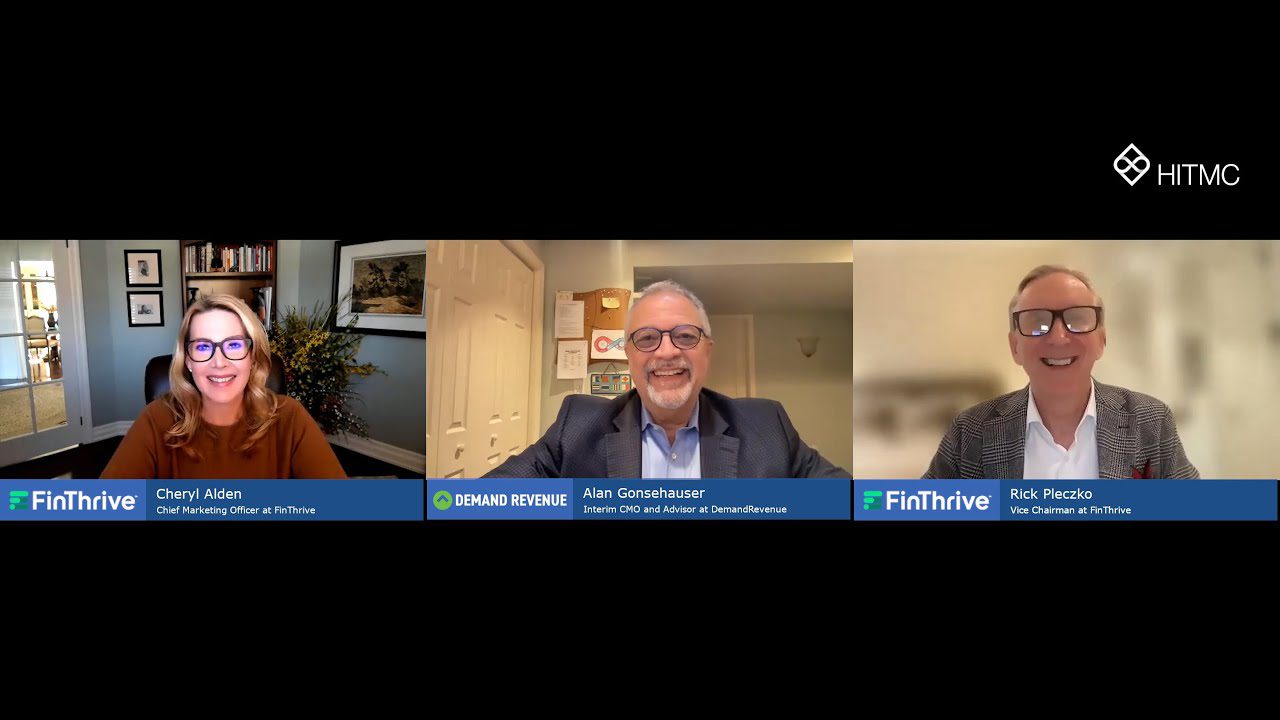
“It was all about velocity,” Pleczko explained. The arrangement offers a concrete example of his operating priorities: start the necessary work, bring in relevant experience and make the transfer useful to the next person. A vacancy on an organization chart need not become a vacancy in the company’s calendar.
The episode is also a small corrective to the solitary executive portrait. Here, progress depended on a sequence of people helping one another, with enough overlap to avoid starting again.
One company becomes a portfolio
Capstreet announced Pleczko’s appointment to lead its Operating Executive team in October 2021. He already knew the firm through his work as a portfolio-company CEO and board member since 2014. Joining it extended an existing relationship into a broader operating assignment.
The expanded team included Cathy Francis in revenue operations and Walker Kahle in portfolio operations. Wayne Washburn had joined earlier to work on technology. Their responsibilities made the proposition fairly concrete: companies would receive help with the functions required to turn plans into routine execution.
Capstreet’s framework lays out an initial onboarding period of less than six months, an execution period from six to 24 months, and intended outcomes beyond that. Early work includes setting strategy, hiring talent, establishing performance indicators and planning acquisitions. Execution includes delivering product plans, improving systems and pursuing organic sales growth.
The framework describes an approach, rather than a promise that every investment follows a timetable. For Pleczko, it provides a setting in which experience can travel between companies. His current board responsibilities include Allpoints, PlanetBids, informativ, TradePending, SmartSights and hh2.
An aircraft deserves a roof
There is another kind of stewardship in Pleczko’s public life. He serves on the Grissom Air Museum’s board of trustees. Rick and his wife, Shamaine, have also supported its project to bring a B-58 Hustler into a permanent indoor exhibit.
Shamaine’s father, Captain Manuel “Rocky” Cervantes, served as a B-58 navigator with the 305th Bombardment Wing. The planned building bears the Cervantes name. Their support belongs to a family connection as well as to the preservation of an aircraft that has spent decades outdoors.
A February 2026 account of the project identified the couple among its major donors. It is a useful place to leave a career that began with aviation software and accumulated a great deal of corporate responsibility. Here the task has a physical shape: preserve the aircraft, shelter it and give its history somewhere to be told.
Software companies and museum buildings operate on different clocks. Both require people willing to concern themselves with what comes next, and with the work needed to make it last.