Chevron’s databases had multiplied, and the old method had become awkward. At more than 200 SQL Server instances, the company’s administrators were still relying on Microsoft’s native Management Studio tools. Their difficulty was wonderfully ordinary: investigating one database at a time took too long. A perfectly serviceable way of working had acquired a queue.
- IDERA builds tools for the people responsible for database performance, access, auditing and recovery.
- Its appeal is practical: collect evidence across an estate, keep history and reduce repetitive investigation.
- The buying decision depends on your databases, license units and operating costs. A handsome dashboard cannot answer those questions for you.
The 200-instance problem
In IDERA’s published Chevron case study, lead database administrator Sumon Basu describes the frustration of “especially trying to troubleshoot issues one database at a time.” The team wanted to monitor several SQL servers together. The turning point was the growing estate and the demands arriving alongside it: incidents, critical applications and users who wanted answers.
There is a lesson here for anyone who manages a growing business. A workflow can fail before the underlying machinery does. Each database may still be doing its job; the person moving between them becomes the constraint. Buying another server does little for an administrator whose afternoon has become a succession of separate investigations.
This is the territory IDERA occupies. It sells software to database administrators, developers and data teams who need to understand, maintain and protect the systems beneath applications. The glamour is limited. So is the patience of a customer staring at a loading screen.
Chevron’s estate had passed this point when one-at-a-time troubleshooting became a problem. A customer example, not a universal buying threshold.
A database with a memory
Consider an intermittent slowdown. By the time someone mentions it, the workload may have changed. A reassuring picture of the present tells you remarkably little about the complaint. The useful question is what the system was doing then, and what else was happening at the same time.
SQL Diagnostic Manager, a central IDERA product, gathers performance information through a collection service. A management service writes collected information into a SQL Server repository; consoles let administrators inspect current status and historical reports. Its architecture keeps these components outside the monitored SQL Server processes. In effect, one database preserves evidence about the others.
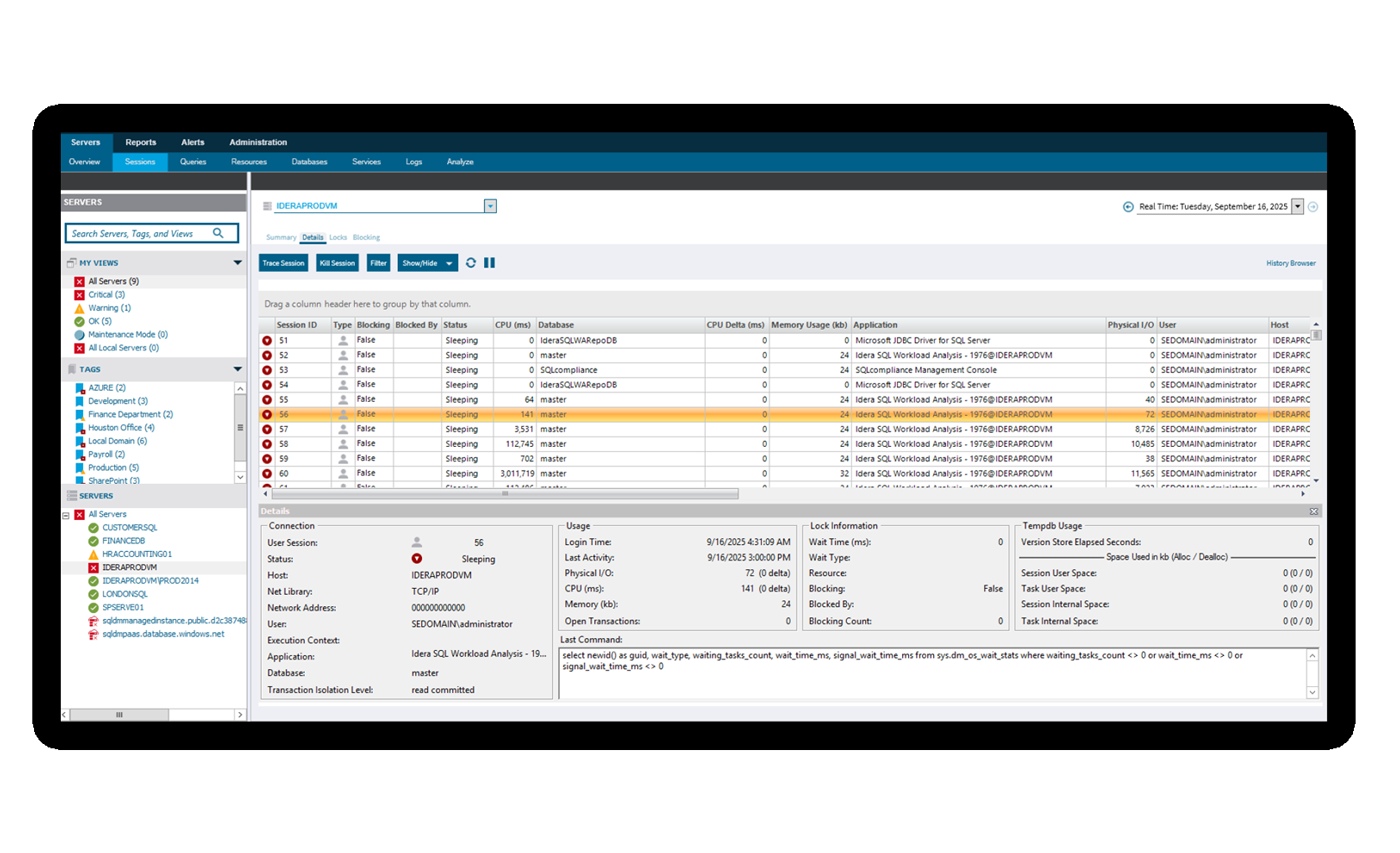
The reports are part of the attraction. IDERA’s reporting demonstration shows server summaries, custom counters and exports to Excel or PDF, with scheduled delivery through SQL Server Reporting Services. That helps translate an investigation into a record someone else can read. The person approving capacity spending need not become fluent in the console to understand a trend.
- 01CollectPerformance statistics from monitored instances
- 02KeepManagement service writes to a SQL Server repository
- 03InvestigateConsoles and reports expose current and historical evidence
History has an obvious boundary: it must have been collected. A monitoring purchase cannot recover every detail of an incident that preceded installation or fell outside the configured collection. The practical advantage is preparation. You arrange to have evidence before the next person asks for it.
One name, two scales
IDERA’s database business sits inside Idera, Inc., a wider software portfolio. The parent’s brand directory includes development tools such as Sencha and Embarcadero, alongside testing brands including Ranorex and TestRail. Treating that whole collection as one SQL monitoring product would make for an impressive claim and a rather confused purchase.
The database neighborhood is broad enough on its own. Aqua Data Studio is a cross-platform database IDE. ER/Studio serves data modeling and governance. Webyog addresses MySQL administration, while WhereScape works on data warehouse automation. These products occupy related stages of technical work, rather than proving that every buyer needs the entire cupboard.
In January 2021, Partners Group announced an agreement to acquire controlling ownership of the parent, following its initial 2019 investment. The announcement described further acquisitions as part of the plan, with TA Associates, HGGC and management retaining minority positions. The portfolio logic is visible: many specialized tools, serving many specialized jobs.
The users are equally varied. IDERA’s higher-education material describes Notre Dame monitoring more than 575 databases across 41 instances. Its software-industry material names PointClickCare and eDiscovery provider D4. A university and a software platform have different deadlines, but both benefit from being able to examine a large database estate without visiting each corner in turn.
Fast, permitted, recoverable
Performance is only one question. SQL Compliance Manager records database activity and changes, providing audit settings, reports and templates for commonly encountered regulatory requirements. An organization can ask who accessed or altered data, rather than merely whether the server was busy. Templates help configure collection; compliance still depends on the organization’s policies and implementation.
SQL Secure tackles access and configuration. It helps administrators examine permissions, identify vulnerabilities and compare security settings. That is a different task from keeping an audit history. One concerns what access exists; the other concerns activity that occurred. Confusing them would be like inspecting a building’s keys and declaring that you had reviewed its visitor log.
SQL Safe Backup addresses the next unpleasant question: how to recover. Its documentation describes centralized management, compression and automated full, differential and transaction-log backups. Backup software belongs in a recovery workflow with defined responsibilities and tested restores. Possessing a backup file is a promising start, but the business wants its application working again.
Fast, permitted and recoverable are separate promises. Each needs its own evidence.
THE BUYER’S DISTINCTION
The invoice has more than one line
SQL Diagnostic Manager advertises per-instance pricing, no per-gigabyte ingest fees and a customer-owned repository. Those terms are useful to a team deciding how much history to keep. They also describe a particular allocation of responsibility: the customer owns the record and must make room for it.
The sizing documentation estimates one to three gigabytes per monitored instance for a year of data. For an illustrative 100-instance deployment, that arithmetic gives 100 to 300 gigabytes before additional operational allowances. Retention, collection settings and workload matter. “No ingest fees” does not make storage, administration or maintenance disappear.
100-300 GB for one year, using IDERA’s documented sizing range. A planning calculation, not measured customer usage or a license quote.
Competitors make the comparison interesting. Redgate Monitor offers multi-platform monitoring and self-hosted or SaaS editions; its licensing includes a server unit that can cover multiple instances. SolarWinds offers SQL Sentry for the Microsoft SQL platform and Database Performance Analyzer for multiple engines. IDERA’s agentless collection is therefore a buying attribute, not proof that alternatives lack it.
The fair comparison uses the same estate, required features and retention period. Count the chargeable units, identify who operates the repository and test the investigation workflow. A cheap license that leaves the important incident unexplained is poor value. An elaborate platform covering things you never run can be poor value too.
September’s verbs matter
On September 25, 2026, IDERA announced general availability of SQL Diagnostic Manager 14.2. The release expands database-level exploration, including files, indexes, dependencies and backup history. It also adds an Amazon RDS Custom repository deployment option and revises some alert thresholds. The larger 14.3 release was announced for October. At this profile’s publication, it remains forthcoming.
Earlier that month, DB PowerStudio 19.2 expanded Oracle platform support and added AWS IAM authentication for MySQL. Both updates reflect a familiar difficulty for database toolmakers: the systems their customers operate keep changing. Useful expertise includes maintaining support for those systems, not merely inventing a new chart.
Borrow the habit, then buy the tool
A sensible evaluation begins with a recent incident and an explicit question. Can the tool preserve the information needed to explain a recurrence? Can another administrator follow the investigation? Does an alert arrive under conditions the team actually considers abnormal? IDERA offers a 14-day SQL Diagnostic Manager trial, giving buyers a bounded setting for that exercise.
Check the less photogenic details early. Supported database versions, network access, service permissions and repository capacity determine whether collection can work. The documentation also advises enabling query wait monitoring for the period needed to diagnose an issue, then disabling it. More collection is a choice with consequences, not an automatic virtue.
The habit worth copying is available before the purchase: define the evidence you need, preserve it and give someone responsibility for responding. IDERA offers specialized tools to make that work easier. Its most persuasive argument arrives when yesterday’s slowdown finally becomes a conversation, and the administrator has something better to contribute than a very confident guess.
Open the toolbox
Explore the products, watch the console at work, or follow the company.