Twenty-seven seconds is barely enough time to explain a company’s mission. On February 3, 1996, it was enough for Rick Enrico and two Wisconsin teammates to score three goals against Minnesota-Duluth. Max Williams, Troy Howard and Enrico broke a school record that had stood for fourteen years. Wisconsin won 5-3. For a future executive in the business of holding an audience’s attention, it makes a pleasingly economical opening.
The number belongs to three players. Keep that detail in mind. Enrico’s later career has the usual founder landmarks: software, fundraising, a new venture, offices overseas. But when he talks about how a business works, other people keep entering the picture. His father. His hockey coach. His managers. The designers who make a client’s argument legible before a meeting begins.
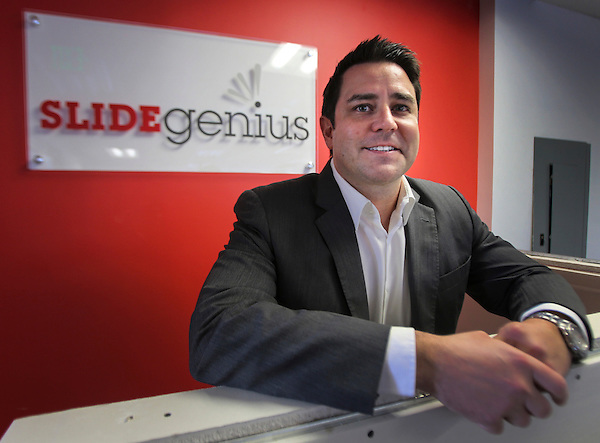
Today, Enrico is the founder and CEO of SlideGenius, the presentation design agency he began pursuing seriously in 2012. His route there was less direct than a polished corporate biography might suggest. The recurring interest, though, is easy to recognize: helping someone make sense of information that has become difficult to use.
A shared record. An unusually short highlight reel.
Before the slides, the silos
Enrico attended the University of Wisconsin-Madison from 1994 to 1998. His professional history then moves through marketing technology: banking software at TSI, customer relationship software at Sideware, and wireless technology at Graviton. These were businesses with products that needed explaining. The work sat where technical capability meets the person expected to buy it.
By 2005, he had founded Juice Media Worldwide. Its territory was marketing automation and analytics. The customer problem was familiar even then: companies possessed more information than they could comfortably connect. A purchase might live in one system, an email response in another. Each fragment was useful. Together, they could tell a different story.
In a September 2008 interview, Enrico described trying to make those scattered records practical for marketers. One retail client had more than a hundred stores but no online sales. Linking purchase records with email behavior helped the business examine whether its messages were producing results in shops. An apparently digital question ended at a physical cash register.
There is a line from that work to his later agency. It is an interpretation of the career, rather than a claim that every move was planned. Juice Media dealt with disconnected customer information. SlideGenius deals with business material that needs a coherent sequence. Both ask what another person can actually do with what is being put in front of them.
A bookshelf with a tell
Earlier in 2008, Enrico supplied a list of favorite books. Among them was Made to Stick, Chip and Dan Heath’s book about memorable ideas. He also chose Bo Peabody’s Lucky or Smart?, Chris Anderson’s The Long Tail and Guy Kawasaki’s The Art of the Start. Entrepreneurship, communication and the mechanics of finding a market shared shelf space.
Two other selections made the list more revealing. Return on Customer concerned the value of customer relationships. Pour Your Heart Into It examined the building of Starbucks. Enrico’s interests extended from the idea itself to the organization that delivers it, and the customer who comes back. Even a good presentation eventually needs an operating business behind it.
A reading list is a modest piece of evidence. Books can look excellent on a desk while accomplishing very little for its owner. Still, these recommendations predate SlideGenius’s official founding year. They show that his interest in explaining, selling and building businesses was already explicit. The later emphasis on presentation design had some intellectual company.
A compliment hiding in a rejection
The change of direction began during a software fundraising effort in 2008. Enrico recalls roughly a hundred refusals. Investors liked his presentations while declining to fund the business. One suggested he might open a presentation agency if the software venture did not work out. It was a peculiar form of career advice, delivered by somebody declining the career currently on offer.
He began helping friends with presentations. The work became a side business, then something he decided to take seriously in 2012. SlideGenius uses that year as its founding date. Enrico has called it an “accidental business.” The phrase preserves something useful: the original plan and the eventual business were allowed to differ.
A persuasive deck had not guaranteed him an investment. That is an unusually sound qualification for somebody selling presentation design. Visual communication can make an argument easier to understand; the business underneath still has to bear scrutiny. His own experience puts a limit on any suggestion that changing the slides automatically changes the outcome.
- 2008Software fundraising meets repeated refusals.
- The side projectPresentation work begins with friends.
- 2012Enrico commits to building SlideGenius.
The people behind the picture
Enrico’s explanation of business culture starts with his father, whom he describes as a serial entrepreneur. The lesson he repeats is “it’s all about the people.” It is an ordinary sentence, and ordinary sentences have to survive contact with the calendar. What does a founder actually make time for once the company has employees, managers and customers waiting?
His later advice becomes specific. Hold weekly one-to-one meetings with direct reports. Spend time developing people. Let managers run their divisions, including the mistakes. Stay curious. In that account, giving somebody authority includes accepting that the result may occasionally be different from the one the founder would have chosen.
He also described a company values framework with fun at its center. In his telling, employees should be appreciated and able to be themselves. Offices were designed with their experience in mind. This is Enrico’s stated approach, rather than a verdict on everybody’s working day. The distinction leaves room for the practical work that any culture requires.
“Learn to pause”
Rick Enrico / Onward Nation, episode 128
The pause has a commercial application, too. Enrico has spoken about entrepreneurs agreeing to opportunities too quickly. His advice was to leave room before committing energy. A founder can be busy accepting possibilities while the existing business waits for attention. Restraint is a surprisingly relevant skill for somebody whose job description begins with starting things.
His hockey memories offer another version of responsibility. He recalled fussing over his stick while coach Mark Johnson redirected his attention toward the player using it. Enrico carried the lesson into his defense of presentation software. Equipment matters, but blaming it offers an excellent way to avoid examining preparation, decisions and execution. The coaching continued to be useful after the skates came off.
A longer bench
Building an agency also meant going where the work and the people were. In 2018, Enrico relocated to New York to lead SlideGenius’s Brooklyn expansion. The office was in DUMBO. Opening a location can look like a small item in a company chronology; relocating the chief executive gives the item a human scale.
In November 2019, he was in Bacolod overseeing another office setup. The announcement described an eight-week training program for successful applicants and a goal of hiring 100 to 200 designers over three years. That was an ambition at the time, not a retrospective hiring total. General manager Angel Tillmann, whose family came from Bacolod, helped lead the local operation.
The training detail deserves attention. A global design business needs more than people who can operate software. They have to understand business material and turn it into a form another person can follow. The announced investment in teaching presentation tools made that requirement concrete. Expansion had a curriculum as well as a location.
By his March 2020 appearance on Sales Schema, SlideGenius was described as serving more than 3,000 customers with a team of over 125 people. Designers worked alongside project managers, animators, copywriters and support staff. The conversation concerned patience, specialization and the distractions that can pull an agency away from its work. The side business had acquired the coordination problems of an organization.
Figures displayed on SlideGenius’s About page, checked October 2026. These describe the company’s collective work.
Getting to the point, again
SlideGenius now describes a service spanning presentation design, graphic design, microapps and motion graphics, supported by a global team. Its public press chronology records a London office opening in 2021 and industry event sponsorships in 2024. These are the less cinematic chapters of a founder story: extending the operation and continuing to turn up where customers work.
Enrico’s public writing makes another part of the picture visible. His author pages collect articles about visual content, social video and marketing. In a 2017 piece about social listening, he urged businesses to pay attention to what customers were saying and engage with them. Communication, in that treatment, requires receiving information as well as preparing something impressive to send.
That gives the early investor anecdote a quieter ending. A useful suggestion arrived inside an answer he did not want. He heard it, tried the work and eventually built a company around it. Years before, three Wisconsin players had shared a brief scoring sequence. The settings changed. Other people remained essential to what happened next.
Follow the conversation
Explore SlideGenius, Rick on LinkedIn, Twitter/X and his professional biography.