Before Matthew Murphy had a marketing company, he had an assignment: help a real estate business show off a property on an interactive CD. He was a college intern. He knew some programming. The medium now sounds like something one might excavate from a drawer beside a dead pager, but the question was thoroughly modern. Could technology make a business easier to understand, and easier to buy from?
Murphy made the tool. Then he made a company. He founded Fusion92 in 1999, the month he graduated from college. The disc belonged to a particular technological moment; the commercial instinct proved more portable. Over the following decades, his work would extend from interactive production into advertising, software, audience modeling and the business of buying other businesses.
There is a pleasing absence of inevitability in this beginning. A client needed something, a student could build it, and the student saw more work to do. Entrepreneurship is often dressed for a keynote. Here, it arrived with a practical brief.
The numbers came with the curiosity
Murphy's education had already put two useful languages within reach. He studied computer science at Valparaiso University before studying finance at Ferris State University, where he graduated magna cum laude. He also played offensive guard for the Bulldogs. His university years contained both the calculation of a balance sheet and the rather less theoretical problem of an opponent trying to get past him.
The combination helps explain why an advertising career could accommodate someone who had not planned on advertising. His early interests ranged from professional sport to stock trading and technology. In the business he eventually built, competition, analysis and invention could occupy the same working day. The career was an unexpected address for several familiar interests.
He has been admirably plain about one of them: “I’m really a techie at heart.” The gadgets mattered to him before they acquired a job description. Later, he would speak appreciatively of Steve Jobs's ability to get an idea made and brought to market. The attraction was execution: persuading people to turn an interesting possibility into something that could actually be used.
That distinction gives his origin story its weight. The interactive CD had a customer and a purpose. It was a small demonstration that technical knowledge could solve a commercial problem. A finance education offered another question to put beside the technical one: what did the solution accomplish for the business paying for it?
A client can be pleased. A result must be earned.
By 2013, Murphy was describing Fusion92 as a full-service advertising agency focused on digital marketing and innovation. He talked about the satisfaction of watching his team produce campaigns that worked for clients. Technology was part of the proposition, but so was the obligation to deliver something useful after the presentation ended.
He was equally direct about recruiting. Finding capable people remained difficult, and the earliest hires demanded particular attention because each carried so much consequence. The founder who could make the first tool himself needed colleagues who could carry the next stage. An expanding service list makes a handsome paragraph; staffing it makes a rather fuller calendar.
“Every employee, client, job, relationship matters”
Matthew Murphy, 2013
His account of ownership left room for uncertainty. Relationships could be influenced without being controlled, and the volatility of the work occupied his thoughts. It is an unusually useful admission in a business that sells plans. The person making the plan still has to live with other people's choices.
When the agency builds the machinery
One revealing piece of Fusion92's history involves a television service. In January 2017, the firm announced a patent for technology behind AT&T's TV Anywhere. The system allowed an existing DVR unit to be used outside the United States. Murphy described an installation that a nontechnical user could complete in about ten minutes.
This is a different sort of deliverable from an advertisement. There is a device, a service and a person who would prefer not to spend an afternoon becoming a network engineer. The agency's contribution sat inside the experience itself. For a founder whose first commercial opening came through programming, it is a recognizable return to the original method.
By its 25th anniversary in May 2024, Fusion92 reported 15 patents. It also described a staff of 275 spanning marketing, technology, data science, strategy, creative work, media and products. The patents belong to the firm's record; they should not be mistaken for a claim that Murphy personally invented every technology. His part in the story is the organization he built around making such work possible.
The client list by that anniversary included AT&T, Bosch, Intuit, H&R Block and Staples. A firm that began with interactive production was now working across a much wider set of business problems. Murphy had kept the technical appetite while widening the table around it.
Buying the next capability
Growth eventually required a second form of construction: acquisitions. Serata Capital Partners and Landon Capital Partners became investment partners in 2021. The following years brought a sequence of deals with specific additions to Fusion92's offering. The pattern becomes easier to read when the acquired skills sit beside the dates.
The April 2022 purchase of Detroit-based DP+ joined two independent firms and brought Fusion92's team to more than 225 people at the time. Murphy continued as CEO. DP+ founder Mark Petrosky remained with the business, including a place on its Founder's Council and leadership of the Detroit team.
Conversion Fanatics, acquired that September, contributed a different specialty: testing and improving websites so more visitors take the action a business wants. Big Footprint, announced in January 2023 after a December closing, brought search expertise from Denver. The sequence addressed several moments in a customer's journey, from finding a brand to doing something on its site.
These deals also changed Murphy's job. Building software and building an organization ask for different kinds of attention. Acquisitions add founders, professional habits and client expectations alongside services. His repeated emphasis on people and compatible culture in deal announcements acknowledges a practical truth: an acquisition has to work after the lawyers have finished.
A Toronto connection, then a larger data picture
In November 2023, Fusion92 acquired TRAK Data, a Toronto-founded platform created by Jessica Akinwale and Brian Tran. Its software automated parts of predictive audience modeling using artificial intelligence and machine learning. The entire TRAK team was retained, and its founders joined Fusion92 in data science and technology roles.
The proposed benefit was speed and access. A marketer could use predictive models without assembling every step of the analysis manually. The announcement also described a service option for clients wanting human support alongside the software. Even in an automated process, someone still has to decide what the answer means.
A June 2024 collaboration with Experian extended this direction. Fusion92 would combine Experian's marketing data and identity capabilities with its own work on audiences, activation and measurement. The announcement described a 20-person team of data scientists and analysts and plans to rebrand TRAK as DIOS.
For Murphy, the arc from disc to data is less peculiar than it first appears. Each chapter puts a technical capability beside a business need. The tools have become more elaborate, and the organizational chart has acquired more names. The question about the paying customer remains quite serviceable.
Chicago, with room for a detour
Murphy was born and raised in Chicago. College took him to Indiana and Michigan, but he has described Chicago as his enduring home base. In 2024, Fusion92 marked its anniversary with a brand refresh and a headquarters move to the Merchandise Mart. The change of address kept the company's next chapter within the city that supplied its first.
There are less desk-bound interests in the picture, too. He has spoken of diving with sharks and heli-skiing in Alaska. His public biography also records an appreciation for good wine, fast cars and sport coats. It is a neatly varied inventory: something for the cellar, something for the road and something appropriate to wear when discussing either.
Recognition arrived that May when EY named him a 2024 Midwest Entrepreneur Of The Year finalist, one of 30 regional entrepreneurs selected. The distinction was a finalist place. His response credited the dedication and inventive spirit of the wider team, while describing his continuing interest in changing how the marketing business works.
Back in a classroom, with a longer answer
In April 2026, Murphy joined students at the University of Illinois Chicago for a fireside chat organized with its Collegiate Entrepreneurs' Organization and Graduate Marketing Association. His account returned to starting immediately after college, this time with another detail: a $25,000 line of credit.
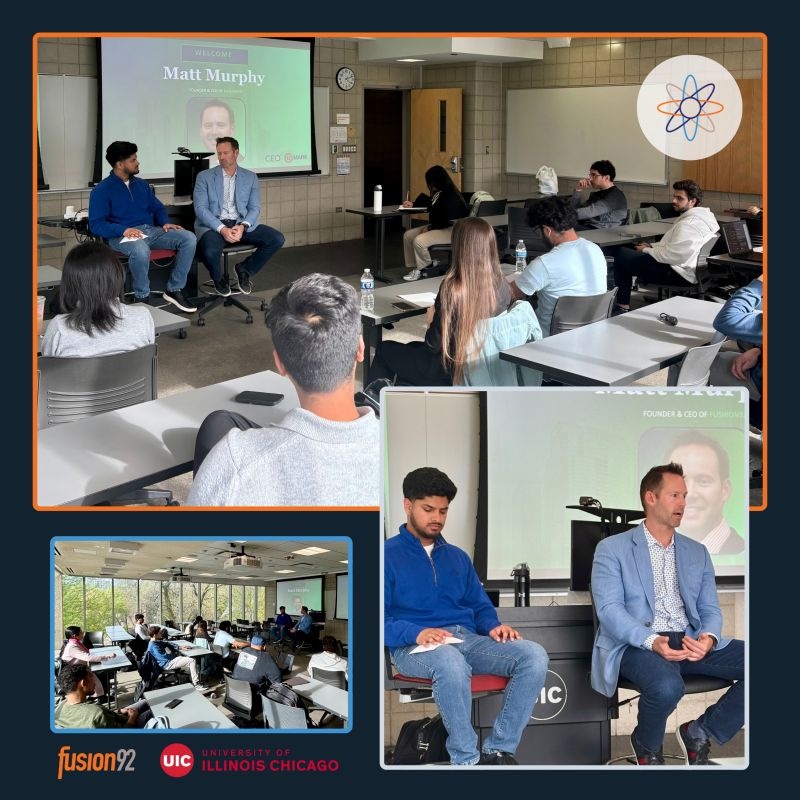
He discussed learning as a first-time founder, moving from agency assignments toward direct client relationships, and adding capabilities through acquisitions. The students' account of the event emphasized turning client problems into opportunities to invent. It was a fitting subject for someone whose first opening had come from being asked to make a property-marketing tool.
The classroom gives the story an agreeable circularity. A graduate once left college with a business to start. Decades later, he returned to students with the accumulated complications: people to hire, companies to combine, technology to develop, clients to retain. The line of credit is a memorable number. The years spent making use of it are the more revealing part.
The CD has aged into a period object. Murphy's original question has rather more life in it. There is still a business with something to explain, a customer with a decision to make and a tool that might help. A surprising amount can follow from taking the assignment seriously.