An appointment reminder is an unlikely object of ambition. It has no glamour, asks for very little attention, and usually disappears the moment it has done its job. Rick Berry built a company around such practical courtesies. In April 2012, Intuit agreed to buy Demandforce for approximately $423.5 million in cash. The humble follow-up had acquired a rather handsome price tag.
Berry’s customers included auto repair shops and salons, businesses whose owners had plenty to do before becoming experts in online marketing. Demandforce helped them communicate with customers, collect reviews and encourage return visits. The proposition had the appeal of a good employee: remember the details, get the work done, and spare the owner another task.
The sale supplies an obvious headline. Berry’s career offers a more interesting question underneath it: how does someone learn to build for people who spend their working day doing something other than thinking about software? His route ran through basketball, business school, automotive software and a company started in a garage. It eventually led back to other founders’ desks.
Westward, with a stop in Austin
Berry came from Detroit and played center in high school and college basketball. He earned a computer science degree at Butler University and an MBA at the University of Virginia’s Darden School of Business. By 1994, he wanted to head west and pursue a career in Silicon Valley. His journey took an extended detour through Austin, Texas.
There he joined Trilogy Software as its fortieth employee, spending four and a half years at the company. A small organization gave him an early encounter with entrepreneurship. He started its automotive division, working in a business whose customers included Ford, Toyota, Chrysler and Mercedes-Benz. Before selling software to small local operators, he had worked with some very large names on the showroom sign.
At OnStation, his next chapter, Berry became senior vice president and handled sales and business development. He secured relationships with NAPA Auto Parts, AAA and Progressive Insurance. The subject running through those jobs was the customer relationship: how a business stays connected to the people who buy from it, and how software can help that relationship survive beyond a single transaction.
In 2003, Berry started Demandforce in his garage. Sam Osman soon joined him. By then, Berry had experience on both sides of the software conversation: the technical education to understand the product and the commercial work of persuading organizations to use it. The garage was a beginning, rather than a substitute for an apprenticeship.
A business hiding in the front office
Demandforce occupied the small but consequential space between a completed job and the next booking. Its software connected with systems businesses already used, then automated communications around the information inside them. That arrangement mattered. A local operator could gain a new capability without first treating the entire office as a renovation project.
Think of an auto shop’s day. A customer arrives, work gets scheduled, the phone rings, and someone needs an answer. Follow-up competes with whatever is happening directly in front of the staff. A reminder or a request for feedback can be useful precisely because it is easy to postpone. Demandforce sold help with that neglected part of the working day.
By 2010, the company had reached No. 361 on the Inc. 500 list, reporting three-year growth of 816 percent. Berry credited customers and employees in the announcement. The figure describes a particular period, rather than a promise about what would happen forever. It also puts some scale behind an otherwise modest product description: routine communications could support a fast-growing software business.
Three-year growth reported when Demandforce reached No. 361 on the Inc. 500.
In October 2013, while Berry was still president, Demandforce introduced recurring campaigns and integrations with Apple Passbook, Google Now and Bing. These were tools for reaching customers across the places they already looked. His explanation emphasized giving small businesses access to marketing capabilities usually associated with larger companies and dedicated departments. The product’s ambition was to make that access practical.
The funding announcement that never arrived
Demandforce’s approach to publicity was unusually restrained. Benchmark invested, yet the company never announced the funding. Investor Bill Gurley later described that silence as a deliberate choice: the team wanted attention directed toward customers and products. A funding round is normally an occasion to order the trumpets. Berry’s company appears to have left them in their cases.
The restraint had a commercial explanation. Demandforce’s customers were busy running local businesses. Being noticed by a technology audience and being useful to an auto shop owner were different tasks, with different rewards. The company concentrated on reaching its buyers. Its relative obscurity among technology readers could coexist quite comfortably with a functioning sales operation.
At the time of the acquisition announcement, Demandforce had about 300 employees and a reported annual sales run rate of $60 million. It was profitable and had $12 million in the bank. Those figures describe a business already operating at considerable scale before it joined Intuit. An unannounced investment had hardly prevented the hiring, selling and building.
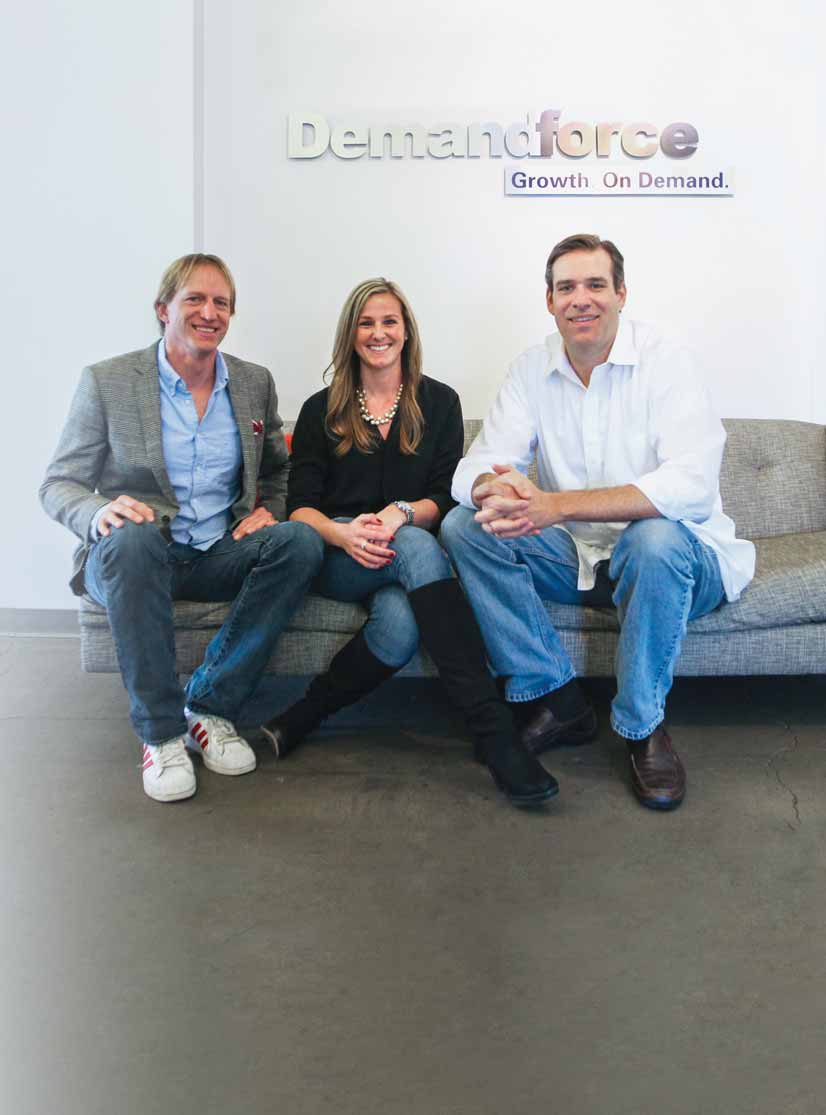
The distinction is useful when considering Berry himself. A founder’s public visibility provides a poor substitute for knowing what the company does all day. Here the work was concrete: connect existing customer information to reminders, feedback and future business. There was enough substance in those unremarkable verbs to attract an established software buyer.
A sale, followed by a larger assignment
Intuit announced its agreement on April 27, 2012. Demandforce would become a division of its Small Business Group, and Berry would continue leading it, reporting to Kiran Patel. The acquisition brought a company built around customer communications into an organization already serving small businesses through products such as QuickBooks. There was a recognizable customer on both sides of the transaction.
For Berry, the agreement offered a way to expand into new markets. He publicly framed it around the interests of customers, partners, employees and shareholders. He remained president and general manager at Intuit until 2014. Selling the company therefore included a period of continuing responsibility for the organization he had built.
- 2003Demandforce begins in Berry’s garage.
- 2012Intuit announces its $423.5 million acquisition agreement.
- 2014Berry and Sam Osman invest in Front Desk.
The next challenge was growth inside a larger company. A Darden teaching case put the assignment at $750 million in revenue, a target that demanded a different scale of organization. That was an aspiration at the time, rather than a reported result. The distinction gives the acquisition a useful second act: a successful founder still had a new job to learn.
The mentor appears in the acknowledgments
Some of the more revealing details about Berry appear in the work of people around him. Annie Tsai, a Demandforce executive, thanked him as her mentor in the acknowledgments of The Small Business Online Marketing Handbook. She credited his support for the project and his encouragement to bring her personal passions into her career.
It is a small professional anecdote with a specific outcome: a colleague produced a book, and remembered the founder’s support when it was finished. Management becomes rather more tangible at that level. A person has something they want to make; someone with authority helps give it room. The acknowledgment offers a glimpse of Berry beyond the acquisition number.
His coaching also comes with a practical refrain. A business owner who received his advice recalled Berry repeatedly saying:
“If you can’t measure it, you can’t manage it.”
Rick Berry, recalled by a coaching recipient at My Office Ops
The line fits a company built around trackable customer activity. It also asks a fairly demanding question of an entrepreneur: which numbers will actually change a decision? A dashboard can become a splendidly decorated distraction. Useful measurement has to lead somewhere, whether to a better follow-up, a repeat booking or a clearer understanding of the business.
Backing the next working business
In December 2014, Berry and Osman invested in Front Desk, a Seattle company offering scheduling, payments and administrative software. Its customers included yoga studios and music schools. The investment returned them to familiar territory: businesses delivering a service in person and needing software to make the surrounding work less cumbersome. Osman joined the board.
Berry later appeared as an advisor to Company Launch Partners and on Liberty Robotics’ advisory board. Lead Edge Capital’s professional biography lists him as an angel investor and mentor at 1528 Webster from September 2018. Taken together, these roles show how operating experience can acquire a second use: helping people make decisions while they are still building.
A more recent investment connects that career to industrial AI. Nexxa.ai named Berry among the angel backers of its $4.4 million pre-seed round in July 2025. In January 2026, its announcement of a further $9 million seed round again identified him among the earlier investors. The company develops specialized AI for heavy industries, including work carried out across existing industrial software systems.
The technologies have changed since the garage in 2003. The practical question remains familiar: what work needs doing, who has to do it, and where does the software fit? Berry’s career has repeatedly come close to that question. There is something pleasing about a business story whose central object is an ordinary task completed on time. Even a very expensive company can begin by remembering to follow up.
- Rick Berry on LinkedInProfessional profile
- Demandforce: where it beganCompany website
- Bill Gurley on Demandforce’s quiet approachAbove the Crowd / April 2012
- The acquisition agreement announcementIntuit / April 27, 2012 / PDF
- Demandforce: Pursuing Entrepreneurial DreamsDarden Business Publishing / 2013 case
- Annie Tsai’s handbook acknowledgmentsThe Small Business Online Marketing Handbook
- Do You Know Your Numbers?My Office Ops / A recollection of Berry’s coaching
- Front Desk’s $4 million funding extensionGeekWire / December 22, 2014
- Nexxa.ai’s January 2026 funding updateCompany announcement / Earlier angel investors named
- The February 2014 Demandforce team featureOriginal photograph and corporate interview / PDF