Consider the empty chair in a dental office. The equipment is ready. The staff are there. The patient is elsewhere. Tomorrow, the dentist can sell another appointment, but today’s vacant half hour has disappeared for good. Demandforce’s business begins with this modest catastrophe: a service business can do excellent work and still lose money because the conversation around that work breaks down.
- Connect existing customer records to reminders, recalls, and marketing.
- Built for practices and local businesses that depend on return visits.
- Subscription software; current pricing comes through a sales quote.
The customer is already in the computer
Founded in 2003 by Rick Berry, Demandforce sells the administrative follow-through that busy businesses struggle to maintain. Its customers include medical practices, chiropractors, veterinary clinics, optometrists, salons, and automotive shops. A person overdue for a checkup and a car overdue for maintenance have something commercially useful in common: someone already knows they should come back.
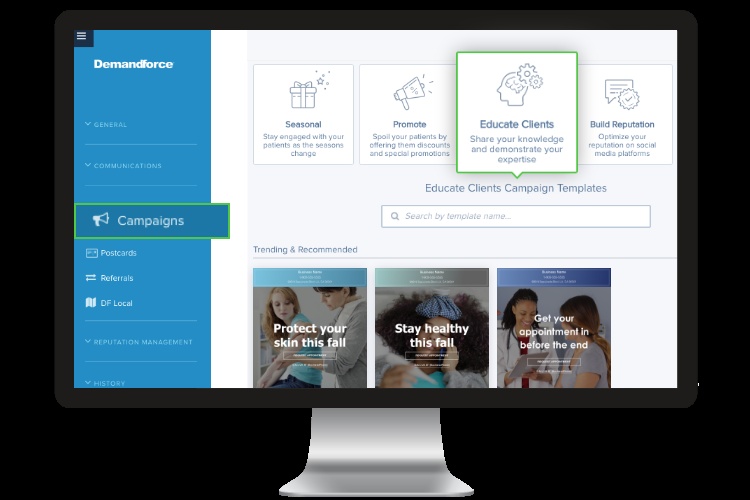
The underlying information often lives in a management system. Demandforce connects that system to tools for appointment reminders, two-way texting, recall messages, email campaigns, and review requests. Its integration directory advertises more than 150 supported systems. That breadth is part of the proposition: use the records the business already keeps to decide whom to contact and when.
Picture the sequence. A customer books, receives a reminder, confirms, attends, and gets a request for feedback. Later, a recall message encourages another visit. Each step is ordinary. The useful part is making the steps happen without requiring a receptionist to remember every one.
- 01BookMake the next visit easy
- 02RemindTurn a booking into attendance
- 03ReviewAsk after the experience
- 04RecallInvite the customer back
First, stop leaving quite so many voicemails
A historical Demandforce case study describes staff at Keystone Chiropractic leaving voicemails and hoping patients received their reminders. Automated texts changed that routine. The problem came before the marketing language: somebody had to do the chasing, and a human being could spend a considerable part of the day doing it.
Today’s product includes online booking, phone tools, mobile access, and payments by text. These features place Demandforce between the customer database and the front desk. It competes for the budget that might otherwise go to separate messaging, review, and marketing tools.
Weave offers a similar bundle of calling, texting, reminders, payments, and AI features. Solutionreach competes in patient communication too. Demandforce’s case therefore rests on how well its combination fits a particular business. A long feature list matters less than a confirmation arriving correctly in the system staff actually use.
The company that skipped the applause
There is an amusing wrinkle in Demandforce’s early growth. Benchmark backed it, but, according to investor Bill Gurley, the investment was never announced. The company preferred attention on customers and products. In a business culture that can mistake visibility for demand, this was an unusually literal interpretation of knowing your audience.
“Our customers don’t read tech sites.”
Patrick Barry, then chief marketing officer, speaking to AllThingsD in 2012
In April 2012, Intuit announced a $423.5 million cash agreement to buy Demandforce. Its rationale was to expand its small-business software offering into customer acquisition and retention. Accounting software could help owners understand the money; communication software could help bring customers through the door.
The fit changed. Intuit later decided to concentrate resources on its core small-business and tax businesses. It sold Demandforce to Internet Brands in a transaction completed in February 2016. Internet Brands emphasized healthcare expertise. In 2018, its dental businesses, including Demandforce, joined the Henry Schein One joint venture.
Those decisions suggest a change in corporate priorities. They do not, on their own, establish that appointment reminders stopped working. The buyer’s strategy and the customer’s daily problem are different questions.
An acquisition price, not today’s valuation or a software subscription bill.
Now the telephone gets a turn
By October 2026, Demandforce’s website was advertising an AI receptionist designed to capture patient details, route requests, and send follow-ups. Other advertised AI tools cover recall timing, email audiences, review responses, and filling available appointments. The ambition is familiar: keep conversations moving when staff are busy.
Demandforce still offers postcards, which puts the AI enthusiasm in perspective. The channel can be new or wonderfully old-fashioned. The commercial question remains whether the right person receives a useful prompt at a useful time. A postcard and an automated call answer can serve the same appointment book.

Put a price on the recovered hour
For a prospective buyer, the sensible starting point is a written quote and a real workflow demonstration. Current dollar pricing is sales-led. Ask what the proposal includes: phone service, AI features, messaging allowances, setup, and contract terms. Then compare the total with the contribution from recovered appointments and the value of staff time saved.
That calculation is an evaluation method, not a reported Demandforce result. A practice with few missed appointments may have little capacity to recover. An unsupported integration or stale contact records can undermine the process. Test a cancellation, a confirmation, and an overdue recall using your own system before treating automation as a saving.
There is also a useful distinction between a reminder and a recall. A reminder protects a booking that already exists. A recall tries to create the next one. Buyers should ask to see both working, because a practice can have excellent attendance and still lose touch with patients between visits. The two workflows address different gaps in the same relationship.
The part another business can copy is the order of operations. Start with people who already know you. Find the points where contact slips. Make the next action easy, then measure attended appointments rather than messages sent. Demandforce’s enduring subject is the return visit: the small, repeatable event on which a surprisingly large amount of business depends.