Richard Socher has an objection to artificial intelligence: there are still an awful lot of people doing the artificial part. At Stanford, he watched clever researchers build elegant statistical models, then spend much of their programming time deciding which clues those models should look for. The mathematics was sophisticated. The preparation remained a craft project. He wondered whether the machine could learn that part, too.
It is a small observation with a long afterlife. Across his research, his startups and his latest company, Socher keeps returning to the work around the work. Who decides what a model should notice? Who builds a separate system for each new assignment? Who finds the information? Who thinks up the next experiment? His career can be read as a succession of attempts to move another of those jobs into software.
Today he leads You.com, which supplies web search infrastructure for AI, and Recursive, which is trying to automate the research process. He also invests through AIX Ventures. The job descriptions look crowded. The underlying preoccupation is remarkably consistent: make useful intelligence require less hand assembly. There is a certain professional awkwardness in devoting your working life to teaching computers to perform more of your working life.
A place where languages could meet mathematics
Socher grew up in Dresden. When he began studying in 2003, languages, mathematics and programming were competing interests with a convenient meeting place: computational linguistics. A computer offered somewhere to ask numerical questions about something as slippery as a sentence. His education took him through Leipzig and Saarbrücken; his publications list records a Leipzig bachelor's thesis in 2006 and a Saarland master's thesis in 2008.
The early record crosses subjects as readily as geography. He was a co-author of the 2009 ImageNet paper, alongside Jia Deng, Wei Dong, Li-Jia Li, Kai Li and Fei-Fei Li. That project assembled a large, hierarchical image database for computer vision. For a researcher drawn to language, images were another way to investigate how machines might organize the world. The boundary between the two fields was a useful place to stand.
At Stanford, his doctoral advisers were Christopher Manning and Andrew Ng. His dissertation, completed in 2014, joined both interests in its title: Recursive Deep Learning for Natural Language Processing and Computer Vision. It received the university's Arthur L. Samuel computer science thesis award. The combination matters more than the ornament: seeing and reading were becoming related computational problems, with lessons capable of travelling between them.
MetaMind founded
Salesforce
co-founded
releases Flint
Words acquire neighbours
One of the difficulties of giving a computer language is choosing a useful representation. A dictionary entry is built for a reader who already knows a great deal. A machine needs something it can calculate with. Word vectors assign words numerical coordinates, allowing patterns in language to become relationships a model can work on. A word acquires neighbours in a mathematical space.
In 2014, Jeffrey Pennington, Socher and Manning published GloVe, short for Global Vectors for Word Representation. Their method used aggregate word co-occurrence statistics: the company a word keeps across a collection of text. The paper connected global patterns with the local relationships that make words useful. Meaning was no longer only something a programmer had to describe through a list of handcrafted clues.
Another strand of his Stanford work dealt with a problem familiar to anyone who has received a carefully worded insult: the sentiment of a sentence depends on how its parts combine. The 2013 Stanford Sentiment Treebank paper, written with six collaborators, supplied phrase-level annotations and explored recursive neural models. Counting pleasant and unpleasant words could miss what the sentence was actually doing. Structure mattered.
These were collaborative projects, with names, datasets and methods that can be inspected. That is a more interesting achievement than the solitary inventor story sometimes attached to AI. Socher's contribution sits inside a research community. GloVe had three authors; the sentiment paper had seven. Much of the progress came from making a shared problem concrete enough for other people to test and extend.
“Math and languages don't intersect often, right?”
Richard Socher, EO interview, January 2026
A paper needed a way into the office
The year he finished his PhD, Socher founded MetaMind. It brought deep learning into a company that worked with image and text data. Salesforce completed its acquisition in April 2016, and he became its chief scientist, later also serving as an executive vice president. A research idea now had to find its way into a business process, where usefulness has a less forgiving examination than a conference presentation.
In a 2017 interview, he described three ingredients for AI in practice: data, algorithms and integration into the work people already do. A better model left outside that workflow could accomplish surprisingly little. Salesforce offered an environment in which those ingredients could meet. His responsibilities extended from fundamental research to product incubation, search and customer-service automation. The range put academic ambition beside the everyday business of getting software used.
The research continued. In 2018, Bryan McCann, Nitish Shirish Keskar, Caiming Xiong and Socher introduced the Natural Language Decathlon. It presented ten language tasks through a shared question-answering format. Translation, summarization and sentiment analysis could be expressed as questions about an input, rather than requiring an entirely separate model design for each assignment.
The benchmark was a practical test of generality. Could the same system learn across different jobs? Its authors reported transfer to new tasks as well as results across the benchmark. Years before writing requests to language models became an ordinary office activity, this work was exploring how much could be gained by giving different problems a common interface. The stubborn question about manual effort had moved up a level.
The answer was there. People scrolled past it.
Socher left Salesforce in 2020 and co-founded You.com with McCann. Search offered a particularly direct route from language research to daily life. People were already arriving with questions. The internet was obligingly full of material. The task was to connect the two without making the person at the keyboard do quite so much sorting.
The early experience contained a fine little joke at the product team's expense. You.com put AI summaries above search results. Some users skipped them. Asked why, they explained that the top of a search page was where they expected advertisements. A new answer had inherited the visual address of something people had trained themselves to ignore. Human habits had quietly defeated a technical improvement.
That episode is useful because it complicates the usual story of invention. A feature can work and still fail to be seen. An interface carries memories of other interfaces. You.com eventually gave language models a more prominent place, but the company also changed its business emphasis. Search would become infrastructure that other AI products could use.
In December 2022, You.com began connecting language models to live web information with citations. The commercial opportunity grew from a recurring limitation: a model's training data cannot by itself supply everything happening now. Retrieval can bring fresh material into the answer-making process. Businesses wanted that capability inside their own systems.
On September 3, 2025, You.com announced a $100 million Series C led by Cox Enterprises at a $1.5 billion valuation. Those figures describe a financing round. The more revealing change was the customer: a company once inviting people to search was increasingly helping other software retrieve information. Socher had followed the problem beneath the original product, even when that meant changing which part of the product became the business.
Series C financing at a $1.5 billion company valuation.
Home comes with a certificate
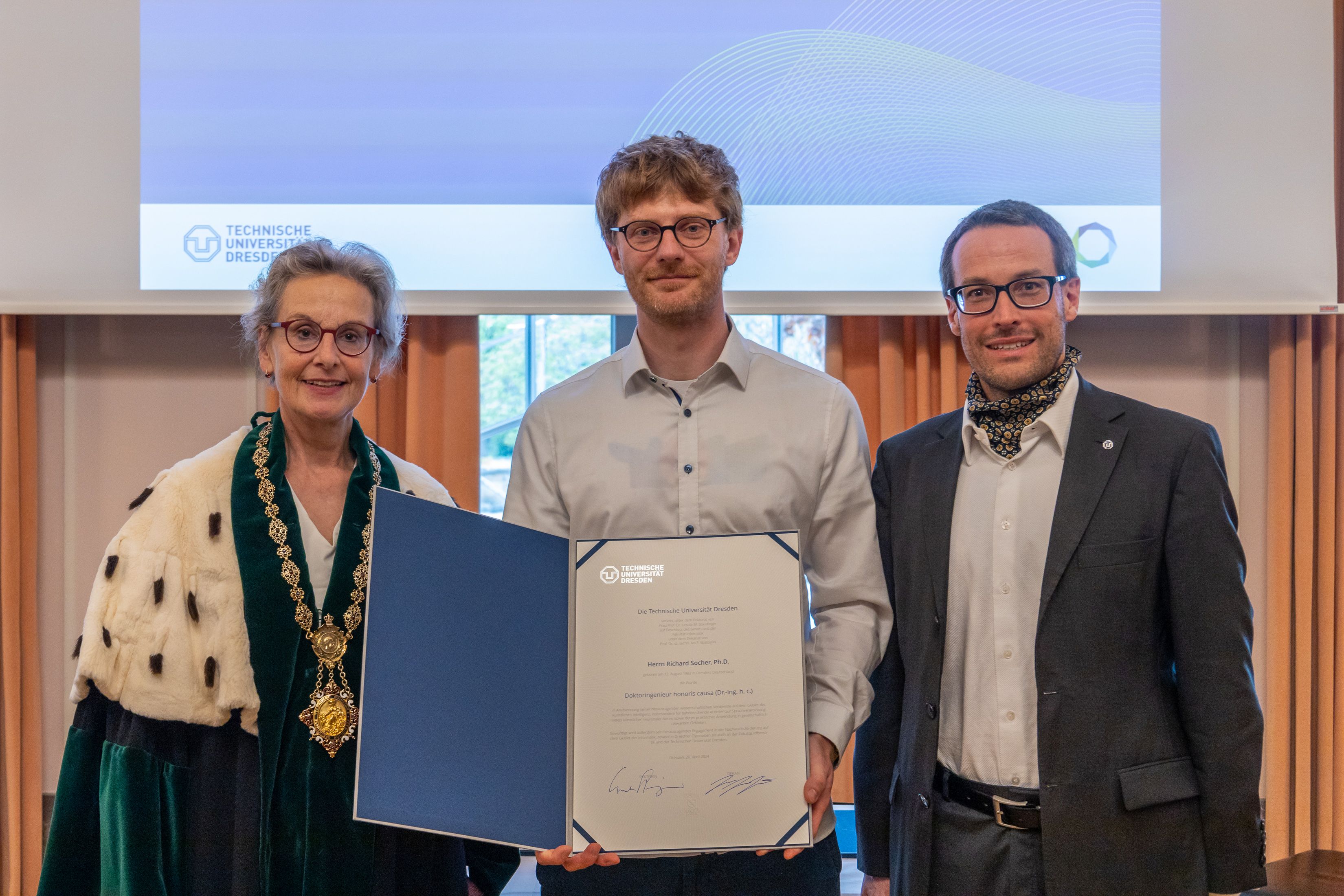
There are other ways to measure the distance travelled from Dresden. On April 26, 2024, TU Dresden awarded Socher an honorary doctorate for his work in deep learning and natural language processing, and for his contribution to computer science education. He had helped establish the Richard Socher Student Innovation Center at his former secondary school in Dresden-Plauen.
That connection gives the career a local address amid all the international titles. The center helps pupils acquire practical computing and AI skills. A former pupil returns with resources for the next set of pupils. The arrangement is refreshingly legible; no explanation of vector spaces is required.
His public biography also permits a little disorder among the credentials. Alongside research awards and recognition in TIME's 2023 TIME100 AI list, he records a first-place finish at a local laser-tag evening. A person could reasonably edit that out. Leaving it in is funnier, and makes a long list of distinctions easier to believe as the work of an actual human being.
Outside work, he flies paramotors and takes photographs. His website has separate collections for aerial pictures and adventure travel. In a September 2026 conversation, he said he was allowing himself one week of paramotoring a year while work was so demanding. He also said he had uninstalled Instagram because it was so effective at consuming his time. Even someone building intelligence can lose an evening to a well-chosen video.
Now improve the experimenter
By October 2026, the question about manual work has reached the research process itself. At Recursive, Socher and his colleagues are building what they call the Eureka Machine: a system intended to propose ideas, implement them, test results and use what it learns to decide what to try next. Its initial focus is the development of AI, including training methods and computing infrastructure.
On October 21, Recursive introduced Flint, a coding model designed to run on local hardware. The company says its automated research system contributed throughout development, including architecture, training recipes and inference optimization. Flint has 40 billion total parameters and activates 2.5 billion per token. The release offers something specific to examine alongside the larger ambition: model weights, software and a description of how the work was done.
Socher's book The Eureka Machine, published by PublicAffairs on September 22, 2026, takes the argument beyond model development. It proposes that AI can accelerate scientific discovery by connecting stages that people currently handle separately. That remains a proposition about the future. The interesting test is whether a system can repeatedly produce ideas that survive measurement, then use the results to improve its next attempt.
The career has a pleasing loop. A student noticed people spending too much time preparing inputs for machines. A researcher sought common methods for different tasks. A founder discovered that even a useful answer could be overlooked. Now he is asking whether the making of new knowledge can absorb more of the same treatment. Each step leaves him with another piece of work to automate. For someone so interested in making himself unnecessary, Richard Socher has kept himself rather busy.
- 01ProposeChoose an idea
- 02ImplementBuild the experiment
- 03ValidateMeasure the result
- ↻RepeatUse what was learned