At 16, Ayush Garg encountered one of the small indignities of academic life: downloading research papers one at a time. It was tedious, repetitive, and apparently acceptable to everyone who had grown used to it. Garg wrote software to do the downloading for him. The result, pygetpapers, became a Python tool for retrieving scientific literature and the subject of a peer-reviewed paper in the Journal of Open Source Software. For most teenagers, annoyance is temporary. Garg turned his into infrastructure.
That detail contains the blueprint for his later work. Garg does not approach research as an abstract market filled with PDFs and potential subscriptions. He knows its rituals from inside: the broad search that produces thousands of results, the screening that discards nearly all of them, the notes separated from their citations, and the late formatting session demanded by a journal’s preferred style. AnswerThis, the company he later started with college roommate Ryan McCarroll, is an attempt to put that entire chain into one workspace without breaking the path back to the underlying evidence.
Chapter one
A family desk piled with papers
The problem arrived before the company. Garg is the son of two PhD scholars, and he watched his mother work through stacks of literature under deadline pressure. When he began publishing his own research, the inefficiency stopped being something observed across the room. It became his own calendar. His response was characteristic: learn the system, find the repetitive part, write code.
The early projects form a surprisingly straight line. With pygetpapers, he helped build a command-line tool that could search repositories and retrieve material through their APIs. With docanalysis, he worked on extracting structured information such as ethics statements from papers. That led to another publication, this time on mining the literature to help standardize the way research ethics are documented. The subjects varied, but the instinct did not. Research knowledge should be easier to retrieve, inspect, and organize.
“I’ve been obsessed with the same problem since: a researcher’s day is full of work someone else has already done.”Ayush Garg
His résumé from the period is dense with side doors into the same building. He developed a chatbot and a gamified scam-awareness tool during an internship with Lion Befrienders in Singapore. He helped present the work to Singapore’s president, Halimah Yacob. He joined the Grounded Natural Language Processing Lab at the University of Richmond, studying how systems could translate human instructions into actions inside simulated environments. In 2025, he co-authored an ACL paper designed to test whether embodied question-answering systems were truly grounded or merely good guessers. Trust, in other words, was not a decorative concern added after generative AI became popular. It was already in the work.
The obsession, translated into a product
Chapter two
A roommate with a different set of muscles
At the University of Richmond, Garg met the person who would turn a long-running technical interest into a company. Ryan McCarroll had his own teenage apprenticeship, but his was in commerce and attention. He had sold coffee subscriptions, managed large Instagram accounts, and run a small web and marketing business. Garg understood research infrastructure. McCarroll understood product, audiences, and growth. They became roommates, close friends, and eventually co-founders.
Large language models supplied the missing mechanism. The pair could now imagine a system that went beyond fetching papers. A researcher could describe a question, search across academic databases, examine relevant work, save material into a library, draft a literature review, and preserve citations that lead back to exact passages. The point was not a talking box with scholarly manners. The point was a workflow.
Garg brought the idea to the university’s innovation programs, where he learned to test desire before confusing it with politeness. He made a mock advertisement offering a free AnswerThis demo. Two hundred people joined the waitlist. It was a compact piece of customer discovery: no ornate forecast, no imaginary total addressable market, just strangers raising their hands.
A 2023 trip to the European Innovation Academy in Porto sharpened that experimental habit. Garg joined students from around the world to build an event-safety app around a simple help button. His team finished in the top 10 and received an invitation from the Alchemist Accelerator. He later described the program as the opening steps in a much longer entrepreneurial journey. The useful lesson was not how to sound like a founder. It was how quickly an idea meets obstacles once it leaves the slide deck.
Chapter three
The audit trail is the interface
AnswerThis began in late 2023 and became a viable business by the end of 2024. Garg and McCarroll competed in accelerators and pitch events, winning the RIoT Accelerator Program and the top student pitch at Accelerate D.C. They pitched at the Startup World Cup. The University of Richmond supplied mentors, professors, and an incubation network that both founders credit openly. Their success was less a dorm-room myth than a community project with two unusually busy students at its center.
The company’s defining design choice is visible in its answers: citations are not swept into a footnote bin. A reader can inspect the supporting paper and the relevant passage. The approach connects Garg’s first command-line tool to his current platform. The software has become more capable, the interface more ambitious, and the dataset much larger. Yet the contract remains: speed is useful only if a researcher can check the work.
That contract matters because the field is full of temptations. A fluent answer can look finished before it is verified. A fast summary can flatten disagreement between papers. A citation can be present yet irrelevant. Garg’s product thesis treats these as interface problems. The user should be able to move from synthesis back to evidence, not take the model’s composure on faith.
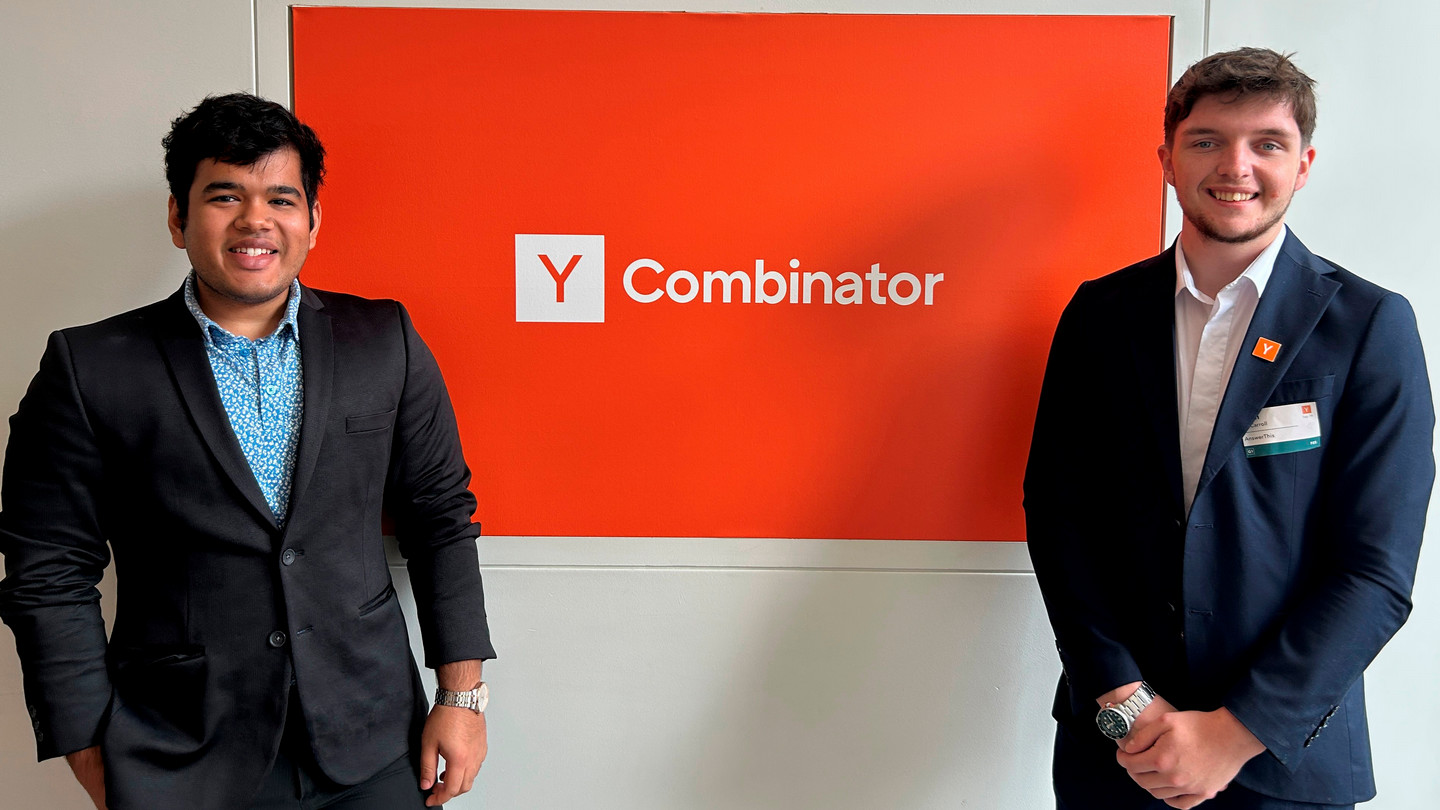
By the time AnswerThis entered Y Combinator’s Fall 2025 cohort, it was the first student-founded company from the University of Richmond to do so. Garg and McCarroll balanced the three-month program with independent study work. They graduated in May 2026, carrying a company incubated in Virginia into its San Francisco chapter.
Chapter four
The founder becomes the workflow
Garg’s recent work shows that his taste for automation no longer stops at the customer-facing product. He has described AnswerThis as operating with two full-time people and a collection of internal agents. One handles support, emails, CRM updates, call context, and user feedback. When it encounters a repetitive task it cannot perform, it can ask a coding agent to build a tool for future use. Garg said the system had accumulated more than 45 internal tools.
There is something neatly recursive about this. The teenager who automated paper downloads now builds software that automates parts of building the software company. The same filter is applied repeatedly: where is human attention being spent on a task that can be made reliable, inspectable, and reusable?
In 2026, Garg reported that AnswerThis had reached 500,000 researcher sign-ups across more than 170 countries and over 1,200 American universities. Those figures are company-reported, but Garg’s reaction to them was revealing. He wrote that the chart looked fake even though he had watched it happen. Most users, he added, had arrived because another researcher told them. For a product built around trust, word of mouth is a fitting distribution channel.
The company has also begun hiring beyond its compact founding setup, including engineering and business-development roles in San Francisco and India. Its horizon is widening from academics toward research teams and knowledge workers with similarly dense evidence problems. Garg’s stated ambition is broader still: knowledge should not remain buried in static documents, and scientific discovery should not be constrained by software habits inherited from an earlier era.
What can another founder borrow from this? Begin with the ugly, manual version of the work. Garg knew paper retrieval before he tried to improve it, and he knew literature analysis before he tried to compress it. Test the promise with a cheap artifact, as he did with the mock ad. Choose a partner whose strengths alter the shape of the company, not merely the length of the task list. Above all, preserve the user’s ability to inspect the result. Automation earns its place when it removes repetition while leaving judgment intact. The advice sounds modest beside a grand mission, which is precisely why it is useful on Monday morning.
The interesting unit of progress is not the answer. It is the hour a researcher gets back to ask a better question.The idea running through Garg’s work
Grand visions are cheap in San Francisco. Garg’s has an unusual paper trail. There is the teenage code, the open-source repository, the peer-reviewed software paper, the ethics-mining project, the university lab, the waitlist, the roommate partnership, and the years spent refining a product around citations. Each item is less glamorous than “accelerating science.” Together they make the phrase credible.
His biography also offers a practical rule for builders: pay attention to what you complain about twice. The second complaint may be evidence of a workflow everyone has learned to endure. Garg noticed one, wrote a script, and kept following it as the available technology changed. The script became research. The research became a company. The company is still, in spirit, trying to eliminate one unnecessary click at a time.