Somewhere near the end of a thesis, the great project of organizing human knowledge becomes a fight with italics. A journal title is capitalized incorrectly. One author has acquired three identities. The bibliography refuses to match the required style. Mendeley lives in that gap between the grandeur of research and the petty tyranny of submitting it.
The Elsevier-owned service is a reference manager, PDF library, annotation tool, Word add-in, research-data repository and, since late 2025, an AI reading assistant. Its customers range from undergraduates writing their first literature review to laboratory teams and university libraries. The job is simple to describe: catch a paper from the web, preserve its metadata, keep the PDF findable, let a reader mark it up, then produce the correct citation when the writing begins.
That useful chain is less sweeping than the founders’ original promise. It is also why the company still matters.
First, make the folder stop misbehaving
Victor Henning, Jan Reichelt and Paul Foeckler founded Mendeley after meeting the same nuisance every researcher knows: downloaded papers accumulate as cryptically named files, while useful details live somewhere else. Their early desktop program worked on Windows, Mac and Linux. Drop in a PDF and it attempted to extract the title, authors, journal and references automatically. The library could then be tagged, searched, cited and synchronized online.
The working name was “Literacula,” because the software sucked metadata from literature. Nobody else enjoyed the joke. The founders eventually spliced Gregor Mendel, who traced inherited traits, with Dmitri Mendeleyev, who organized the elements and predicted the gaps. The new name was an unusually accurate product brief: arrange what is known so the missing pieces become visible.
Mendeley’s investor pitch was catchier: “Last.fm for research.” Observe what people put in their libraries, then recommend papers and chart emerging fields just as a music service learned from listening. In 2009, backers connected to Last.fm, Skype and Warner Music led a $2 million round. The company won European startup awards and attracted researchers with a free tool that was valuable even before the network became crowded.

“The important lesson was to focus on the essential features of a product instead of trying to do too many things at once.”Victor Henning, reflecting on Mendeley’s early technical debt02 / The overload
Everything, everywhere, with a small engineering team
What failed first was focus. Henning later recalled trying to build desktop software across three operating systems, mobile applications, a social network and a huge machine-learning backend at the same time. The result was half-finished features, a confusing experience and technical debt. The ambition was not foolish. Each piece reinforced the others. But the organization had to support five companies’ worth of surfaces before any one of them felt complete.
The early ambition stack
Editorial illustration of simultaneous scope, not measured spending or staffing.
There was a business problem underneath the product problem. By 2011, users had uploaded tens of millions of papers, publishers were objecting to previews, and investors wanted a return. Mendeley sold premium storage and team accounts, then packaged readership analytics for institutions. Those signals could tell a library what journals its researchers read or show a publisher which field was warming up. The data was valuable. The monthly revenue, contemporary reporting said, was still only in the tens of thousands of dollars.
03 / The saleThe rebel moved into the publisher’s house
Elsevier had already become an unlikely ally. When the publisher closed its 2collab service in 2011, it pointed users toward Mendeley. It invited the startup to build on ScienceDirect and sponsored open-science events. In April 2013, Elsevier bought the company. The price was never disclosed; reports put it between $69 million and $100 million. Mendeley had more than 2.3 million users and over 100 million references at the time.
The reaction was immediate and personal. Open-science advocates saw a network built on sharing being absorbed by a publisher criticized for expensive access. Some prominent users closed their accounts. To them, the sale looked like the Galactic Empire buying the Rebel Alliance, a phrase that stuck because it captured the emotional distance between the brands.
What changed Mendeley’s mind was not one epiphany. It was the squeeze between scale, publisher rights and the need for a durable business. Elsevier offered money, content relationships, distribution and room to hire. Jan Reichelt later called the deal Mendeley’s biggest funding round. The company added staff and kept its API, while becoming a component of a much larger research-information business. The cost was trust among users who had treated corporate independence as part of the product.
04 / The retreatThe social network left. The citation engine stayed.
By 2020, Mendeley said customers valued reference management, research data and citation tools most. It retired the Feed, public groups, profiles and its funding service. In March 2021, it removed the native mobile apps from Apple and Google stores, saying overall usage did not support further investment. The decision was unpopular with researchers who read and annotated papers on tablets. It was also a clean statement of product strategy: fewer surfaces, more attention on the library and the manuscript.
The old Mendeley Desktop had become difficult to extend. Its replacement, Mendeley Reference Manager, put the library in the cloud and aligned the web and desktop interfaces. Mendeley Cite became a standalone Word add-in, able to work without the desktop manager being open. Notebook gathered notes across papers. Web Importer caught references in the browser. Mendeley Data gave datasets DOIs and long-term preservation through DANS, later moving onto the Digital Commons Data platform.
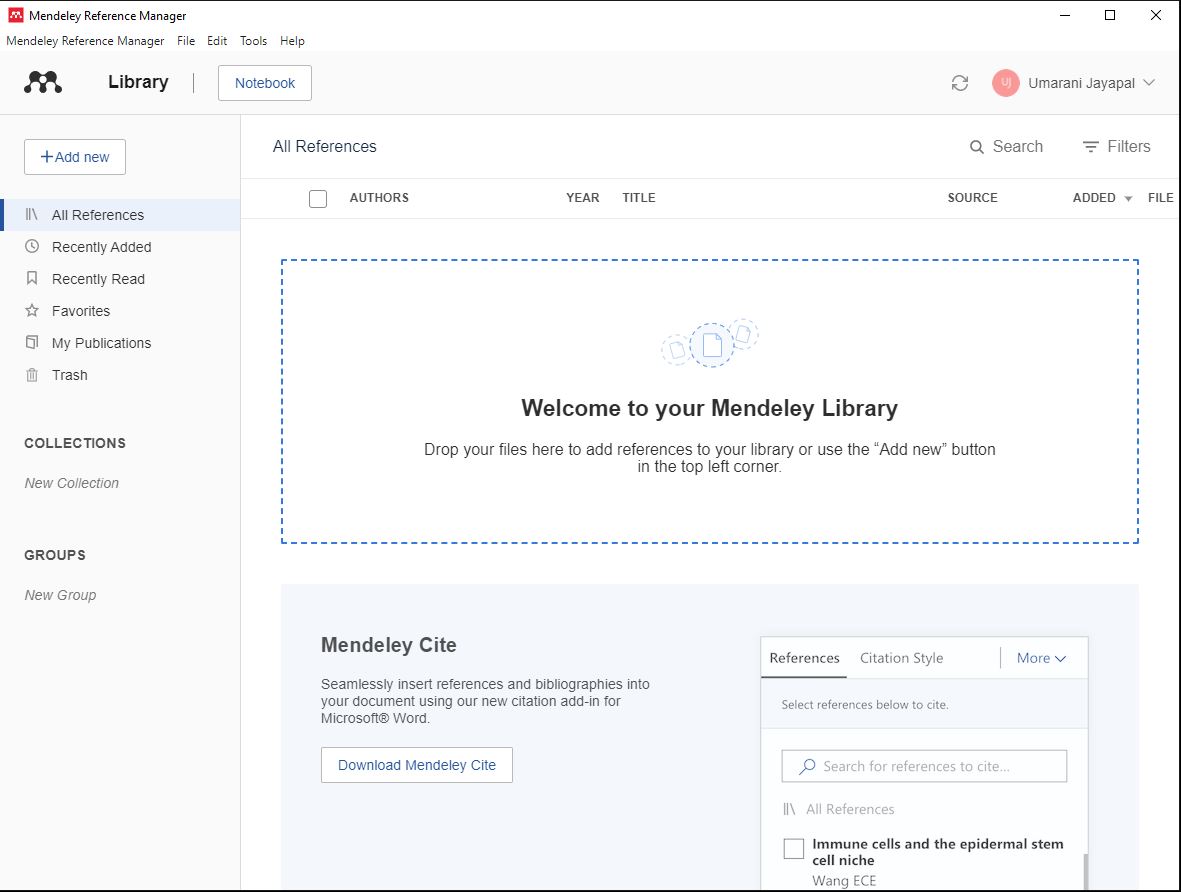
The handoffs are Mendeley’s real differentiation. A single feature is easy to copy. A reliable trip from browser tab to highlighted passage to correctly styled bibliography is harder. Real-time sync between Reference Manager and Cite arrived in 2024, eliminating a manual step that had annoyed users. In 2025, Cite added manual bibliography refresh for very long documents because updating hundreds of references after every edit caused slowdowns. That is mature software work: removing a button in one place and adding one back in another.
05 / The billFree habit, paid capacity
Mendeley’s current consumer model is legible. The free plan offers 2 GB of storage and five questions for Reading Assistant. Plus costs $4.99 a month and includes 5 GB. Pro costs $9.99, adds 10 GB, Ask My Library and Compare Experiments. Max costs $14.99 with unlimited storage. Annual billing discounts roughly one month. Universities can also provide institutional privileges through Elsevier arrangements.
Free
$02 GB + 5 AI questionsPlus
$4.995 GB + reading assistantPro
$9.9910 GB + library AIMax
$14.99Unlimited storageThe new AI layer is carefully matched to the asset Mendeley already owns: an organized personal library. Reading Assistant answers questions from one PDF. Compare Experiments places as many as ten papers side by side. Ask My Library searches across the collection and points answers back to supporting text. It is a more credible proposition than a general chatbot inventing citations, although researchers still have to check the source. The service is useful precisely when the user has done the slower work of collecting trustworthy papers.
06 / The marketA crowded shelf with different loyalties
Mendeley sits between personal productivity software and research infrastructure. Zotero attracts users who value open-source software, nonprofit stewardship and flexible connectors. EndNote has decades of institutional familiarity. Paperpile feels natural in browser and Google-centered workflows. RefWorks, Citavi and ReadCube Papers each have strong pockets of academic use.
| Choice | Natural home | Reason to pick it |
|---|---|---|
| Mendeley | Cloud library + Word | Integrated PDF, citation, data and Elsevier ecosystem |
| Zotero | Open web | Open-source governance and broad capture tools |
| EndNote | Institutional desktop | Established library and publisher workflows |
| Paperpile | Browser + Google | Fast web-native collaboration |
Mendeley works best for a researcher who writes in supported versions of Word, wants the same library on web and desktop, and prefers one account for storing, reading and citing. It is less convincing for someone who needs a full native tablet workflow, refuses cloud-first storage, depends on LaTeX-heavy customization, or will not place a research library inside Elsevier’s ecosystem. Institutional security policies can also block Office add-ins. And no reference manager rescues bad metadata without human inspection.
07 / What travelsThe useful lesson is smaller than the original vision
What can another company copy? Not the corpus, the university distribution or Elsevier’s balance sheet. The portable parts are product decisions.
Win before the network
The first desktop app organized a single person’s PDFs. It did not require everybody else to join.
Own the handoff
Value compounds as a paper moves from discovery to reading to the finished bibliography.
Charge at expansion
Free storage builds habit. Larger libraries, institutional controls and costly AI create paid demand.
Cut with evidence
Mendeley used usage data to narrow the roadmap, while accepting that some devoted users would leave.
The approach depends on a frequent, persistent chore. It fails when usage is occasional, switching is easy, or the free product never becomes a system of record. It also fails if simplification removes the one feature a valuable niche cannot replace. Mendeley’s mobile withdrawal shows the trade-off: focus improved, but a tablet reader lost a complete workflow.
Mendeley once imagined that aggregated reading behavior would redraw academic publishing. A version of that idea survived in readership metrics and recommendations, but the company’s sturdier achievement is more domestic. It keeps the research desk in order. The PDF is where it should be. The note returns when needed. The bibliography updates when asked. In scholarly work, civilization sometimes looks exactly like that.