Before Francois Chaubard tried to give a grocery store a set of eyes, he wanted a cheaper ride home. The train journey was long, crowded and expensive. He was a University of Delaware student travelling to New York State, and the inconvenience suggested a business: organize charter buses around the journeys people actually wanted to make. It was an unglamorous place to begin. An overpriced ticket rarely announces itself as a career adviser.
That idea became BusBookie, developed with computer science graduate Brandon Maas. By October 2009, Chaubard was describing trips to Phillies tailgates, Six Flags and New York City. The venture had won a university business-plan prize. Years before his work involved neural networks, the essential question was already practical: could a system be arranged so that an ordinary activity cost less and worked better?
His later career took him through missile-guidance algorithms, Stanford, Apple and Focal Systems. Today he is back at Stanford as a computer science PhD student, alongside a visiting partner role at Y Combinator. His questions have become larger. The habit of looking for an expensive, awkward process has survived.
A train ticket before the training data
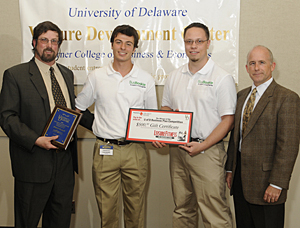
Chaubard graduated from Delaware in 2009 with a bachelor’s degree in mechanical engineering. His early professional work included missile-guidance research at Lockheed Martin. Later, at Stanford, he earned master’s degrees in computer science and electrical engineering and researched computer vision under Fei-Fei Li. He also worked in deep learning at Apple.
These are very different settings for an engineer. Guidance systems have to estimate where something is going. Computer vision has to interpret what a camera sees. A transport venture has to find enough people who want the same journey. They share a dependence on observations that are useful enough to act on. That connection helps explain the grocery aisle that came next.
When Chaubard discussed the AI atmosphere of 2014 and 2015, he remembered a narrow conversation about what automation might accomplish. He had another question: “What about everything else?” Retail gave that question a physical address. Products moved, employees worked around gaps in information, and a customer’s desired item could be missing from the shelf even inside a store full of stock.
The shelf has to tell you something
Focal Systems was founded in 2015 and joined Y Combinator’s Winter 2016 batch. Its work applied deep learning and computer vision to brick-and-mortar retail. The ambition was to make the store observable, then use those observations to guide its operations. A shelf photograph would become the beginning of a decision.
The distinction matters because a sale and a shelf are different kinds of evidence. A checkout system can record what left the store. It does not, by that fact alone, show what remains in the place where a shopper expects to find it. An item may need replenishing. A space may be empty. For the customer, the distinction between an item somewhere in the building and an item available to buy is quite decisive.
Focal’s approach used small cameras mounted on shelves, looking across the aisle. In the company’s 2022 description, they captured shelf conditions hourly. That data fed FocalOS, designed to inform replenishment, ordering and merchandising. The recurring observation was the point: a store changes throughout the day, and yesterday’s picture has limited manners when asked to explain today’s gap.
“In order to automate, you must first measure.”
Francois Chaubard, 2022
- 01 / ObserveCameras photograph shelves.
- 02 / InterpretSoftware identifies shelf conditions.
- 03 / ActStore teams receive operational tasks.
- 04 / RepeatA new observation updates the picture.
The early company also explored shopping-cart and checkout technology. In June 2018, Chaubard presented Focal at an AI Computing at the Edge pitch event organized by In-Q-Tel and Silicon Valley Bank. It won among twelve participating startups selected from more than seventy submissions. The announcement described inexpensive cameras and product recognition, a reminder that retail AI has always had to contend with the price and practicality of its hardware.
A book for the person holding the budget
Teaching runs alongside Chaubard’s commercial work. He helped create Stanford’s CS224d course on deep learning for natural language processing and CS231m on mobile computer vision, and served as a teaching assistant for CS229. The subjects span language, images and the underlying machinery of machine learning. Explaining how a model works is one task; explaining why someone should reorganize a business around it requires another vocabulary.
His book, AI for Retail: A Practical Guide to Modernize Your Retail Business with AI and Automation, appeared from Wiley in April 2023. Its contents move from AI fundamentals to inventory, labor, checkout and pricing, before reaching implementation. The closing topics include buying versus building, running a proof of concept and changing an organization’s relationship with data.
That ordering gives the book its practical character. It leaves room for the meeting after the demonstration: the one where people ask what they should purchase, how they should evaluate it and what will happen to existing routines. A retailer needs those answers before a technical possibility can become an operating decision. Enthusiasm is easy to distribute; a workable set of instructions takes more thought.
Passing the keys, keeping the questions
On April 2, 2024, Focal announced Kevin H. Johnson as its new CEO. Chaubard would become CTO, concentrating on the science of deep learning in retail. Johnson brought experience leading Udemy and Ebates. The handoff followed nine years with Chaubard at the helm.
The camera count is a dated company figure. Still, it establishes the distance between an initial computer-vision idea and a system operating in physical stores. Deployments require maintenance, routines and people willing to keep using the product. Each camera also represents a commitment to a setting where the experiment cannot simply stop because the research question has become less interesting.
Chaubard entered Stanford’s computer science PhD program in autumn 2024. He now describes research with co-advisors Chris Ré and Mykel Kochenderfer. In a May 2026 interview, he said Focal had reached his goal of becoming financially sustainable after signing a $60 million enterprise deal. That was his account of the milestone. The decision that followed is clearer: he stepped back and made room for scientific work.
A founder’s return to university can sound like a neat circular ending. Here it opens a new set of costs. His interest is in how learning algorithms use computation and memory, and whether different approaches could make useful intelligence less expensive. The store had asked whether AI could improve a working system. The laboratory asks whether the AI itself could work differently.
The price of teaching a machine
Chaubard’s research agenda separates several questions that are often bundled together: the architecture of a model, the procedure used to optimize it, the way it is trained and the tests used to judge it. That framing gives him multiple places to look for improvement. Making a model larger is one option. Changing how it learns is another.
His December 2024 paper with Duncan Eddy and Kochenderfer explored Gradient Agreement Filtering. It examines whether conflicting training updates can be filtered before they are averaged. The aim is better learning from the available data, including less memorization of noisy labels. It is a specific investigation, with experiments on image-classification benchmarks, rather than a promise that every model will improve.
Zero-order optimization occupies much of his newer work. Broadly, it estimates useful parameter changes by perturbing a model and measuring the effect, instead of directly calculating derivatives through backpropagation. The appeal includes lower memory requirements. The difficulty is finding useful changes reliably as a model grows. Saving memory offers little comfort if learning stalls.
His writing about the subject acknowledges that difficulty. He describes frustrating experiments and how effective backpropagation already is at finding a direction to move. This makes the research more interesting than a simple announcement of a replacement. He is looking for another workable route, with tradeoffs suited to particular constraints.
A May 2025 paper with Kochenderfer studied zero-order training of recurrent neural networks at billion-parameter scale. Then, on September 29, 2026, Chaubard, Kochenderfer and Ré submitted two further preprints: one on splitting zero-order pretraining across model components, the other on improving optimization through probe-space preconditioning. They test distinct ways to make the approach more effective. Their findings remain tied to the experiments reported.
- 2009
- Mechanical engineering graduate; BusBookie trips underway.
- 2015-16
- Focal founded, then joins Y Combinator.
- 2024
- CEO handoff; Stanford PhD begins that autumn.
- 2025-26
- YC visiting partner; new optimization research.
Coming back with something to teach
In October 2025, Y Combinator announced Chaubard among its new visiting partners. He greeted the return with “Coming back home!” and said he wanted to help the next generation make the transition from AI researcher to founder. His own path gives that intention substance: he has worked on both sides of the transition, and returned to research with operating experience behind him.
His advice to academic founders is pointed. He argues for observing customers, understanding who uses and buys a product, and being willing to solve a problem by ordinary means. An elegant technical problem can be absorbing while the business needs something much simpler. These are judgments from his writing, and they reveal the tension he wants founders to notice.
Another essay concerns the delay between an idea’s creation and its wider circulation. He encourages readers to get closer to people doing the work: through open projects, direct conversations and primary research. His public website follows that preference by sharing unfinished thinking alongside papers and code. It leaves the rough edges visible.
The train ticket, the empty shelf and the cost of training a neural network belong to different chapters. Each starts with a system that consumes resources and a question about whether it could be arranged better. Chaubard has built a company around one such question. He is now spending his time on another, with the results still arriving.