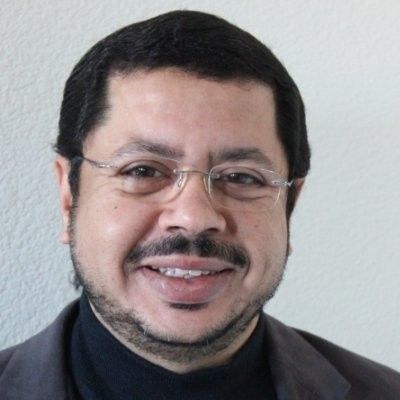
A man, a model, and every disaster that hasn't happened yet
Most software promises to tell you what is. Moataz Rashad built software to tell you what could go wrong - and then what to do about it. His company, DeepVu, runs the Mississippi river drought, a component shortage, a labor strike, and a sudden spike in consumer spending. All of it before the coffee gets cold. Then it hands a manufacturer the next best move.
He calls the idea autonomous resilient planning, and he did not borrow the phrase from anyone. Generative AI planning agents, trained on top of digital twins, rehearsing catastrophe so that real supply chains do not have to learn the hard way. It is an odd thing to wake up wanting to build. Moataz wakes up wanting to build it anyway.
With perpetual shocks - climate, health, geo-political - every company's success is primarily predicated on its supply chain planning resilience. - Moataz Rashad, founder & CEO, DeepVu
DeepVu sits in San Ramon, California, a small team with a large appetite. The flagship product, VuDecide, is an AI agent for shock-resilient demand planning, and in 2024 it landed on Microsoft AppSource - the kind of milestone that sounds procedural and is actually a long climb. The pitch is not glamorous. Factories, freight, inventory, margins, emissions. The work is to make those words bend toward resilience instead of luck.
Reinforcement learning, with a human still in the room
DeepVu's models do not just forecast. They recommend - actions optimized directly for business KPIs, learned through reinforcement learning with human feedback, and tested against multi-environment digital twins that simulate normal days and very bad ones side by side. The bet is subtle: a forecast tells you the weather; a decision agent hands you the umbrella, the route change, and the reorder.
Moataz is careful about the part everyone gets nervous about. In his own writing he frames the agents as assisting human planners, not replacing their judgment. The machine runs ten thousand scenarios overnight. The planner still decides which future to bet on. That distinction is the whole philosophy compressed into a sentence.
We strive to provide manufacturing customers with best-in-class shock resilient planning to future-proof their supply chains against external shocks. - Moataz Rashad
From a Sony Mobile whiteboard to a digital twin
Before DeepVu there was a career that reads like a tour of how modern hardware and software actually got made. Moataz studied Computer Science and Control Systems at Alexandria University, then went to Stanford for a master's in electrical engineering inside the Computer Systems Lab. He started a PhD there too. He did not finish it. Some people carry a dropped doctorate as a regret; he carried it as runway.
Then came the architect years. Product Architect at Samsung Electronics America. Director of Engineering and Chief Architect at Mindspeed Technologies and Conexant. Head of Software Architecture at Sony Mobile in Silicon Valley. Two decades of being the person in the room who decides how the thing is built before anyone writes the first line.
His first company, Vufind, aimed the same engineering instinct at shopping. A visual, behavioral and transactional intelligence engine for the strange new seam between augmented reality and ecommerce - products with names like vuHunt, vuMatch, vuStyle, and vuGraph. He was doing computer vision and deep learning before either phrase became a conference badge. On his personal page he still describes himself, plainly, as an "AI/Computer Vision/Deep-learning hacker." Not a visionary. A hacker.
Vufind quietly became DeepVu. The computer vision that once helped a shopper find the right jacket grew up into decision agents that help a manufacturer survive a quarter. One pivot, the same stubborn idea: teach machines to see the thing humans miss.
Diamond doves, deep space, and the patience to wait
Here is the detail that sticks. On his own page, between the AI credentials, Moataz lists what he actually is when the laptop closes: Mediterranean, space enthusiast, wisdom seeker, father - and a bird enthusiast who keeps diamond doves, cockatiels, and finches. A man who spends his days simulating chaos goes home to the smallest, most fragile creatures he can find and tends them.
It fits, oddly. Birds are the original early-warning system. Finches in the dark. The whole DeepVu thesis is the same instinct scaled up to a global supply chain: notice the shock before it arrives, build the cage strong enough to hold steady through it.
There is a long-horizon temperament here too - the space enthusiast who left a Stanford PhD half-built, the engineer who spent twenty years on architecture before deciding the most important system to architect was the one that keeps the world's goods moving when the world wobbles. He is not in a hurry to be loud. He is in a hurry to be right.