Money has learned many tricks. It can become a tap, a token, a line of code or a number that crosses the Pacific before breakfast. Yet in the ordinary machinery of global commerce, money retains an old theatrical habit: it makes an entrance, then leaves everyone waiting. A payment may be approved today while settlement arrives three or four days later. Somewhere between those moments, a business must supply the cash, park it in advance, or decline an opportunity. Richard Liu has spent the current chapter of his career staring at that interval.
As co-founder and co-CEO of Huma Finance, Liu calls the field PayFi, short for payment financing. The phrase sounds like a new district in the large city of fintech. Its central problem is pleasantly concrete. A receivable is valuable, but it is not cash yet. Huma connects those short-duration claims with liquidity, using stablecoins and blockchain rails to make funds available while the old settlement clock is still ticking.
This is a characteristic destination for Liu. His résumé moves through telecommunications, machine learning, consumer finance, venture investing and crypto, but the underlying habit changes less than the logos. He finds a system people have learned to tolerate, then asks whether software can remove its most irritating pause.
An engineer follows the friction
Liu grew up in Sichuan, China, and built an education that looks like a determined tour of systems thinking: electrical engineering at Sichuan University, automation at Tsinghua University, an MBA at Southern Methodist University, and a doctorate in electrical and computer engineering at the University of Florida. The sequence crosses countries and disciplines, from circuits to organizations. Later, when asked to introduce himself on a podcast, he used a modest summary: “My background is mainly in engineering.”
His early industry career included Verizon. In 2008 he joined Google, where he stayed for roughly seven years and led the launch of several zero-to-one products. The best known was Google Fi, the mobile service unveiled in 2015 as Project Fi. Fi tackled a familiar annoyance: mobile connectivity was fragmented by carrier networks and Wi-Fi handoffs. The product tried to make those boundaries less visible to the person holding the phone.
There is a useful clue there. Liu did not leave the complexity on display and ask the customer to admire it. The value lived in hiding the handoff.
In 2016, he left Google and co-founded Leap.ai, a career platform that used machine learning to match people with jobs. Liu served as CEO. Three years later, Facebook acquired the company, and Leap’s work moved into the orbit of Facebook Jobs. Telecom had given way to talent, but the design question remained recognizable: how can a large, messy field of choices become a more useful match?
Then finance made the question less abstract. Liu became CTO of EarnIn, whose core product lets workers access wages they have already earned before payday. The delay in this case was not a network handoff or an imperfect recommendation. It could mean the difference between paying for an ordinary expense today and waiting for a payroll schedule to catch up.
Liu’s career becomes coherent when viewed as a collection of waits: for a signal, a match, a paycheck, a settlement.
The company inside the reunion
EarnIn also supplied the cast for Liu’s next company. He worked there with Erbil Karaman, a product and growth leader, and Ji Peng, an engineering leader. When the time came to start Huma in 2022, the three were not assembling from conference badges and hopeful coffee meetings. They already knew how one another worked.
The founding anecdote contains a small fork in fintech history. Karaman was considering joining Circle as chief product officer. Liu persuaded him to build Huma together. Founders often celebrate the idea that started a company, but the prior relationship can matter more. A new financial network began with an old professional network.
Their initial premise drew on a lesson visible at EarnIn. New financial businesses can have real demand and performing assets yet struggle to obtain flexible capital from conventional institutions. Funding may arrive through a narrow set of private channels, making growth dependent on a few gatekeepers. Liu saw blockchain infrastructure as a possible way to connect those receivables with a wider pool of capital.
Cross-border payments made the need especially visible. A remittance company promising quick delivery may have to prefund accounts with partners in destination markets, tying up a meaningful share of monthly volume. The transfer feels immediate to the sender because somebody else’s balance sheet has agreed to wait. Huma’s model finances that waiting period. Short repayment cycles allow the same capital to turn over repeatedly rather than remain parked.
In 2024, Huma combined with Arf, a cross-border payment liquidity company and its largest client. The same year, Huma announced $10 million in equity financing and $28 million in liquidity commitments. The combination moved Huma closer to the payments themselves, joining a protocol for capital with an operating network that puts that capital to work.
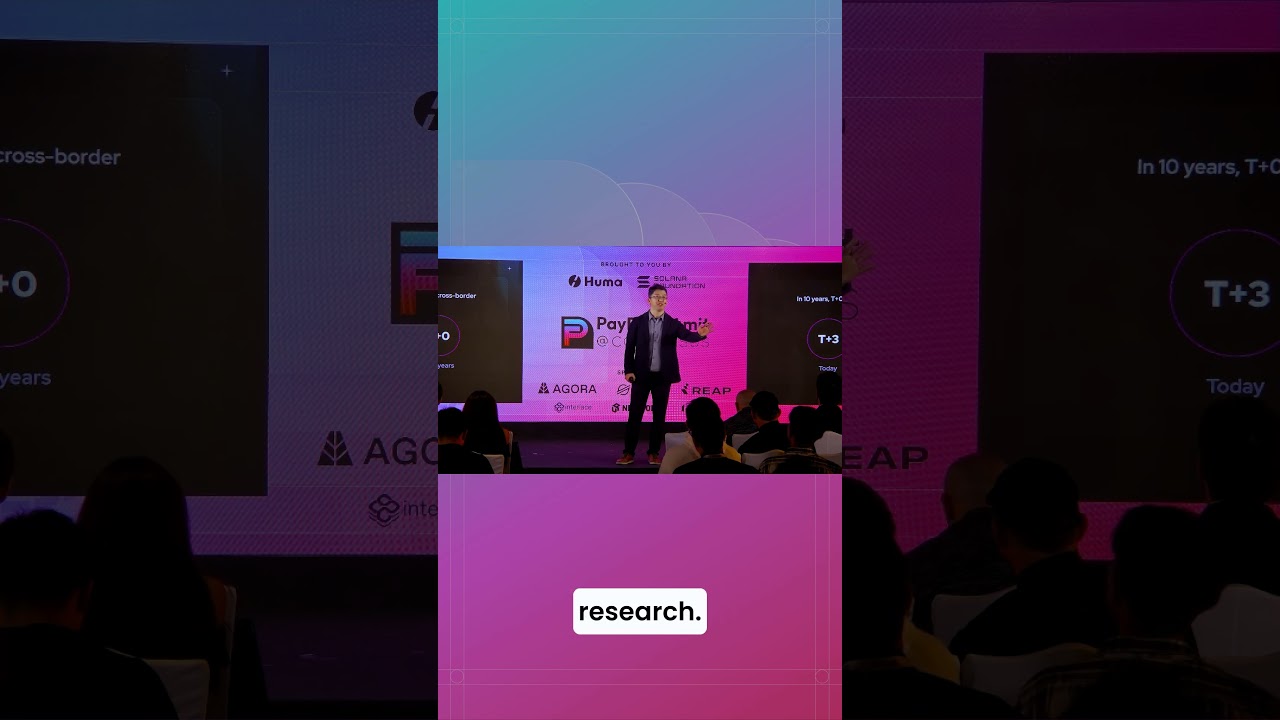
A category needs a diagram
“PayFi” gives Liu and Huma a compact name for a stack of unglamorous but consequential operations: underwriting, compliance, liquidity, custody, payment routing and settlement. Liu has compared the desired structure to the layered logic of the OSI networking model. Standard layers helped different computer systems communicate. A payment-financing stack could give builders agreed places to plug in capital, risk controls and applications.
The comparison suits an engineer, and it also exposes the size of the coordination task. Code alone cannot verify every offchain receivable, satisfy every jurisdiction or make risk disappear. Huma uses both onchain programs and offchain services. Its institutional product requires investor checks, while Huma 2.0, launched on Solana in April 2025, opened a permissionless route for eligible wallets outside restricted regions. The system still screens wallet risk and imposes operating rules around deposits and redemptions.
That balance between openness and control became more visible as Huma grew. The company introduced its HUMA utility and governance token in May 2025. In January 2026 it added Prime, a Huma 2.0 mode that combines payment-financing yield with a managed looping strategy. Liu’s June 2026 podcast appearance spent substantial time on the questions that arrive after a product has users: institutional due diligence, reserve transparency, redemption pressure, bad-debt scenarios and an exploit involving an older contract.
This is where a category graduates from a slogan. The founder’s job becomes less about announcing motion and more about explaining the brakes. Liu has argued for transparency around the underlying facilities and turnover of receivables. The work asks investors and users to understand where yield originates, how quickly capital recycles, and what can go wrong. Finance is rarely improved by mystery, however fashionable the wrapper.
The five-minute reset
Liu’s public biography is crowded with systems, but his personal notes are refreshingly analog. He likes hiking with entrepreneurs and friends on weekends. His favorite books include No Rules Rules, High Growth Handbook and Principles, a shelf concerned with culture, scaling and decisions. Asked to name his magic power, he chose a five-minute power nap every day.
It is difficult to invent a better founder detail. The ambition is to rewire how global payments are financed; the restoration protocol lasts about as long as a coffee queue. The combination suggests neither mysticism nor heroic exhaustion. It suggests a person fond of compact systems that return useful output.
He has also mentored in the Lighthouse Mentorship Program since 2015, helping develop experienced managers toward director roles or entrepreneurship. At Foothill Ventures, where he serves as a venture partner, his stated interests are Web3, fintech and AI. Those are the same territories his operating career has crossed, which makes the investing role feel like another form of pattern recognition.
The aspiration at Huma is larger than shaving a few hours from a wire. Liu wants payment financing to become an open layer: capital available when commerce needs it, receivables made legible to funders, and the plumbing standardized enough for other businesses to build upon it. Whether that architecture becomes ordinary will depend on underwriting, regulation, reliability and the daily evidence beneath every diagram.
For now, Liu’s career offers a quieter idea worth stealing. The future does not always announce itself as a dazzling new object. Sometimes it is hiding inside a delay everyone else has accepted. Look for the prefunded account, the payroll calendar, the carrier boundary, the unmatched résumé. Find the person waiting on the other side. Then make the handoff disappear.