Sentora occupies an odd and increasingly valuable corner of finance: it helps large companies use decentralized markets without asking their customers, treasury teams or compliance officers to become crypto hobbyists. The end user sees an Earn button. Underneath it, Sentora evaluates vaults, chooses strategies, monitors collateral, watches liquidity and changes positions when a limit is breached. It is plumbing with opinions.
That distinction matters. DeFi already has lending markets, exchanges and vault software. Its shortage is not code that can move money. It is an operating layer that can explain where the money went, why it went there and what happens when the answer changes at 3 a.m. Sentora sells that layer to exchanges, fintechs, custodians, funds, protocols and stablecoin issuers. Its platform combines strategy design, non-custodial vault curation, live economic-risk data, capital formation and protection mechanisms.
A company assembled from complementary scars
Sentora did not begin with two founders and a blank whiteboard. It arrived in May 2025 when IntoTheBlock merged with Trident Digital. IntoTheBlock contributed years of on-chain analytics, quantitative strategies and risk tooling. Trident brought institutional lending, structured finance, liquidity programs and the muscle memory of traditional markets. Anthony DeMartino, a Trident co-founder and former Coinbase risk executive, became chief executive. IntoTheBlock co-founder Jesus Rodriguez became chief technology officer.
The combination raised a $25 million Series A led by New Form Capital, with Joint Effects, Tribe Capital, Ripple, UDHC and other strategic investors participating. The money was earmarked for product development and partnerships, but the more interesting asset was inherited experience: the predecessor businesses said they had supported more than $3 billion in historical institutional DeFi deployments.
The centaur in Sentora's logo is almost too tidy a metaphor: half one thing, half another, built to travel between worlds. The company is not trying to turn a pension committee into a DAO. It is trying to make open, programmable markets behave enough like governed financial infrastructure that institutions can use them on their own terms.
A dashboard was useful. A downturn demanded controls.
The first thing to fail was not a Sentora product. It was the assumption that analysis delivered on a human timetable could manage a market that moves continuously. IntoTheBlock has said the severe 2023 downturn made the weakness obvious. A risk memo can be correct when written and stale before a committee reads it. Liquidity vanishes, a stablecoin slips its peg or a whale changes a pool's concentration while everyone is still scheduling the meeting.
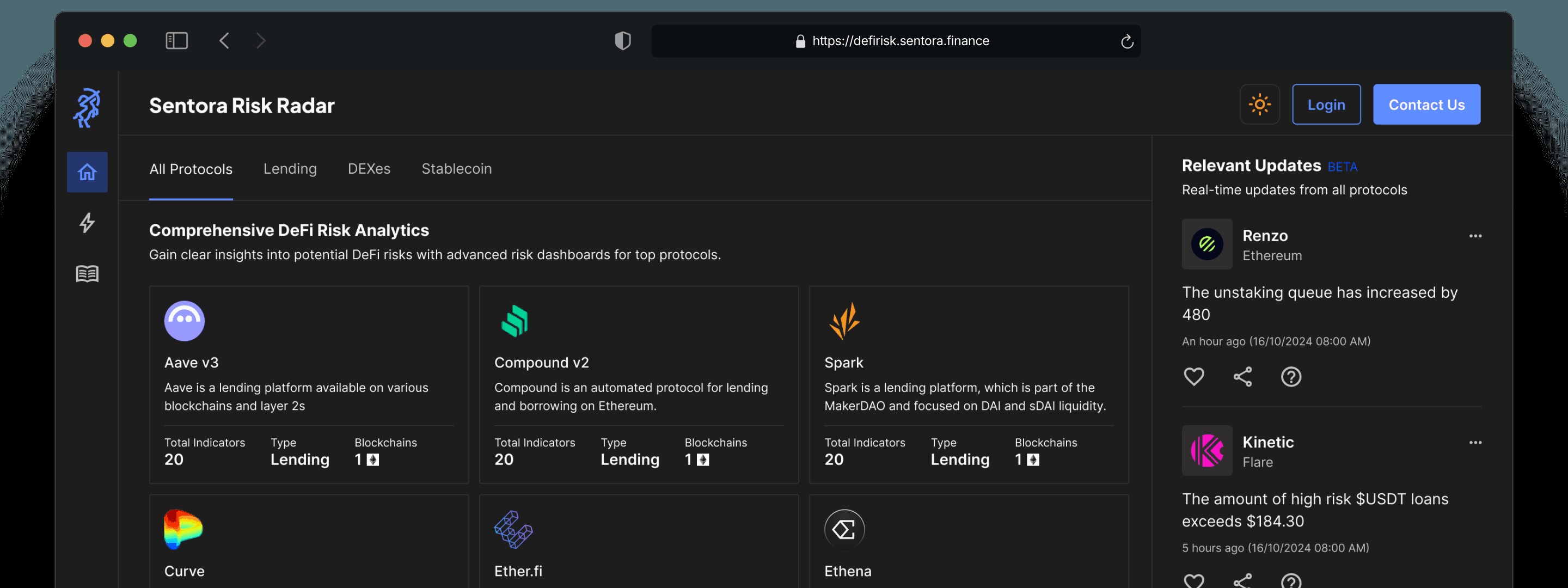
That experience led to Risk Radar, which computes venue-specific economic signals block by block, and later Risk Pulse, an alerting product for liquidations, depegs, risky loans, volume spikes and large-holder movements. Sentora now describes a seven-part framework spanning technical, concentration, liquidity, interest-rate, duration, leverage and correlation risk. Alerts feed escalation procedures; some limits can trigger automated rebalancing or deleveraging.
Return of capital before return on capital.Sentora's stated risk principle
Can the position exit without moving the market or waiting through a redemption queue?
Are a few wallets, pools or correlated assets quietly holding the strategy together?
How close are borrowing positions to liquidation, and can they unwind automatically?
What happens if an oracle, bridge, validator set, governance process or smart contract fails?
The approach does not make DeFi safe in the absolute. Sentora's own legal terms list smart-contract exploits, oracle errors, depegs, insolvency, governance attacks and regulatory action among the remaining hazards. The value proposition is narrower and more believable: define risk, measure it repeatedly, restrict what a strategy may do and document who responds when conditions break.
The customer buys an outcome, not another crypto tab
Sentora's customers sit on both sides of the market. Exchanges and fintechs want to offer yield without building an internal DeFi team. Asset managers, lenders and funds want allocations with institutional controls. Protocols and stablecoin issuers want capital, distribution and credible risk oversight. Sentora connects those needs through a modular stack.
Kraken's DeFi Earn program is the cleanest example. Kraken handles the familiar app experience. Veda provides vault infrastructure. Sentora designs and curates strategies across four vaults, from balanced USDC to a Bitcoin strategy. Deposits move into established lending and liquidity venues while users avoid wallets, bridging and gas management.
By July 2026, Sentora reported more than $600 million in balances and over 80,000 active depositors across those vaults within six months. Its case study lists a 25 percent performance fee for each vault and says the system had recorded no liquidations. Those figures are company-reported, but they reveal the commercial shape of the business: Sentora can earn service, data or performance fees while the distribution partner keeps the consumer relationship.
Kraken DeFi Earn after six months
Do not win the vault war. Supply the intelligence.
At the start of 2025, Sentora says it was integrated with one vault provider. As the year progressed, management concluded that vaults were becoming the standard way for applications to touch DeFi. The company changed course: instead of betting on one provider or trying to own every layer, it integrated with UpShift, Kiln, Blockdaemon, Mellow and Veda.
That decision is the strategy hiding inside the product story. Vault code risks becoming interchangeable. The durable layer may be the mandate that tells a vault which assets are approved, how large a position may grow, what liquidity buffer it needs and when it must retreat. Sentora wants to be that control plane across providers and chains.
Its partnerships show the range. For PayPal's PYUSD expansion on Solana, Sentora says it coordinated incentives, integrations and institutional capital to produce $700 million in net-new TVL in two months, exceeding a $500 million target while using 35 percent of the program budget. On Tempo, it launched a pathUSD vault on Morpho against cbBTC collateral. On Stellar, it began rolling out native vaults with the Stellar Development Foundation and Stellar DeFi Hub. The common product is not a single pool. It is organized capital plus rules.
The playbook is useful well beyond crypto
Founders can copy Sentora's architecture without copying its market. First, separate distribution from specialized execution. Let a trusted platform own the user and embed your capability underneath. Second, turn expert judgment into a repeatable policy system: approved inputs, measurable thresholds, automated actions and named escalation owners. Third, integrate with the likely standards instead of insisting that customers adopt your entire stack.
The stealable five
- Merge complementary capabilities when the buyer needs one accountable outcome.
- Convert a report into a live control loop when the environment outruns meetings.
- Sell through products customers already trust.
- Make risk rules inspectable, measurable and tied to action.
- Use partnerships to widen distribution without surrendering the intelligence layer.
There are conditions where the model will not work. Multi-strategy vaults introduce more integrations and smart-contract surface area than a single lending pool. Small programs may not generate enough incremental yield to justify the fees and operational complexity. Thin liquidity can make a theoretically attractive strategy impossible at scale. A partner that wants guaranteed returns, instant liquidity in every market and zero technical risk is asking for a triangle that cannot close.
Regulation is another boundary. Software, non-custodial architecture and careful disclosures do not erase questions about securities, advice, custody or cross-border access. Nor can an alert system repair a broken oracle after the fact. Sentora works best when markets are liquid enough to exit, counterparties accept transparent constraints and the distribution platform can support the legal and technical integration.
Competition is broad: Gauntlet and Chaos Labs in risk, specialist curators such as Steakhouse Financial and Re7, analytics companies such as Nansen, and the simple option of integrating directly with Morpho or Aave. Sentora's difference is breadth. It combines the quant desk, risk committee, allocator, integrations team and capital-formation shop. Breadth can become bureaucracy; for now, it is also why a partner can buy an Earn product instead of assembling six vendors.
The best infrastructure may disappear into the interface
Sentora's wager is that on-chain finance will become less visible as it becomes more useful. A consumer will see a savings balance. A treasurer will see an approved allocation. The lending pools, automated market makers and collateral rules underneath will matter enormously, but they will look like back-office machinery rather than a lifestyle.
That future favors companies willing to be invisible and accountable. Sentora does not need every depositor to recognize its centaur. It needs the exchange, fintech or asset manager to trust its models, controls and response process. The company's real product is not yield. Markets supply that. Its product is the governed path between an institution and a market that never closes.
Go deeper
DeFi strategies can lose money through smart-contract failures, depegs, liquidations, liquidity shortages and regulatory changes. Performance figures in this profile are reported by Sentora and are not investment advice.