The emergency had not yet begun, and Helmerich & Payne’s security team was already doing the work that often consumes the opening hours of a crisis: locating people, checking journeys and identifying exposure. In Restrata’s account of the drilling company’s preparations for conflict in the Middle East, personnel reports were ready before the team needed them. That sounds like a modest achievement. Anyone who has tried to reconcile several departments’ spreadsheets will recognise the ambition.
Previously, H&P had to bring together information from Security, Health and Safety, HR and Operations. Staff assembled and checked records while an incident was developing. With resilienceOS, Restrata says, those streams became a shared view, allowing the team to restrict travel and prepare earlier. The customer story is about buying back attention: less effort establishing the facts, more effort deciding what to do.
“We already had the key data, and could respond in a deliberate way.”
Rob Ream · Helmerich & Payne
In Restrata’s customer account
A booking is not a whereabouts
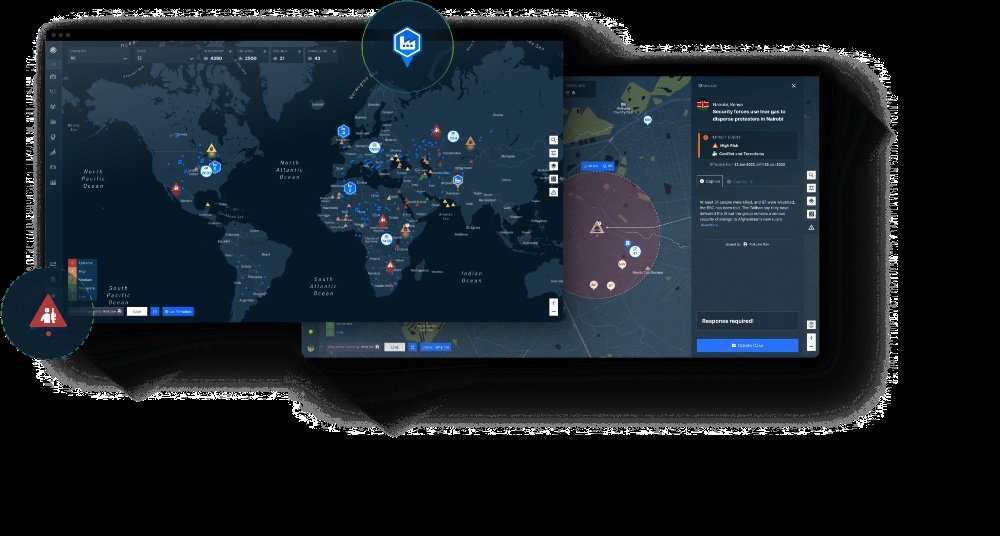
Restrata sells operational resilience software and services. Its core product, resilienceOS, connects people, sites, assets, journeys, threat intelligence and response. The practical question beneath that vocabulary is straightforward: something has happened somewhere; which of our people might need help?
One employee can leave several trails. A travel reservation describes an intended journey. A badge swipe records entry to a building. A mobile device can supply a more recent location. An HR system knows the employee’s usual office. These records answer different questions, and treating them as interchangeable invites confusion.
Restrata’s Location Confidence engine combines evidence from multiple sources to estimate the most probable location. Threat information can then be related to the organisation’s actual footprint. The distinction matters: a report about disruption in a city becomes operationally useful when the security team can connect it to a traveller, a facility or a planned journey.
Communication follows the same logic. Restrata’s mass communications product uses location and operational context to select recipients and help confirm their safety. A company-wide broadcast may be appropriate in some circumstances, but it is a blunt instrument for a local problem. Repeated irrelevant warnings can teach employees to ignore the next one. The product’s aim is to connect the message to the people who need to act.
The oil terminal test
Much of Restrata’s credibility comes from places where counting people is daily operational work. Its Flotta Terminal case study, now presented under NEO NEXT+, describes a deployment for Repsol. Ageing access control sat alongside manual processes for visitors, journeys, mustering and communications. Safety-critical information was harder to assemble than it needed to be.
The installation brought personnel-on-board records, mustering, visitor management and mass communications into resilienceOS. Restrata reports quicker access to personnel information and continued operation in offline scenarios. Here, the useful feature is almost stubbornly ordinary: knowing who is on site and who has reached the assembly point.
That case helps explain the company’s market. Energy and industrial operators have contractors, remote facilities, changing shifts and people moving between sites. Restrata also describes customers in manufacturing, healthcare and software. It says more than 180 organisations use resilienceOS, with its software and services operating in over 100 countries. Those are company-reported figures, but the customer mix makes the direction clear: the product is moving beyond its energy roots.
The freedom to change the feed
A different customer illustrates Restrata’s competitive argument. An unnamed global software company with roughly 5,000 employees wanted to use MAX Security’s intelligence. In Restrata’s telling, its existing AlertMedia arrangement made the platform and intelligence difficult to separate. The company wanted a different information provider without committing itself to another inseparable bundle.
It selected resilienceOS with MAX Security integrated. Restrata says the arrangement maps intelligence to people, sites and journeys while preserving the option to change or combine providers later. This is a vendor’s account of one customer decision, not a universal verdict on AlertMedia. But it gives a concrete meaning to a frequently overused software adjective: open.
The partnership itself was announced in April 2025, with MAX’s Intel Portal feeding resilienceOS. The commercial logic is appealing. A security team can choose intelligence for its geographic needs, then use an operational platform to make that information relevant to its own workforce. A change in intelligence requirements need not automatically dictate a change in the rest of the system.
Restrata competes in a busy neighbourhood. Everbridge offers critical event management, risk analysis and response coordination, and has published integrations with International SOS. Connectivity alone therefore cannot settle the comparison. Restrata’s specific pitch combines a shared data model, selectable intelligence and practitioners who support the response. Buyers have something tangible to inspect: how those pieces work together in their own operating environment.
Someone still has to answer
A map does not pick up the phone. Alongside its software, Restrata sells monitoring, response and advisory services through a Resilience Operations Centre. The service ranges from round-the-clock platform support to monitoring, incident management and a broader programme of crisis advice, exercises and governance reporting.
The distinction is commercial as well as operational. A buyer can purchase software for an existing team or add outside capacity to help run the programme. Restrata’s published tiers are Support, Monitor, Respond and Command. They expand from keeping the platform working to helping an organisation prepare for and manage disruption.
Its customer material describes approximately 500 lone workers at a New Zealand housing organisation supported by mobile technology and continuous monitoring. That is a useful counterweight to the offshore imagery. A worker attending an unfamiliar property may need a check-in and a human response just as surely as a travelling executive needs travel intelligence.
The companion app makes that connection visible to employees. Its listed functions include SOS activation, location sharing, missed-check-in alarms, geofences and discreet duress alerts. It can also connect to a Bluetooth panic button. The app requires subscriptions to relevant resilienceOS modules, placing it within an employer’s wider service rather than making it a standalone consumer safety purchase.
From response work to a software investment
Restrata’s history predates the platform. Scottish Equity Partners dates the business to 2006 and identifies Chris St George and Botan Osman as co-founders, bringing together technology, security, military and government experience. In April 2019, Restrata publicly unveiled its cloud-based software platform for energy and industrial customers.
The company says it began building the platform because practitioners were repeatedly encountering fragmented information in difficult operating environments. It still links its development work to lessons from advisory and incident response engagements. That connection gives the business a plausible feedback loop: the people helping customers through disruption can see where the software needs work.

In February 2025, SEP announced a growth equity investment to support product development, AI enhancements and expansion across North America, Europe and the Middle East. It reported that resilienceOS revenue had increased by more than 50% in 2024. The measure refers to platform revenue, so it should not be read as the growth rate of every Restrata activity.
The business model follows the product’s shape: enterprise software capabilities supported by services, with customers able to start with a particular need and expand. A meaningful cost comparison would include implementation, intelligence feeds, training and the level of operational support. For a buyer, the financial question is how that scope compares with maintaining the equivalent capability internally.
ROSA gets a seat, not the final say
Restrata’s current AI offering, ROSA, operates inside resilienceOS. The company describes it as a way to interpret live workforce, travel, threat and incident information, prepare executive briefings and recommend actions. The ambition is to shorten the interval between seeing information and understanding its implications.
ROSA won the Threat/Risk Management Software Applications category at the 2026 Security Industry Association New Products and Solutions Awards. That is a specific industry recognition, rather than evidence that every proposed use works equally well. Restrata’s own product description leaves responsibility for decisions with people.
That division of labour is sensible. An assistant’s interpretation depends on the records beneath it, while the consequences of an evacuation, travel restriction or emergency escalation belong to the organisation. Adding fluent explanations cannot repair an incomplete personnel picture. It makes the earlier work of connecting and checking records more consequential.
The part readers can copy
The practical lesson from these cases costs no software licence to understand: prepare the information before you need the response. Identify which system owns each employee record, how journeys and site visits update it, and who acts when a check-in is missed. Then rehearse a scenario that forces those responsibilities to meet.
This is an inference from Restrata’s cases, not a promise of results. The approach depends on usable records, maintained integrations and people who understand escalation. It will disappoint if nobody owns the underlying data or answers the alert. A simpler organisation may have little reason to buy the full range of capabilities. The test is whether the system helps a real team reach a defensible decision with less delay.
One of Restrata’s published workplace values is to discuss failure openly. It is an apt ambition for a company in this market. The useful moment to find a missing contact, a contradictory location or an unclear handoff is during ordinary operations or an exercise. By the time the headlines arrive, the headcount should already be somebody’s job.