At Close Brothers, four people took turns updating a spreadsheet. The merchant banking group was preparing a data center failover, the sort of operation in which a small mistake can acquire an expensive social life. Its plan had 200 lines. People completed tasks, messages appeared in chats, and somebody had to record what had happened. According to Cutover’s account, the spreadsheet could fall at least an hour behind. The computers were moving. The account of the computers was struggling to catch up.
- Cutover turns IT recovery plans into executable, shared runbooks.
- People and automated tools work through dependencies in a visible sequence.
- Banks use it for recovery tests, incidents, migrations and releases.
- The useful lesson: measure the handoffs as carefully as the machines.
The spreadsheet fell behind
That gap is where Cutover has made its business. Enterprise technology contains plenty of specialist tools. There are systems to raise tickets, systems to send alerts, systems to deploy software. But a complicated operation crosses their borders. Someone needs to know whether the database team has finished, whether the application team can begin, and whether the executive asking for an update is interrupting the person doing the work.
Close Brothers replaced its manual approach with Cutover runbooks. Around 200 people executed 1,400 tasks, while another 30 stakeholders needed updates. A node map exposed dependencies and the critical path. Individual users could filter their tasks; administrators could inspect progress by business unit. Dashboard updates went to stakeholders automatically. The exercise finished successfully, with an audit trail recording who did what and when. The change addressed a precise failure: keeping the shared account of an operation current.
A plan that can answer back
A conventional runbook is a set of instructions. Cutover makes it a working environment. Tasks have owners and dependencies. Notifications tell people when their work is ready. Dashboards show progress, and integrations can initiate actions in other systems. The plan can be rehearsed, reused and amended during execution. A manager gets an overview; an engineer gets the next relevant task.
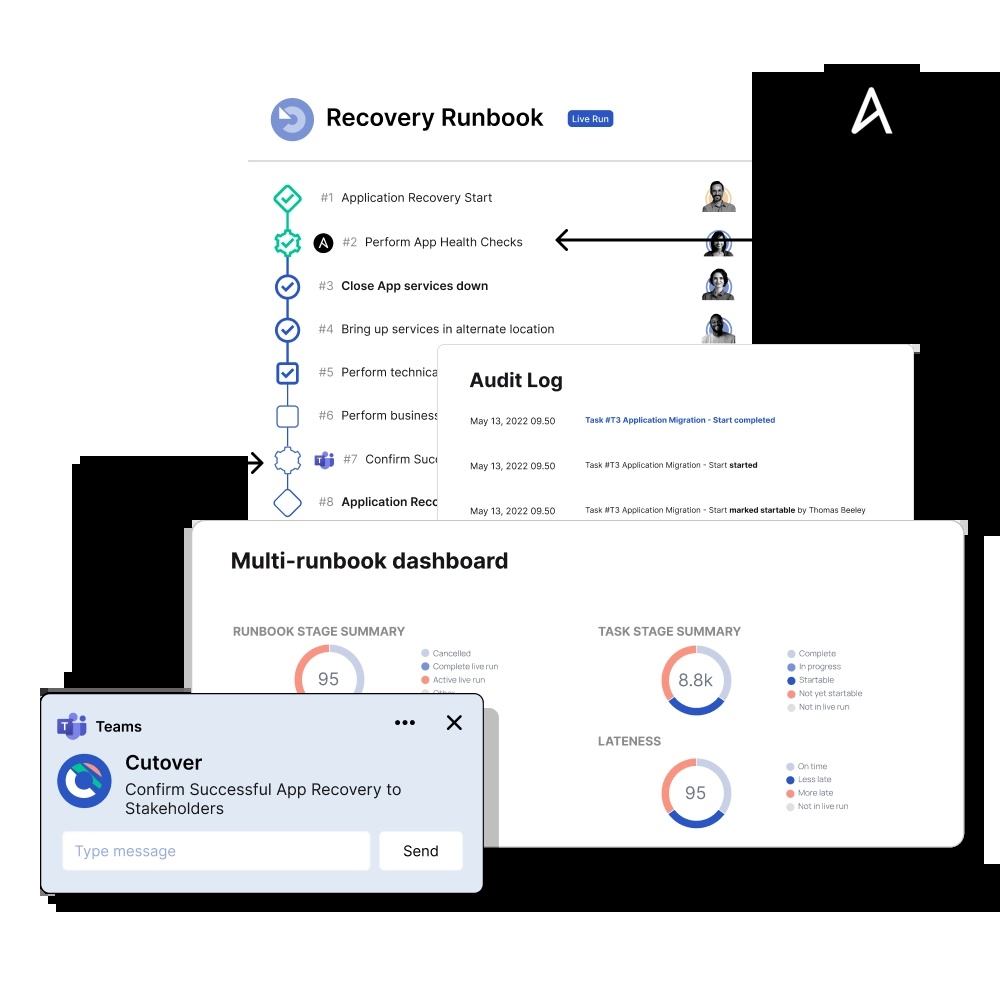
The product family follows those occasions. Recover handles disaster recovery. Respond coordinates major incidents. Migrate manages migrations; Release organizes software releases; Implement supports technology implementations. Application Metastore connects application data with recovery templates. The common machinery is coordination across people and tools, rather than a separate invention for every occasion.
This places Cutover in an interesting patch of enterprise software. ServiceNow can remain the system of record; PagerDuty handles alerting. Ansible and Jenkins can execute technical work. Cutover’s stated distinction is orchestration across the whole event. Its integrations connect these existing investments, including collaboration tools such as Slack and Microsoft Teams. Buyers are purchasing a way to organize execution across departmental and technological boundaries.
The rehearsal changed the plan
Danske Bank supplies a revealing example. Its recovery testing had relied on spreadsheets and Confluence. The processes worked, but around 130 services took ten hours to test and shut down. Those long windows also restricted other teams’ opportunities to make changes. The constraint was logistical as well as technical: resources, dependencies and people had to arrive in the right order.
After evaluating suppliers, the bank adopted Cutover. Its first large test converted existing failover plans into a runbook with 3,000 tasks. For the second, individual database service owners uploaded their own plans. Owners checked their sections before the resilience team merged them into one runbook. Training and rehearsals exposed changes before the live exercise. The software gave the bank a shared view; the preparation made that view useful.
Cutover’s case study reports that the bank subsequently could fail over more than 400 services in fourteen hours. The event took longer, yet covered substantially more ground. Simple division gives roughly thirteen services an hour before, versus more than twenty-eight afterward. That is a useful improvement to examine. It also explains why recovery claims deserve a denominator: duration alone can conceal how much work a team actually accomplished.
The bill includes the human work
Cutover sells enterprise SaaS through personalized quotes based on team size, usage and advanced functionality. Integration and professional service requirements matter too. A commissioned Forrester study models a composite retail organization, assembled from four customer interviews, with about $922,000 in undiscounted total costs over three years. It reports 313% return on investment. Those are modeled results for specified assumptions, rather than a price tag or promised return for every buyer.
The model includes subscriptions, integrations, onboarding and ongoing management. Its implementation assumption is three months, with effort concentrated in change management and creating runbooks. That makes the practical question sharper: can the organization supply accurate application data, agreed dependencies and accountable owners? Automating a disputed plan preserves the dispute at higher speed. Danske’s owner reviews and rehearsals offer a method readers can copy before selecting any software.

AI inherits the handoff
“While we never designed Cutover solely for banks”Craig Gregory / co-founder
Cutover’s founding story helps explain its market. Co-founder Craig Gregory recalled a small team working through lunches and weekends before entering the Barclays Techstars accelerator. He wrote that banks’ complicated, regulated problems suited the software. Ky Nichol leads the company; Marcus Wildsmith leads product. A $17 million Series A in 2019 and a $35 million Series B in 2021 financed expansion.
Today, AI can create runbooks from existing documents, suggest improvements and summarize outcomes. Cutover announced an early preview of its conversational AI Assistant in November 2025; its current product page describes questions and changes in natural language. AWS resilience competency recognition followed in December. These developments extend the same proposition: make complex work easier to coordinate and inspect. The enduring question is wonderfully ordinary. Has the previous team finished, and who goes next?
Follow the work
Cutover / Close Brothers’ failover / Danske Bank’s tests / The cost model / News and blog / Funding announcement / Leadership / Gregory’s founding account / LinkedIn / X / Facebook / YouTube videos / Watch the agent demo