Botan Osman sells software for the moment when a company needs an answer quickly. Where are our people? Who is exposed? Who can act? Yet one of his more revealing prescriptions for running a technology business involves buying people time together in the same room. Save money on offices, he argues, then spend some of it bringing colleagues together. A calendar full of calls is a rather expensive way to prove that communication remains difficult.
There is a useful tension here. Restrata’s co-founder and CEO wants information to travel across organisations with less friction. He also recognises that people need more than an efficient delivery mechanism for instructions. The thread running through his career is the work of making separate parts cooperate: government departments, regional operations, security teams, software systems. The difficult part often begins where one responsibility ends and another starts.
A department before a platform
Before Restrata, Osman worked inside the Kurdistan Regional Government of Iraq. Appointed in late 2006 to establish its Department of Information Technology, he became the department’s head and an IT adviser to the prime minister. His education was in software engineering at the University of Manchester. The assignment in government placed that technical background inside an institution-building project.
The department’s work included a regional IT academy, a biometric electronic identification system, plans for a cloud-based regional data centre and a government-wide IT strategy. These were different kinds of infrastructure: training people, establishing identity, organising computing capacity and setting common direction. Taken together, they show the breadth of the job. An identification system needs an institution willing and able to use it; a strategy needs people capable of putting it into practice.
Osman also completed executive programmes at Harvard Kennedy School, the US National Defense University and the UK Defence Academy. His professional education crossed the border between computing and public administration. It is an apt background for someone whose later business would depend on explaining technical systems to people responsible for decisions with consequences beyond a screen.
- 2006Establishing government IT capability in Kurdistan
- 2013Joining Restrata to build its regional business
- 2019Co-founding the Restrata software venture
The view from Kurdistan
He joined Restrata in 2013 as country director for Kurdistan and northern Iraq. The work brought him close to the practical problems of businesses operating around oil and gas infrastructure. In a 2015 interview, his priorities included helping international operators concentrate on production while security specialists dealt with the surrounding risks. He also wanted to develop local Kurdish capability within the businesses.
That second ambition deserves attention. Local expertise changes the relationship between an international company and the place where it operates. People who know the language, institutions and working environment contribute something that cannot simply be shipped in with equipment. Osman’s interest in building a Kurdish cadre placed workforce development alongside security technology.
His government and commercial careers also overlapped through business institutions. He was a founding committee member for institutional relations at the British Business Group Kurdistan, established in June 2014. The role fits a career spent moving between public bodies and private operators, where an introduction, a shared vocabulary or a workable institutional relationship can matter as much as a technical specification.
By 2017, he had moved through global business development into Restrata’s managing director role. His argument about Iraq’s economic future extended beyond the oilfields. He saw growing connectivity and the transfer of technical knowledge as foundations for new industries. Internet access, in this account, gave people more ways to participate in the economy and reach public services. The ambition was broader than supplying another corporate system.
The business hidden between the systems
Restrata’s wider business dates to 2006; Osman’s part in its history came later. His conference biography dates his co-founding of the software venture to 2019. Keeping those dates separate matters. It describes a move towards software inside a business with an existing operational history, rather than a founder arriving with an empty notebook and a newly invented problem.
By 2021, Osman was making a clear case for combining local operational data with a global view. Travel information could suggest where an employee was expected to be. Information from the ground could establish something more useful. The gap between an itinerary and a person’s actual circumstances becomes particularly awkward when an organisation has to make a decision quickly.
“We believe the future of security is knowing the present.”
Botan Osman, 2021
The appeal of that sentence is its modest time horizon. It asks a business to become competent at the present before getting carried away with predictions. Osman described a platform that connected sites, travel, incidents and risk information. Restrata’s own operators also used the technology in responding for clients. The software was intended to serve both the central view and the person dealing with an event locally.
There is a recognisable engineering instinct in this: establish what the inputs mean, bring them together and make the result usable. But the customer’s difficulty is organisational too. Different teams have different tools, duties and definitions of a useful answer. Connecting them requires more than placing several windows on the same monitor. Someone still has to decide what happens next.
Aberdeen supplies a practical test
One concrete expression of this approach appeared in July 2023, when Restrata and LOGIC announced a service partnership for VantagePOB. The system had launched in 2004 as a collaborative industry effort to standardise aviation logistics across UK Continental Shelf operators. Its subject was the movement of people through offshore operations, where reliable information has an immediate practical purpose.
Osman emphasised Aberdeen’s place in Restrata’s identity. The company’s emergency response centre had operated there since 2012. The agreement brought its technology and incident-management experience to an established industry service. For a software executive, this is a useful sort of connection: the product sits beside an existing workflow with users, history and a reason to care whether it works.
The same question reached Westminster in June 2026. During a parliamentary evidence session, MP Christopher Chope referred to a recent panel with Osman and asked about gaps between private-sector security advice and information available to government security bodies. The exchange concerned the North Sea. It gave public expression to a familiar Osman theme: separate organisations can each possess useful knowledge while still struggling to work from a common picture.
A growth round with a specific job
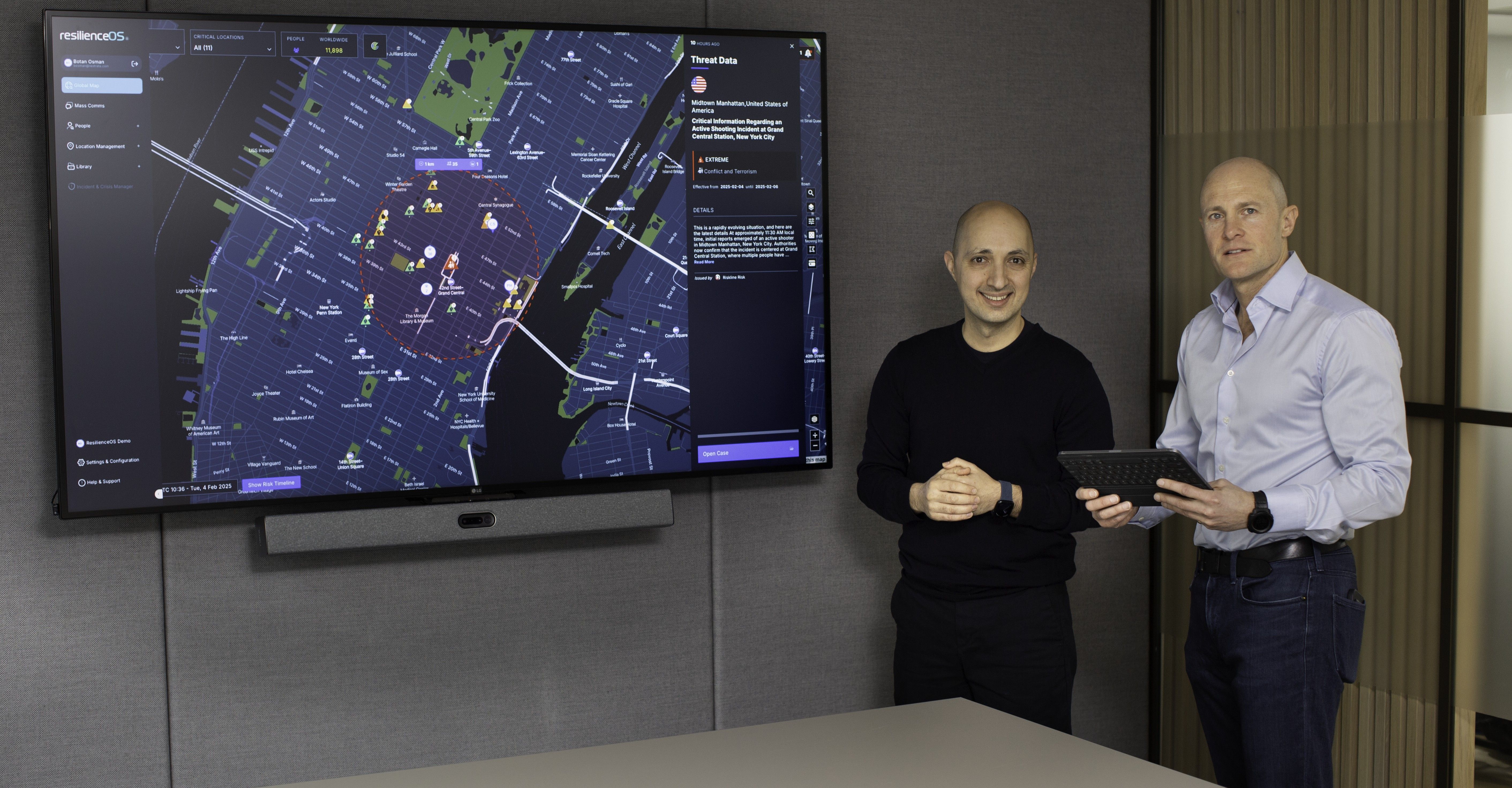
In February 2025, Scottish Equity Partners announced growth investment in Restrata. The funding was intended to support product development, AI capabilities and expansion across North America, Europe and the Middle East. The announcement paired Osman with co-founder and chair Chris St George, bringing their technology, government and security experience into the account of how the business had developed.
The accompanying growth figure was specific: resilienceOS revenue had increased by more than 50 per cent during 2024. That is a measure of the platform’s revenue, rather than a blanket number for every activity in the group. Its relevance to Osman’s story is the adoption of the software proposition he had helped build.
Capital made the next set of commitments more concrete. The company would have to keep improving the product while serving customers across several regions. For Osman, the investment also put an outside financial partner behind an argument he had been making for years: fragmented operational information was a business problem worth spending money to solve.
The remote-work advocate who budgets for a room
His account of managing Restrata provides a smaller, more personal test of the same thinking. In 2024, he described a workforce spread across the UK, Europe, the United States, South America and Sri Lanka. He favoured independent work, clearer workflows and collaboration across time zones. Constant meetings could indicate that the organisation itself needed attention.
Yet he also described reinvesting office savings in physical gatherings. He wanted colleagues to have conversations beyond the immediate task. His company used its own tools too: when staff were in Orlando during Hurricane Milton, it monitored the developing situation. The people building a system for distributed teams were themselves distributed.
“By going remote, you should invest in the anti-remote, too.”
Botan Osman, 2024
It is a pleasingly awkward phrase for a software executive. The budget for connection includes software subscriptions and the occasional shared room. A well-designed workflow can reduce unnecessary calls; trust and informal conversation still need somewhere to happen.
Leave room for the operator
At GSX in 2025, Osman’s presentation focused on open systems, freedom to choose providers and the foundations needed for effective AI adoption. His concern was that an organisation could automate a broken process and merely spread the trouble faster. Architecture, data and operational choices came before the promise of intelligent assistance.
He kept pressing that argument in 2026. A September Intersec article challenged closed security systems and their promises of integration. In October, he hosted a security leaders’ roundtable at the House of Lords, with contributors from bp, Jacobs and Apple. He described the value of relationships established before a crisis and preparation that could adapt when events changed direction.
That leaves a consistent ambition across a varied career. Government IT, a regional security business, offshore operations and enterprise software each involve people trying to act through institutions larger than themselves. Osman keeps returning to the joins: between one system and another, between information and authority, between colleagues who rarely share a room. The screen can bring a great deal into view. The next decision still belongs to somebody.