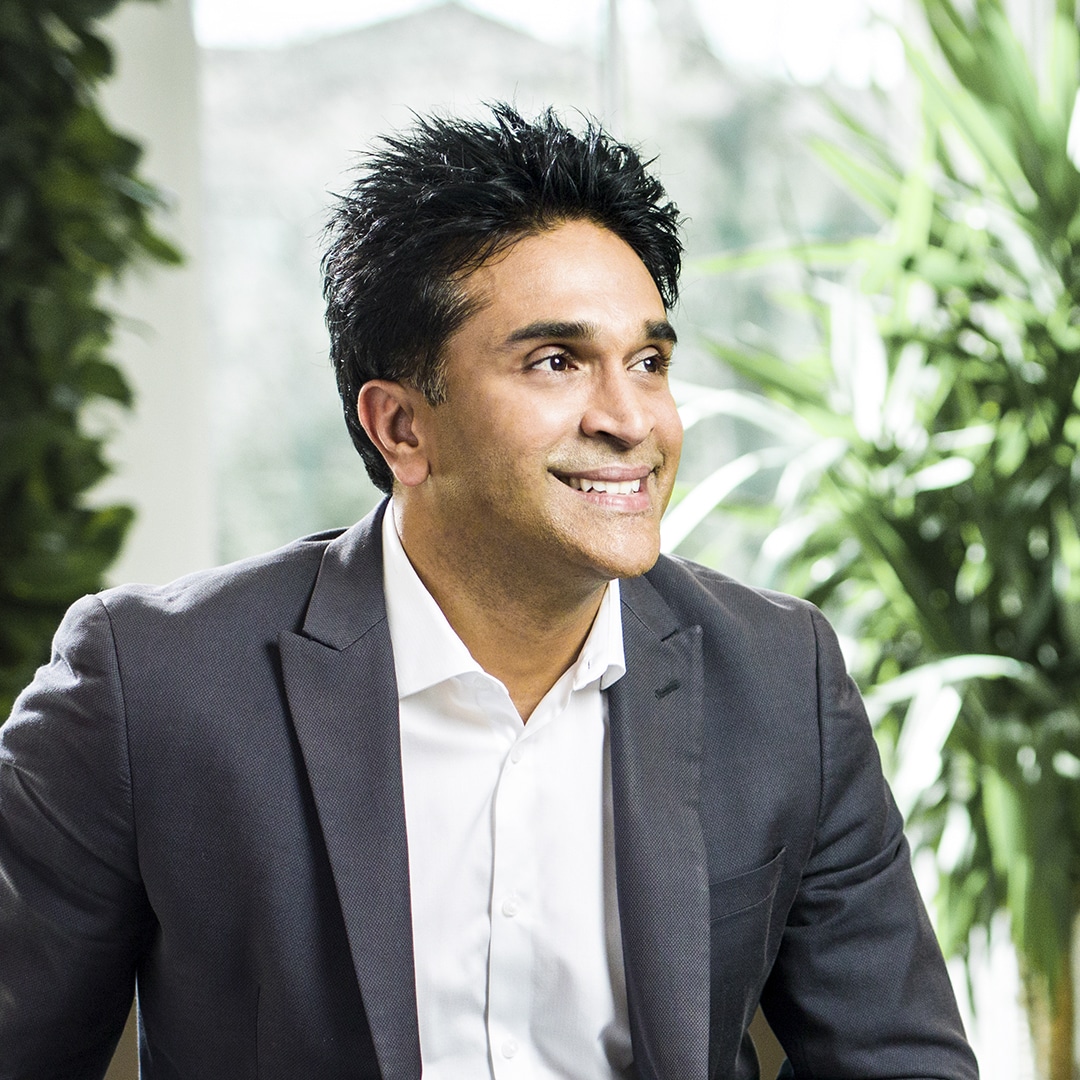
What happens when an insider becomes the disruptor
Ren Menon grew up in a village in rural India with no electricity. By the time he co-founded OrthoFX in 2017, he had spent more than two decades at the heart of the clear aligner industry - first as Director of R&D at Align Technology, then as Head of Global Product Development & Innovation, and finally as Head of North America Commercial Operations. He watched Invisalign grow from startup ambition to a $7 billion market cap company. He helped it happen.
Then he left. And built a competitor.
That's the move, and it's not an accident. Menon describes himself as "a people person first, businessperson second, and a technologist third" - an unusual self-description for someone who started as a software engineer and went on to lead global product strategy. But that ordering matters. When he and his co-founders Nichole Garcia (former GM at Align Technology and Philips Oral Care) and Henry Chan (former Director of R&D at Invisalign) sat down to design OrthoFX, they started not with the material science but with the patient experience. Who is getting left out? What does the current model force people to sacrifice?
I founded OrthoFX along with my co-founders to provide consumers with an option where they do not choose between quality, safety, and affordability.
The answer they found: roughly 192 million Americans with crooked teeth, many of whom are priced out of Invisalign or skeptical of the direct-to-consumer model that cut out dentists entirely. OrthoFX's proposition is a third way - D2C convenience and pricing, but with a doctor in the loop on every case. Not mail-order teeth straightening. Not a $6,000 orthodontist bill. Something between.
Patients responded. They nicknamed the product "the Tempur-Pedic of teeth" because of how comfortable the aligners felt against the competition. Menon adopted the nickname without hesitation. It's the kind of brand positioning that $10 million in ad spend can't buy.
He didn't just study Invisalign. He helped build it.
Menon's tenure at Align Technology - the company behind Invisalign - spans a critical window in the company's growth. He joined when the company was still finding product-market fit for the clear aligner concept, worked through an IPO phase, and left after helping the company's annual revenues reach $900 million with a $7 billion market cap.
The trajectory through Align is worth pausing on: Director of R&D, Head of Professional Marketing, Head of Global Product Development & Innovation, Head of North America Commercial Operations. Each jump is a different kind of problem - scientific, then go-to-market, then cross-functional, then commercial scale. That breadth of operational experience across a single transformative company is rare, and it's precisely what allows someone to look at a $40 billion industry and see not just what works but what's broken.
When Menon talks about what was broken in the industry - the lack of innovation in polymer technology "for decades," the tension between direct-to-consumer convenience and professional oversight, the pricing opacity - these aren't outside criticisms. They're insider confessions.
OrthoFX: where materials science meets patient experience
OrthoFX launched on June 12, 2019, out of Irvine, California, with a flat-rate price of $3,950 - roughly half the market rate for comparable treatment. The company is incorporated in Fremont, California, and has grown to a 130-person team. But the price was never the headline. The product was.
Menon's team developed the FXTetra polymer - a proprietary HyperElastic material that delivers 50% faster treatment times compared to standard aligner materials. For context: orthodontic polymer technology had not seen meaningful innovation in decades. FXTetra was a materials science bet, not just a marketing claim, and it required the kind of R&D investment that only someone who has lived inside the industry's product development cycle would know to make.
Proprietary HyperElastic material. 50% faster treatment time than competitors. Decades overdue.
First FDA-cleared aligner system rated for 12+ hours of continuous daily wear. Not a claim - cleared.
Remote monitoring platform for orthodontists. Fewer office visits. Better treatment adherence data.
Clear aligners with integrated teeth whitening. Multitask while you straighten.
Purpose-built tool for addressing orthodontic complications mid-treatment. Showcased at AAO 2025.
New technology (2025) for orthodontic detailing in final treatment stages. More control, less guesswork.
The FXOnTrack AI platform is the connective tissue. It enables orthodontists to monitor patients remotely - checking photos, tracking progress, making micro-adjustments without requiring in-person visits. This is how OrthoFX threads the needle between convenience and doctor oversight. It's not replacing the doctor. It's giving the doctor better tools.
$17M across three rounds - with strategic backers who bet on the model
The $13M Series A, closed July 22, 2020, was led by SignalFire with participation from Unusual Ventures, ShangBay Capital, and Kairos. SignalFire wrote publicly about their thesis: the hybrid D2C/doctor-delivery model, the materials differentiation, and the remote monitoring infrastructure. That's what a bet on OrthoFX looks like on paper.
The latest round closed in December 2024, bringing the total to $17M. For a 130-person company operating in a capital-intensive space with proprietary materials and an AI monitoring platform, the capital efficiency is notable.
A dog, a bad diagnosis, and a referral network that preceded OrthoFX
Before OrthoFX, Menon co-founded Goldenslate - a big data analytics-powered social referral network for trusted service professionals. Doctors, babysitters, contractors, lawyers, tutors. The idea was personal: Menon's dog received an incorrect diagnosis from a vet he found through an online recommendation service. The referral was generic. The vet wasn't the right fit. The diagnosis was wrong.
Rather than just complain about it, Menon built a company to solve it. Goldenslate later exited through a planned sale. The episode is a small case study in how Menon operates - he doesn't observe problems, he converts them into startups. Goldenslate was about trust and professional services. OrthoFX is about trust and medical care. The thread is consistent.
I did not choose to be an entrepreneur - it's innate to me. My mom and dad are probably the most risk-averse people you will meet, but I just always had a restless soul and felt much more at ease in situations where I was creating versus consuming.
He also co-founded Starsona Inc. and served as Managing Director at Silicon Valley Capital, leading the firm's diversification into health and wellness - another bridge role between the technology world and the healthcare industry he'd been operating in for decades.
The through line in Menon's career is restlessness. He describes his father's abandoned artistic aspirations as a cautionary example of what happens when you stop creating. He is, by his own account, constitutionally uncomfortable not building something. OrthoFX is the largest, most capital-intensive, most technically ambitious thing he's built. But it's not the first time he's chosen the hard problem over the comfortable one.
Chief calibrator
Menon has a phrase for what he does as CEO: "constantly serving as the chief calibrator." Evaluating what has changed and what hasn't. Which velocity needs to accelerate and which needs to slow down. What the market is saying versus what the company assumed six months ago. It's a deliberately humble framing for a CEO role - not "visionary" or "strategist," but someone whose job is to check and adjust.
We consider ourselves to be a customer experience business first and a product company next. We are about making this category fun and engaging for our customers, while ensuring they receive quality medical care.
There have not been advancements in polymer technology for decades within the clear aligner category, so we are consistently challenging ourselves to push the boundaries of orthodontic innovations.
My greatest fear is failing my team - people who have placed their trust in my co-founders and I.
I describe myself as a people person first, businessperson second, and a technologist third.
The fear he names isn't failure. It's failing the people who trusted him. That's a meaningful distinction in a startup environment where CEOs routinely frame everything around mission, market, and growth. Menon's primary frame is the people on his team who took the risk to join him.
He is, by multiple accounts, fascinated by human behavior and crowd dynamics - an unusual interest for a dental technology CEO but one that maps neatly onto his career. Reading markets, reading teams, reading patient behavior. The through-line is attention to humans as the variable that matters most.
AAO 2025, AirFlex, and what's next
At the American Association of Orthodontists annual conference in 2025, OrthoFX showcased its Rescue Aligners innovation - a purpose-built tool for addressing orthodontic complications mid-treatment. The reception validated a thesis Menon has been building toward: that the most interesting orthodontic innovation isn't in the consumer-facing aligner but in the clinical toolset around it.
The October 2025 announcement of AirFlex with PrecisionFinish extended that logic. PrecisionFinish provides orthodontists more control in the final stages of aligner treatment - the detailing phase where fine adjustments determine whether a case ends cleanly or requires further refinement. Menon's quote on the announcement: "We're advancing orthodontic finishing by giving doctors more control in the final stages of aligner treatment."
2025 Milestones
- Rescue Aligners showcased at AAO Annual Conference 2025 - innovations for mid-treatment complications
- AirFlex + PrecisionFinish launched - first FDA-cleared system for 12+ hr/day continuous wear with enhanced detailing
- December 2024 funding round completed, bringing total capital raised to $17M
- FXOnTrack AI platform continuing to expand remote monitoring infrastructure for orthodontic practices
The company's trajectory points toward deepening its B2B infrastructure - tools for orthodontists, monitoring platforms, clinical support. That's the sustainable moat in a market where consumer-brand spending is expensive and loyalty is thin. Build the best tools for doctors, and the doctor network becomes a distribution channel that's very hard to replicate.
The academic path
-
🎓Bachelor's in Engineering Undergraduate Degree — Institution not publicly confirmed
-
📋MBA Pepperdine University
-
⚡Executive Education Stanford University Graduate School of Business