The most consequential moment in the life of a hospital delivery robot is not when it recognizes a person, calculates a route, or flashes a charming face on its screen. It is when the elevator doors open. A nurse is waiting. A medication is waiting. Somewhere upstairs, a patient is waiting. The little machine must enter before the doors close, travel to the correct floor, and get out without trapping itself behind a linen cart. The future, at this particular moment, is holding up the elevator.
The handoff
- What it does: autonomous indoor delivery for hospitals and hotels.
- What it moves: medications, specimens, supplies, food, packages, and guest amenities.
- What customers buy: a custom-quoted robot service, deployment, integrations, software, and support.
- What makes it different: small footprint, secure payloads, human-aware navigation, and deep elevator experience.
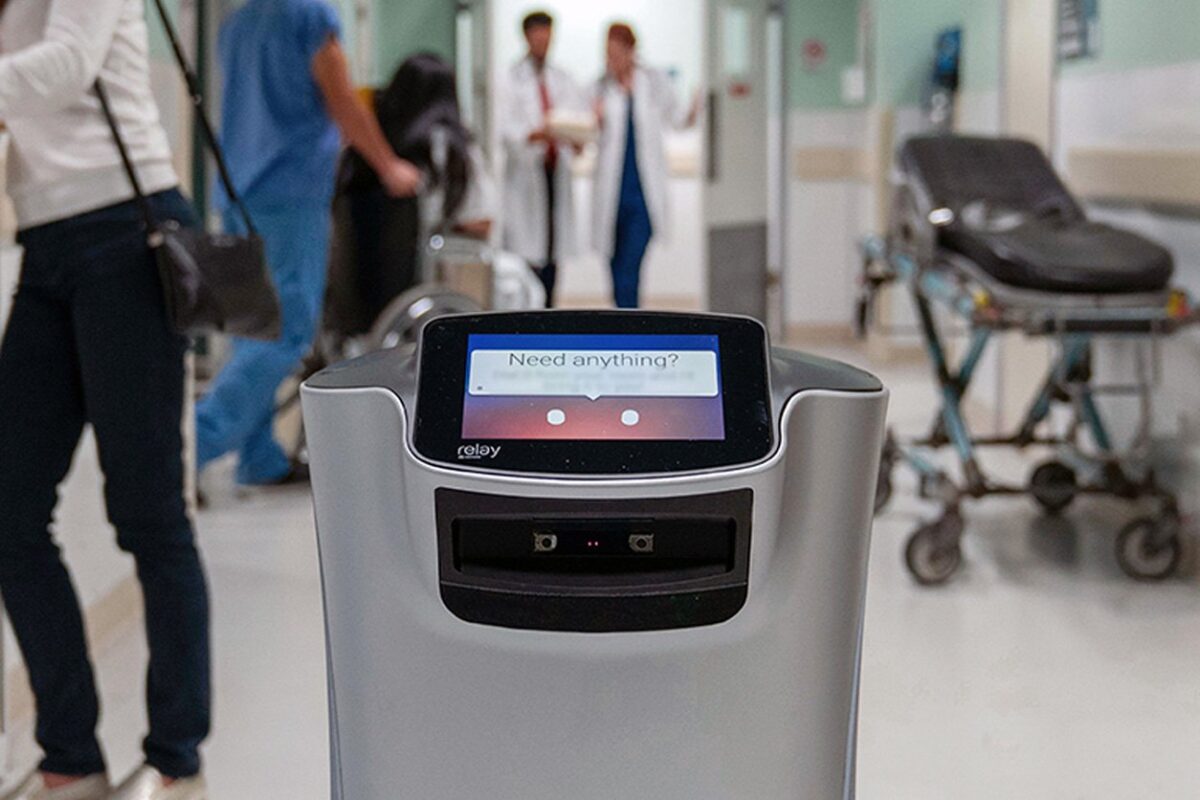
Relay Robotics has spent more than a decade becoming very good at this uncinematic business. Its machines are three-foot-ish wheeled couriers with a compartment, sensors, a touchscreen, and no desire to look human. Staff load an item, choose a destination, and send the robot away. It maps the corridor, steers around people, works secure doors and elevators, alerts the recipient, opens only for the right person when authentication is required, and eventually returns to its charger.
The company says its fleet has completed more than 1.5 million deliveries worldwide. It reports a 99.8 percent success rate, more than 25,000 deliveries a month, and more than 10,000 miles a year. Those figures matter because Relay is not selling the spectacle of autonomy. It is selling the disappearance of an errand.
The origin
First, teach the trash can to be charming
The company began in 2013 as Savioke, assembled by alumni of Willow Garage, the influential robotics lab behind the Robot Operating System. Founder Steve Cousins had been Willow Garage's chief executive. His colleagues included roboticist Tessa Lau, industrial designer Adrian Canoso, and business-development leader Izumi Yaskawa. They carried an unfashionably practical conviction: robots should leave laboratories and do one ordinary job around ordinary people.
Their first proving ground was the Aloft hotel in Cupertino. The prototype, called Botlr, carried toothbrushes, newspapers, snacks, and other small requests from the front desk to guest rooms. A hotel was forgiving in just the right way. A towel could tolerate a detour. Guests enjoyed the novelty. Staff could watch the machine meet elevators, Wi-Fi shadows, luggage, children, and the occasional human who stopped directly in its path to take a photograph.
Early user research produced a small but important reversal. The designers had made the robot minimal, almost like a kiosk. Guests wanted more interaction. So it chirped. It asked for a rating. After a good review, it performed a tiny dance. The team did not add arms, a synthetic voice, or a humanoid face. It added just enough personality to make hallway negotiation feel social rather than mechanical.
“We wanted to do that outside the assembly space.”Steve Cousins, explaining the move from factory robotics to service settings
One trip, three hard handoffs
Copy this: choose a repetitive route with a clear start, clear finish, measurable frequency, and expensive interruptions. Automate the trip before automating the judgment.
The escalation
A toothbrush is a rehearsal for chemotherapy
Hospital logistics made the same idea more valuable and much less cute. A pharmacy technician walking medication to another floor is not only transporting a box. The technician is leaving the pharmacy. A nurse carrying a specimen is not merely taking a walk. The nurse is choosing the specimen over the patient who needs attention now.
At Hutchinson Health, lab supervisor Jamie Schmidt described the choice with unusual clarity: three patients could be waiting while three stat samples also needed to reach the lab. Before the robot, somebody had to decide which queue would lose. Afterward, she said, “we just send our robot.” This is Relay's sharpest pitch. It does not replace bedside judgment; it removes the corridor from the decision.
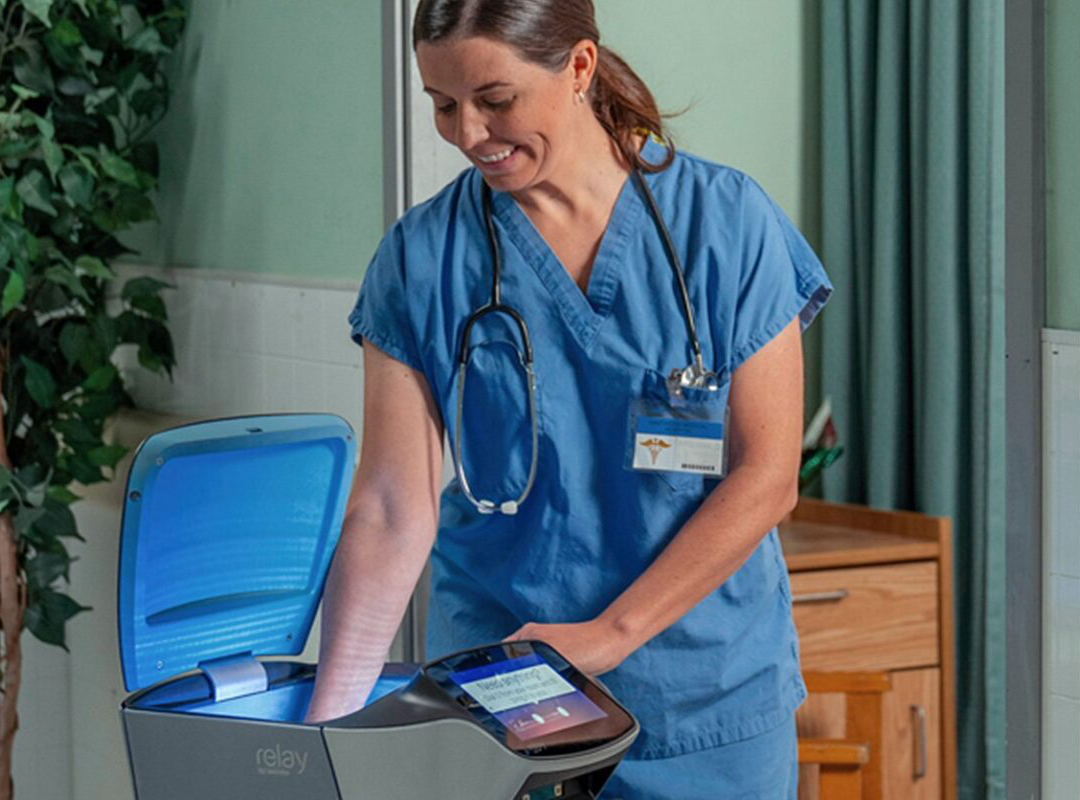
The hospital version, RelayRx, arrived in 2023 with a 10-gallon, or 41-liter, compartment - twice the capacity of earlier models - plus chain-of-custody controls and navigation tuned for busy clinical space. The company says it supports major elevator systems including Otis, Schindler, TK Elevator, Mitsubishi, and KONE. Cameras, lidar, and other safety sensors build a changing map of nearby people and obstacles. Badge authentication and live tracking create a record for sensitive items.
The revealing story comes from MedStar Georgetown's oncology pharmacy. Its previous delivery robot had been out of service for more than six months. That is what failed first: not the concept, but the confidence. A robot that works brilliantly on Tuesday and becomes furniture on Wednesday creates a second job - explaining the robot. In March 2018 the hospital installed a Relay named Fabio. It ran six days a week between the pharmacy and medication room, 75 to 80 trips a day. In its first 18 months, it completed 30,000 deliveries while saving an estimated five to ten minutes per patient.
Reliability changed the purchasing argument. The machine was no longer an attraction looking for a use. It was a route with an audit trail. BayCare followed the same pattern: a 2025 pilot at St. Anthony's Hospital recorded roughly 50 deliveries a day at a reported 99.8 percent success rate. In June 2026, BayCare expanded to two Winter Haven hospitals with robots assigned to specimens, medication, and supplies. Pilot first; count the trips; expand after the staff trusts the result.
The business
A robot subscription with a building attached
Relay sells business-to-business, commonly through subscription or Robotics-as-a-Service arrangements. There is no public menu price. The company quotes each deployment according to the number of robots, floors, elevators, secure doors, and workflow complexity. That is sensible, if less satisfying than a sticker: the hardware is only the visible piece. The service includes mapping, integration, fleet software, support, and the unglamorous work of making an old building cooperate.
Customers include Johns Hopkins, HCA Healthcare, MedStar Georgetown, El Camino Hospital, Hutchinson Health, and BayCare, plus Marriott, Hilton, Westin, Mandarin Oriental, Radisson, and hotel groups such as InnVest and Seaview Investors. Hospitals buy recovered clinical time, secure custody, and fewer specimen delays. Hotels buy faster amenity delivery, staff availability, and an unusual guest who never asks for a tip.
Competitors approach from several directions. Aethon and Swisslog have deep hospital-logistics experience. Diligent Robotics focuses on clinical support. Pudu, Keenon, Bear, and Richtech sell service robots into hospitality and other commercial spaces. The old alternatives are more stubborn: a runner, a cart, a pneumatic tube, or simply asking whoever is nearby. Relay's position is the compact middle - more flexible than fixed infrastructure, less ambitious than a humanoid, and designed for public buildings where people retain right of way.
The conditions have to be right
Relay works best when trips are frequent, destinations are stable, elevators and doors can be integrated, and staff will actually hand work to the machine. It is a weaker fit for low delivery volume, oversized loads, constantly changing routes, poor connectivity, or tasks that still require judgment and physical handling at both ends. A robot cannot rescue an undefined workflow; it can only repeat a good one.
The lesson
Make the promise smaller until it becomes dependable
Founders can copy Relay's discipline without building a robot. Begin with a narrow, expensive interruption. Observe the people doing it. Find the physical interfaces everyone ignores - the elevator, the badge reader, the closing door. Give the product enough social grace to share space, but do not confuse personality with utility. Run a pilot with a number attached. Expand only after the number survives daily life.
The company itself has repeatedly followed that script. Savioke raised a $2 million seed round in 2014, a $15 million Series A in 2016, and $13.4 million in 2018 as healthcare partners joined. In 2022, a new Relay Robotics entity backed with $10 million from MK Capital acquired the people, intellectual property, product line, and customer agreements. The name changed. The route did not.
That continuity may be the best explanation for why the machine has lasted. Relay did not wait for general intelligence, hands, or a perfect imitation of a person. It chose wheels, a locked compartment, a friendly screen, and one hard promise: the thing you put in here will arrive over there. Then it learned to take the elevator.